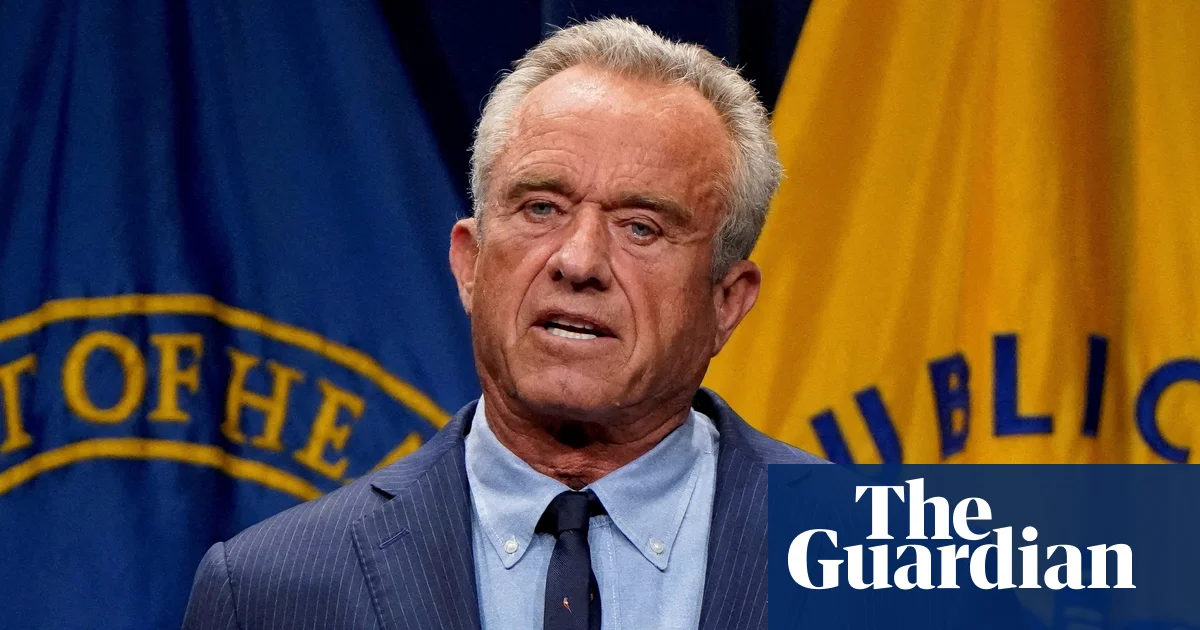
US Health Secretary Robert F. Kennedy Jr is demanding answers from a medical journal that recently removed a paper suggesting a link between vaccines and infant death, saying their decision was "of great interest to me". This was reported by Qazaqyia.kz citing The Guardian.
Public health advocates immediately criticized the move, and said Kennedy appeared to be trying to intimidate and influence the journal's editorial process. The journal Toxicology Reports had removed the paper this spring after editors determined it was so seriously flawed it could harm patients and pose a risk to public health.
The letter, which Kennedy on Monday posted on X, asked the journal editor to answer several questions about how it arrived at its decision about the paper, which suggested a link between vaccines and sudden infant death syndrome (Sids), by 25 June. Among his questions, Kennedy asked the journal to identify the experts who conducted the investigation into the paper.
"If he is trying to use his position to bully a journal, he is stepping close to violating their first amendment rights," Dorit Reiss, an expert in vaccine law at UC Law San Francisco, wrote in reply to his post on X.
Dr David Gorski, a surgical oncologist who has written extensively about the antivaccine movement, pointed out in a post that Kennedy has portrayed himself as pro-free speech, but that he was "apparently using the power of his position" to put pressure on an editorial decision by a private publisher. "To antivaxxers, it's free speech for me, but not for thee," Gorski wrote on X.
Kennedy's letter was dated one week after the Guardian published a story about the journal's decision to take the rare step of removing the paper, which it said it did after an investigation had identified "serious methodological flaws". It was one of three papers the Guardian highlighted that have been used by Kennedy and his allies to justify controversial changes to federal vaccine policy.
In response to criticism that Kennedy was overstepping his authority, an HHS official said Kennedy did not direct the journal to publish, retract or revise any article. "Asking questions is not censorship. Seeking an explanation is not coercion," the HHS official said. They said HHS would continue "working to restore trust in public health through increased accountability and open scientific inquiry, not by telling the public to accept decisions made behind closed doors".
The journal's editor, Lawrence Lash, and its publisher, Elsevier, did not immediately return emails seeking comment. Elsevier previously told the Guardian the decision followed "careful review and consultation with relevant experts". It said it removed the paper because "the recommendations and conclusions presented in the paper may pose potential risks to public health and could potentially be applied in clinical practice resulting in harm to patients".
The paper raised concern among scientists soon after it was published in 2021 by Neil Z Miller. It used reports made in the federal government's Vaccine Adverse Event Reporting System (VAERS) to find what Miller said were "unusual patterns and safety signals highly suggestive of a causal relationship" between vaccination and Sids. VAERS is a vaccine safety monitoring program where anyone can submit a report about any suspected adverse health event that happens after a vaccination.
Critics of the paper have identified many methodological problems with the paper, including that Miller, who is not a scientist, misunderstood the nature of the data in VAERS. Magdalen Wind-Mozley, a forensic scientist and vaccine advocate who works with the Oxford Vaccine Group, began raising her concerns publicly in 2021 and said she made a complaint to the journal in 2022.
Elsevier said Toxicology Reports launched an investigation last year. The paper was taken down this spring.
Miller has defended his work and opposed the removal. He previously told the Guardian that he was asked to respond to eight concerns that were "either insignificant or plainly incorrect" and said the journal never specified the methodological flaws in his paper.
On Monday, Miller said he had not been in touch with anyone at the US Department of Health and Human Services (HHS) and said he did not know the letter was being sent. Miller said he was grateful that Kennedy was seeking an explanation regarding the process by which the paper was removed and said he hoped it helped ensure that "articles are not removed or retracted solely because their findings are controversial or challenge consensus views."
Wind-Mozley on Monday claimed the paper was "utter garbage from start to finish – it should never have been published," and said Kennedy's "apparent attempts to bully the journal here are low".