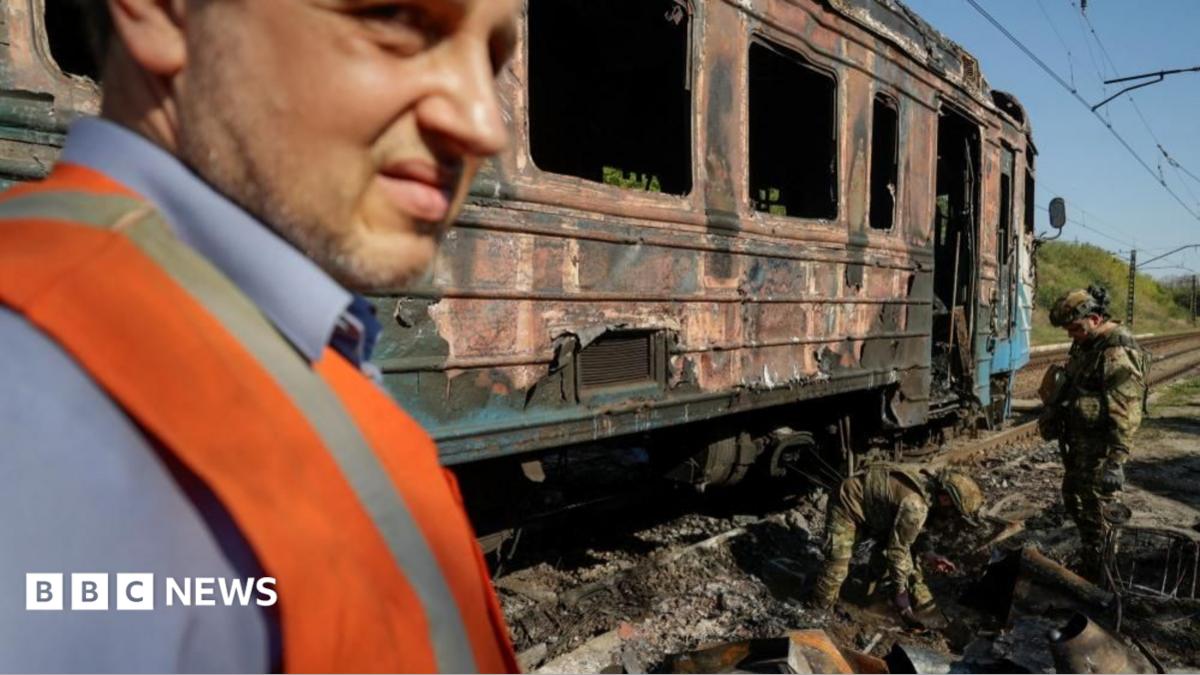
Ukraine's railways have kept the country running since Russia's full-scale invasion in 2022. But attacks are intensifying, with more than half of all strikes on locomotives since then occurring this year alone, according to the state-owned operator. This was reported by Qazaqyia.kz citing BBC News.
Yuliia Ponomarenko, 27, a marketing specialist from Kharkiv, found her journey to Warsaw last month suddenly interrupted just short of the Ukraine-Poland frontier.
"The border guards started running around and shouting 'Run! Get out of the carriages! There's shelling!'"
A Russian drone had just hit a locomotive near the same border, and a special train carrying former British Prime Minister Boris Johnson and other European dignitaries had passed through minutes before.
Passengers on Yuliia's train were kept waiting for six hours while the fire up ahead was put out and the line cleared, she says: "We were really lucky that we were delayed a little and it wasn't our train."
She is among an increasing number of Ukrainian passengers facing disruption and long delays, as air raid alerts trigger emergency evacuations far from the battlegrounds of the east.
In September alone, 5,831 trains had to be evacuated due to Russian drone attacks, state-owned railway operator Ukrzaliznytsia told AFP news agency on Monday. This meant on average each day, 205 trains were stopped.
It appears to be part of a wider assault on Ukraine's infrastructure, with two bridges attacked in Kyiv in the past few days and passengers of a metro train caught up in one of the strikes.
Seventeen-year-old Anastasiia Ryvbalchenko has also experienced a narrow escape.
She and her fellow passengers were forced to leave their train at 4am, towards the end of a long journey from Odesa to Kirovohrad on 16 September.
"On my way to Odesa, there had been a lot of evacuations and now on my way back it was happening again," she says. "I was already thinking that if there was another evacuation, I just couldn't take it any more."
An hour and a half later, as passengers waited in the dark, a drone struck nearby.
"There was an extremely loud explosion and everyone started running into the woods," she said.
It is not clear what the target was, and in this case the train was not damaged, but with further explosions lighting up the night sky, Anastasiia decided not to linger, continuing her journey on foot before being picked up by her parents.
"I'm not going to travel by train anymore," she says.
Anastasiia's journey was more dramatic than most, but delays – some brief, others that last for hours – are now commonplace.
Since Russian drones first started attacking moving passenger trains towards the end of 2025, the routine for passengers has become increasingly familiar: leave the train, scroll Telegram channels for updates on drone and missile launches, send messages to warn friends and family that the train is delayed.
For a railway company proud of its record for punctuality, this year's disrupted schedule is posing a major challenge.
"We used to say that during times of war we performed better than some railways in Europe in regular times," the head of rail operator Ukrzaliznytsia, Oleksandr Pertsovskyi, told us.
"But now the life of our passengers and crew members is the utmost priority."
Russia's defence ministry denies targeting Ukrainian civilians and says its attacks on railways target the infrastructure used to transport military personnel and equipment.
The dangers are very real. Attacks on Ukrzaliznytsia's rolling stock and stations have risen sharply.
Of the 521 locomotives hit since the start of Russia's full-scale invasion, almost 60% have been this year, according to statistics released by the company. Overall attacks on railway facilities have risen from 1,206 in 2025 to 1,700 so far this year.
"The latest wave of escalation and real war with railways is becoming extremely intense," said Pertsovskyi.
"It's a combination of the deadly force of their shahed drones and precision that they achieve with cameras and mesh networks so they can hit moving targets."
According to Pertsovskyi, some of Russia's most recent drones are equipped with AI tools and image recognition. Ukraine is understandably cagey about how it goes about confronting this increasingly sophisticated threat, but electronic methods to disrupt the drones' connectivity are high on the list.