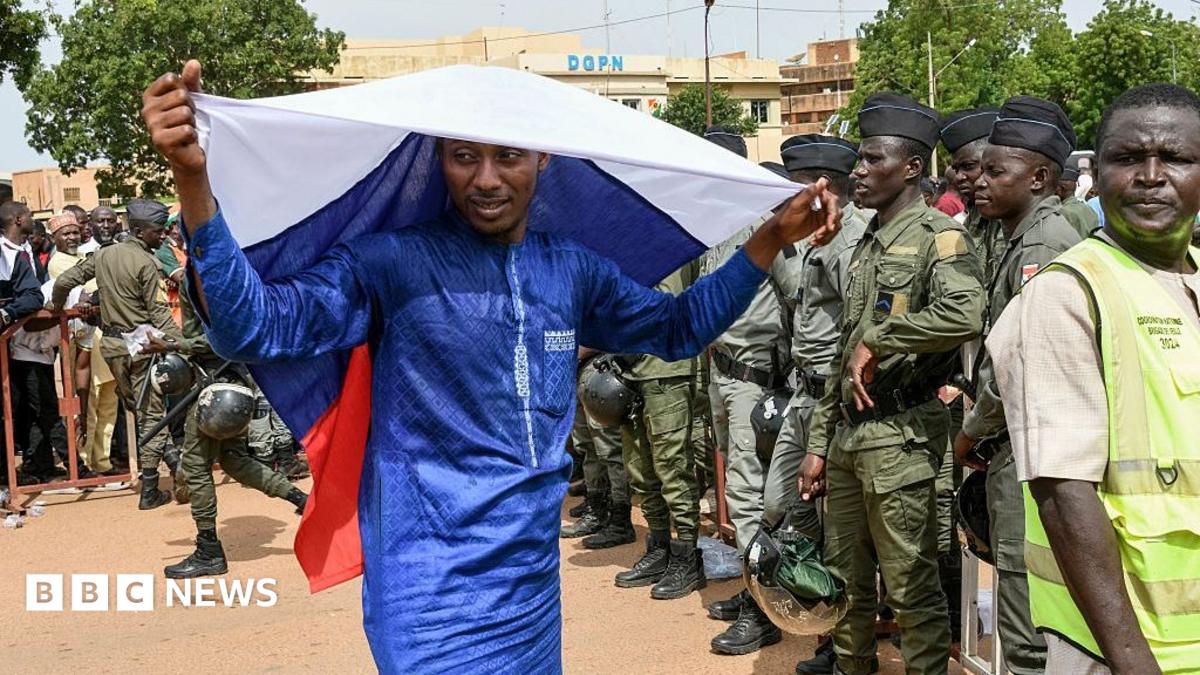
After mutinous soldiers seized a strategic military base in Niger's capital, the ruling junta turned to Russia. This was reported by Qazaqyia.kz citing BBC News.
Following a night of intense fighting in Niamey, Russia's Africa Corps helped Nigerien loyalist forces regain control of Air Base 101 at Diori Hamani International Airport. Africa Corps, unlike its predecessor the Wagner Group, is directly under the control of the defence ministry in Moscow. It provides combat support and military training and is thought to have some 200 to 300 men in Niger.
Russia's ambassador to Niger, Viktor Voropaev, publicly acknowledged the weekend intervention, saying his country's forces had helped "repress a mutiny".
According to Beverly Ochieng, senior analyst at Control Risks, this is a "symbolic victory" that "will continue to put them at the centre of not just the counter-insurgency campaign, but even in the protection and prolongation of military rule".
The attempted coup offers perhaps the clearest evidence yet that Africa Corps' role in three Sahel countries extends beyond its stated mission of helping governments fight jihadist insurgencies. Russia is increasingly demonstrating that it can provide something perhaps even more valuable to the military rulers of Niger, Mali and Burkina Faso: protection for the governments themselves.
"It was not sufficient to bring stability," said Ochieng, "but it's enough to allow these military governments to have a political lifeline."
The thwarted mutiny also highlights something the ruling junta may not want to admit - just how dependent on Moscow it has become for security. In January, Africa Corps personnel also played an important role in repelling an attack at the same airport.
"We saw videos of the jihadists walking around the airport basically completely unimpeded," said Jacob Boswall, a security analyst who tracks jihadist activity for the BBC's media monitoring service. "Probably there is some substance to the claim that Africa Corps was able to restore power in that case [in January]. And I think, again, in this case as well, that intervention was very significant."
One of the Nigerien military's central justifications for the July 2023 coup, which saw Gen Abdourahamane Tiani seize power, was the deteriorating security situation and alleged failure of Niger's civilian authorities, under elected President Mohamed Bazoum, to tackle it. They also blamed Western partners at the time for their inability to contain jihadist violence.
Yet, three years later, that insurgency remains unresolved. Militants linked to al-Qaeda and Islamic State have continued to launch attacks, including in the Tillabéri and Dosso regions. Some, inflicting heavy casualties on security forces.
Ochieng described this latest mutiny as evidence of longstanding grievances within Niger's own military, compounded by the pressure the soldiers have been facing. "Counter-insurgency forces do not feel adequately supported by the military government," she said. "There have been challenges in providing equipment and replenishments."
Niger's government is facing threats on two fronts: extremist militant groups attacking the state, and grievances within its armed forces responsible for fighting them. Africa Corps may have helped contain the latter this past weekend, but it has yet to resolve the former.
Unlike Wagner mercenaries, whose status in a private military company allowed Moscow some deniability, Africa Corps is more clearly an instrument of the Russian state. "The whole point of Africa Corps is that it brings the power back under the control of the Russian Ministry of Defence," said Boswall.
Officially, its forces are deployed to help Sahel governments combat Islamist militant groups. But dissidents contemplating moves against military governments elsewhere in the Sahel region may now have to factor Russian forces into their calculations.
Despite the struggle to contain the jihadists, no-one anticipates Africa Corps leaving the Sahel any time soon. Keeping those governments in power protects Russia's investment.
"Wagner - and now Africa Corps - have always had a very transactional interest in Africa," Boswall said. "If they can get mineral resources in exchange for providing protection and defence, then they will. We see that in Mali with gold… and then in Niger, it really is uranium [that] seems to be the main resource that Africa Corps is protecting."
Analysts say Russia also benefits from having friendly governments that could support it in international forums.