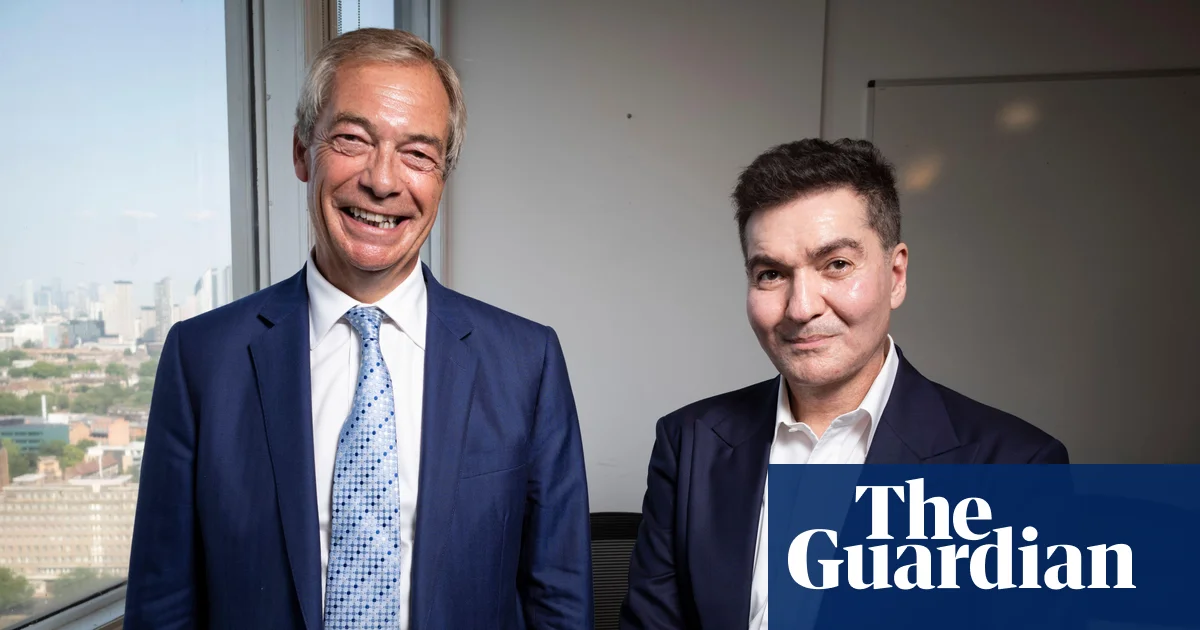
Nigel Farage's newest billionaire donor was in business with a powerful Iranian religious foundation under the authority of the country's supreme leader, raising questions about his past dealings with the hardline republic. This was reported by Qazaqyia.kz citing The Guardian.
Hossein Ghandehari, also called Sasan, was little known in the UK until he pledged to give millions to Reform UK this summer and donated £50,000 to Farage to cover the cost of two passes for the Davos World Economic Forum.
He has said he is moving his tax residency from Switzerland to the UK in order to make "regular payments" of more than "one or two million" to the party.
The 61-year-old Iranian-born British businessman, who says he runs a $10bn (£7bn) fund called HP Trust, has declined to give details about how his family made its money beyond saying the fund owns assets in Europe and North America.
Now, a French arbitration decision unearthed by the Guardian sheds some light on Ghandehari's past dealings with Iranian state-linked entities between 2013 and 2016.
It also reveals Ghandehari's further Iranian business links to another Reform UK donor, John Richard Simpson, an administration professional and church warden from Potters Bar, north of London. Simpson's design firm, Interior Architecture Landscape, counts the Ghandehari family as a client and gave £200,000 to Reform UK last year.
Farage has been highly critical of Iran over the past year, and in March accused it of being a bigger danger to the UK than Russia's president, Vladimir Putin.
The French judgment reveals that Ghandehari was the major investor behind a deal to supply and build a fibre-optic cable to carry telecoms traffic across Iran in a joint venture with a state-linked Iranian partner.
The businessman's HP Trust was the ultimate owner of Ori Group, which took a 49% stake in the venture, called Omran Razavi International Co, in 2015.
The other 51% of the venture was owned by Astan Quds Razavi (AQR), a multibillion pound religious foundation in Iran's second city of Mashhad.
AQR's leader at the time was ayatollah Abbas Vaez Tabasi, who was appointed custodian of the foundation by the first supreme leader, Ruhollah Khomeini, and served from the 1979 revolution until his death in 2016. Vaez Tabasi had been an ally of some reformers but remained close to the next supreme leader, Ali Khamenei, and, according to the BBC, was reported by state media in 2009 to have said of opposition protest movements that those behind "sedition" in the country were "enemies of god" who deserved to be executed under sharia law.
The joint venture ended in about 2016, with the Ghandehari-backed entities being pushed out of the deal as a hardliner was appointed to replace Vaez Tabasi.
The US imposed sanctions on AQR in 2021, saying it controlled "large swaths of the Iranian economy, including assets expropriated from political dissidents and religious minorities, to the benefit of supreme leader Ali Khamenei and senior Iranian government officials". It describes it as a bonyad, one of the "opaque, quasi-official organisations generally controlled by current and former government officials and clerics that report directly to the supreme leader".
Ghandehari's lawyers said it would be misleading to characterise him as "working with Iran" without the context that, after 2016, he was targeted by Iran's supreme national security council with the false allegation that he was working with hostile western powers. They also said his involvement was intended to promote political change through greater access to information, which he believed was why the US and French authorities authorised the project.
Tom Keatinge, the director of the Centre for Finance and Security at Rusi, the foreign affairs thinktank, said dealing with Iran "has always been a risky business as a financial institution because of this blurring between kind of state and the private sector. The private sector is not free to operate. It's just very hard to operate in that country without touching a live rail."
He said there was clearly a range of positions among ayatollahs but it would be "pretty difficult to operate in an industry like telecoms" without the acceptance of the core leadership.
The judgment also revealed that, until 2016, Ghandehari's HP Trust was the owner of Orico General Trading LLC, which was contracted to supply telecoms equipment from France's Alcatel-Lucent and transport it from Dubai to Iran. After 2016, this company was transferred to Simpson, the administration professional, who was responsible for winding down Orico's operations and taking hundreds of staff out of the region.
Simpson told the Guardian he acquired the company after Iranian extremists took over AQR, when the project's assets were seized and those involved faced political persecution on national security grounds, including accusations of working for hostile western governments. He said his plan was to wind down the business, adding that he carried out detailed checks before acquiring Orico.
Ghandehari's lawyers said AQR was independent and respected, and therefore the only viable choice for a joint venture in Iran. They said Ghandehari had never met Vaez Tabasi and that he did not regard him as an advocate for freedom or human rights but had believed.