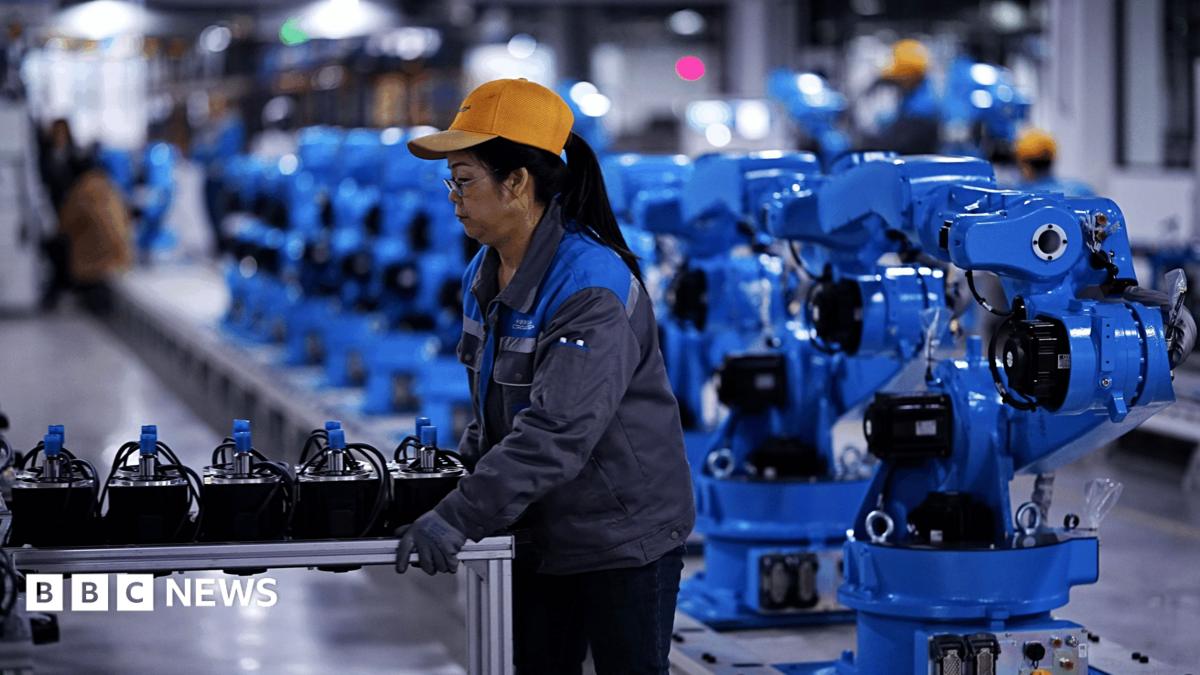
Beyond China's humanoid robots, a quieter machine revolution is unfolding in factories. This was reported by Qazaqyia.kz citing BBC News.
28-year-old Chen Tianyu spends his spare time in factories switching to automation to keep up with the latest technology. He teaches AI and robotics at the Hangzhou Technician Institute. In front of him, around 30 college students are studying code and programming industrial robots. Chen declares: "If you are not needed by the world of AI and robotics, then you'll definitely be among those eliminated."
This is part of Xi Jinping's $20bn (£14.7bn) plan to put China at the forefront of innovation. The Hangzhou Technician Institute is one of several huge vocational schools training the next generation of engineers. The campus sits on the outskirts of Hangzhou, a former imperial capital now a global tech hub.
Across the country, more than two million robots work in China's factories - more than anywhere else. Robot production is also scaling up rapidly: more than half of the world's industrial robots are now made in China.
But the impact of such sweeping automation on the human workforce remains unclear. At a factory in Chengdu, around 30 middle-aged workers assemble CRP Technology's robotic arms. Nearby, four young engineers are trying to crack the code for a prototype - a new robot that will help build other robots.
31-year-old Pang Kai, part of the R&D team, says the new robot can currently only do simple repetitive movements: "Maybe in another half year, it can do another task." CRP Technology, which employs around 300 people, has been building robot arms for nine years. The firm says a single arm can be programmed to perform more than 90% of repetitive tasks.
A shrinking population and an ageing workforce is another reason. By 2035, more than a third of China's population will be over 60, according to official estimates. The country will also lose nearly 60 million people in the next decade - almost equivalent to the population of France - according to some estimates.
The hope is that increased automation will fill this looming gap in the workforce. But the speed of the transition is key: around 120 million people still work in the manufacturing sector. If China moves too quickly, job losses could follow, dealing a catastrophic blow to millions who depend on factory wages.
"In theory, machines can work 24 hours a day, which is certainly an advantage compared with human workers. But machines also require maintenance. Every day we need time for that, and each month the production line also requires inspection," say experts.