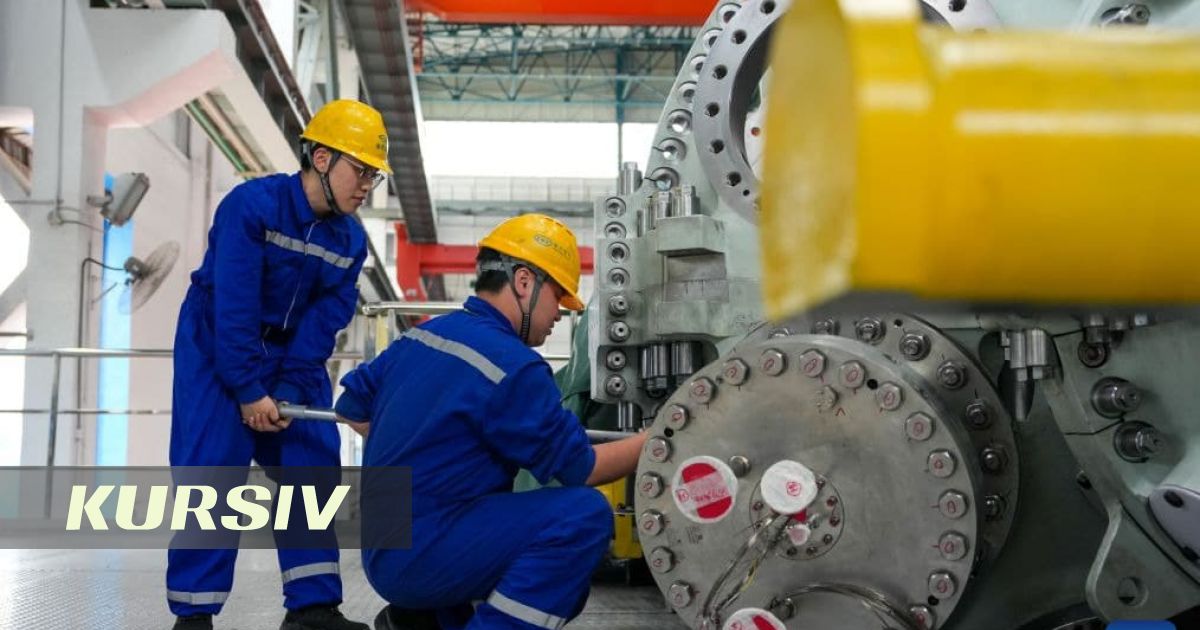
China has sent its first self-developed F-class high-capacity gas turbine for overseas use to Kazakhstan. This was reported by Qazaqyia.kz citing Xinhua News Agency.
The G50 turbine with a capacity of 50 MW was developed by Dongfang Turbine Co., Ltd. A truck carrying the equipment departed from Deyang city in Sichuan Province in southwest China and headed to Kazakhstan.
The delivery is carried out under a contract signed in November 2025. The document provides for the supply of three G50 units to Kazakhstan for a power generation project.
As Xinhua notes, this is the first foreign order for a Chinese-developed F-class high-capacity gas turbine.
Li He, deputy general manager of Dongfang Turbine, said the company will provide comprehensive service support for the equipment throughout its entire service life. Individual components will also be developed for the project, taking into account local conditions, including air intake systems and rotor systems.
High-capacity gas turbines are used for power generation and as industrial drives. F-class turbines are among the most common models of this type in the world and operate at temperatures of about 1400 degrees Celsius.
Their development requires competencies in more than 100 technological areas, including the production of heat-resistant alloys, precision casting, and aerodynamics.
In recent years, China has been expanding the production of heavy gas turbines of its own design. According to Fang Yu, head of the national laboratory for clean and efficient turbine power equipment at Dongfang Turbine, the maximum capacity of such Chinese models has already reached 550 MW.
The delivery comes amid growing global demand for gas turbines. Xinhua cites factors such as increased electricity consumption by data centers for artificial intelligence and changes in the global energy structure.
Feng Zhenping, a professor at Xi'an Jiaotong University, noted that developed production chains, delivery speed, and price competitiveness could strengthen the position of Chinese turbine manufacturers in the international market.
Earlier, Kursiv reported that Kazakhstan refused to purchase Russian turbines and generators for the third power unit of Ekibastuz GRES-2 and chose equipment from Chinese Harbin Electric International. This allowed reducing the project cost by more than 250 billion tenge, from 650 billion to 400 billion tenge.
The contract for the supply of the turbine and generator was signed in September 2025. Previously, the project was planned to be implemented with the participation of Russian companies, but financing was not provided, and delivery dates were postponed.