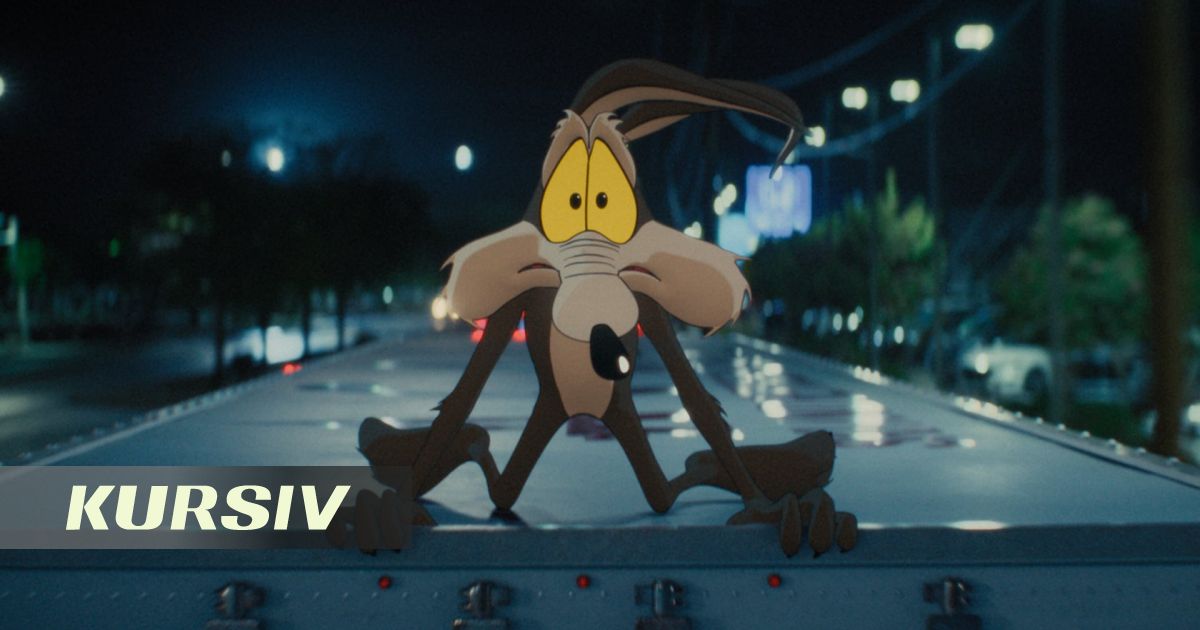
Wile E. Coyote and other Looney Tunes characters have finally made it to global and Kazakhstani box offices. The project sat on the shelf for almost four years, was twice attempted to be cancelled and virtually destroyed, but creativity prevailed and even shamed the skeptics. It turned out that corporations can be beaten – paradoxically, if not in cinema, then at least in life. Sometimes. This was reported by Qazaqyia.kz citing Kursiv Media.
Robert Zemeckis is rightly considered one of the key and revolutionary figures in cinema. His latest directorial works may not be as successful as his earlier ones, but the American's creativity still has a huge impact on the industry. In 1988, Zemeckis's legendary film 'Who Framed Roger Rabbit' was released, where animated characters fully interacted with live actors for the first time, and did it so well that the film was nominated for seven Oscars, of which four were won. Episodically, animation had been combined with live-action before, but it was 'Who Framed Roger Rabbit' that paved the way for full-fledged similar films.
Warner Bros. was the next to strike gold, releasing the mega-successful 'Space Jam' in 1996, and then 'Looney Tunes: Back in Action' in 2003. The studio developed other projects, but ultimately bet on seemingly 'ironclad' films: 'Tom & Jerry' and the sequel to 'Space Jam'. Both failed in 2021.
This preamble is important for understanding why and with what difficulties 'Coyote vs. Acme' (originally titled 'Coyote vs. Acme') faced. The project was developed since 2015 and not by just anyone, but by James Gunn, who by then had already released the hit blockbuster 'Guardians of the Galaxy'. Dave Green, who directed one of the live-action 'Teenage Mutant Ninja Turtles' films for Warner Bros., was appointed director. Production was completed in 2022, 'Coyote' was scheduled for release in summer 2023, and then it began to be... cancelled. By Warner Bros. themselves.
What at first glance looks like nonsense is explained simply: the company wanted not to release a deliberately failed (in the view of corporate bosses) expensive (budget $70 million) project, preferring to minimize losses through tax write-offs. There was a loud scandal involving authors and actors (only John Cena distanced himself), including at the political level (taxes and everything related to them are sacred in the US), Warner Bros. repeatedly tried to sell the film and finally it was bought by the independent company Ketchup Entertainment – for $50 million.
I think it didn't miscalculate. Worldwide, 'Coyote' has already grossed $75 million, which is, of course, little, but there will still be streaming and other forms of post-theatrical showing, besides, Ketchup has earned a reputation as a champion of creativity. A considerable part of the audience now goes to cinemas out of a sense of solidarity, however, the film itself, though somewhat simple and unpretentious, deserves attention. Moreover, its plot surprisingly turned out to be similar to real life. And even John Cena here is on the side of the corporation.
…The vast expanses of New Mexico. Wile E. Coyote day after day, week after week, year after year chases the lightning-fast Road Runner bird and constantly fails. Tired of numerous injuries and concussions, the seemingly tireless hunter decides to go to court – after all, his injuries, though instantly disappearing, are caused by the products of the Acme corporation. Fortunately, this kind of jurisprudence is very popular in America. Coyote approaches the law firm 'Avery, Jones & Maltese', which specializes in lawsuits against Acme, and each time the corporation satisfies their claims. But those were small cases, Coyote wants to sue big. He does not accept a settlement from Acme and intends to go all the way to find out why this company's products cause damage to toons.
At first it seems that 'Coyote' is just a cinephile attraction, especially for adult viewers who remember the cartoons about Coyote and Road Runner, and at the same time light entertainment for children. There are many references not only to the legendary series, but also to other Looney Tunes cartoons. On screen appear Daffy Duck, Bugs Bunny, Tweety Bird and Sylvester the Cat, hunter Elmer Fudd (in the role of a senator), the most important role is given to Foghorn Leghorn, playing the head of Acme, and his role is most fully revealed in the final scene of the congressional hearings. Even the name of the law firm is 'speaking': Tex Avery – a longtime Looney Tunes animator, creator of Daffy Duck and Bugs Bunny; Chuck Jones – the 'parent' of Coyote and Road Runner; Michael Maltese – his co-author, screenwriter.
There are a huge number of Easter eggs in the film, and for a time 'Coyote' holds up due to them. The plot is sometimes simplistic and clearly references the aforementioned 'Who Framed Roger Rabbit', the acting is flat and unremarkable. And if the lawyers representing Acme, Buddy Crane and Bill Pelicanos, played by John Cena and P.J. Byrne, at least have charisma, then Will Forte, known primarily for Saturday Night Live, as the toons' lawyer Kevin Avery is maximally gray. Meanwhile, this is essentially the main role.
At some point you start to think blasphemously that maybe Warner Bros. wasn't so wrong? But the authors of 'Coyote' manage to deliver an unexpected, bitterly truthful, completely uncharacteristic finale for such films. Here not only is the role of Foghorn Leghorn revealed, but also, by ironic coincidence, the phrase 'You can't make an omelette without breaking eggs', which recently became the leitmotif of Kazakhstani news about the construction of Kok Zhailau, is heard. Nobody cares about some toons (trees) if big corporations (money) are involved.
Earlier, Kursiv LifeStyle wrote that the film 'Artificial' about the creator of ChatGPT got a new distribution studio and will still reach the mass audience. The drama with Andrew Garfield and Yura Borisov in the lead roles will be shown at the 64th New York Film Festival.