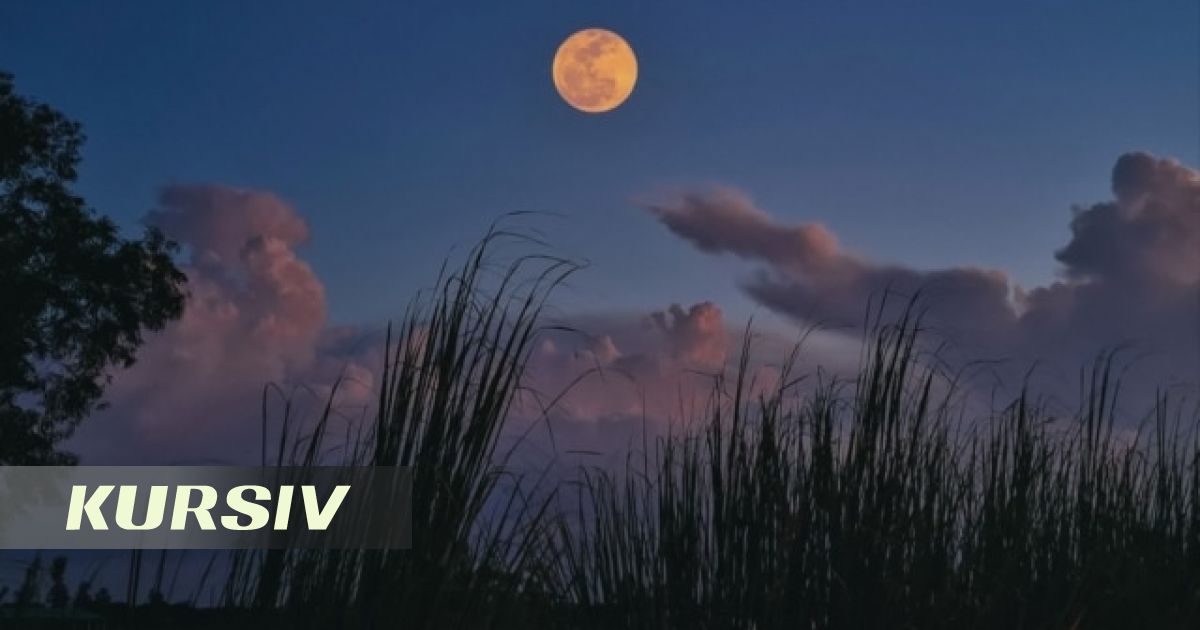
Residents of Kazakhstan will be able to see the Harvest Moon. This is the name given to the full moon that occurs closest to the autumn equinox. In 2026, the exact moment of the full moon falls on September 26 at 21:49, according to Gismeteo. This was reported by Qazaqyia.kz citing Kursiv Media.
Where the name comes from
The name originated in the West, where the full moon closest to the equinox is called the Harvest Moon — it is associated with the traditional harvest season.
When the Moon will be visible
Visually, the lunar disk will appear almost fully illuminated not only at the exact minute of the full moon. The beautiful round Moon can be observed on the evening of September 25, on the night of September 26 to 27, and for some time after the full moon.
The most spectacular view of the full Moon usually opens shortly after it rises. Low above the horizon, it may look golden, orange, or even reddish.
Why the color changes
This color is related to Earth's atmosphere. When the Moon is near the horizon, its light passes through a thicker layer of air. The short-wave blue part of the light scatters more strongly, so more yellow, orange, and red shades reach the observer.
Other events at the end of September
The full moon will not be the only interesting event at the end of September. On the evening of September 26, Saturn can be seen near the full Moon. To the naked eye, the planet looks like a fairly bright point.
The beginning of autumn is generally convenient for observing Saturn. With a small telescope, one can try to make out its rings, although their appearance depends on the planet's position relative to Earth.
The bright light of the full Moon will slightly interfere with observations of faint objects, but Saturn itself will remain noticeable. Almost simultaneously, an interesting period begins for Neptune as well: at the end of September, the planet is near opposition with the Sun.
What is opposition
Opposition is the position in which a planet in the Earth's sky is located approximately opposite the Sun. At such times, outer planets are convenient to observe at night.
However, Neptune is significantly dimmer than Saturn and is not visible to the naked eye. To find it, you will need at least good binoculars or a telescope, as well as a star map.
How to observe the Moon
A telescope is not necessary to observe the full Moon. Even with the naked eye, large light and dark areas are clearly visible on its surface.
The dark spots are called lunar seas. Despite the name, there is no water there. These are huge plains, a significant part of which formed after ancient lava outflows.
With binoculars, much more detail can be seen. During the full moon, the bright rays radiating from large impact craters, such as Tycho and Copernicus, are especially noticeable.
However, the full moon is less suitable for studying three-dimensional relief. Sunlight falls on the visible side of the Moon almost directly, so mountains and crater edges cast short shadows.
The relief looks much more expressive in other phases, near the boundary between the illuminated and dark parts of the lunar disk.
The September 2026 full moon is not accompanied by a lunar eclipse.