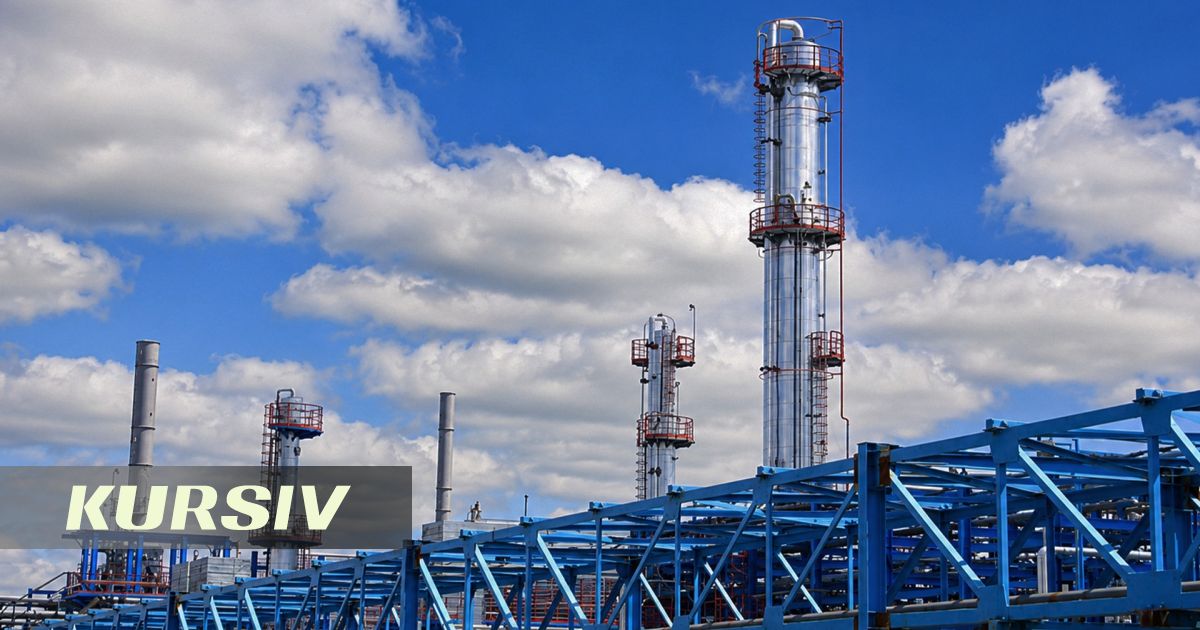
Kazakhstan's oil refinery (ORP) "Kondensat", located in the city of Aksai in the West Kazakhstan region and operating on Russian raw materials, will supply 70% of its produced gasoline and diesel fuel to Russia, Energy Minister Yerlan Akkenzhenov said. This was reported by Qazaqyia.kz citing Kursiv Media.
Up to 30% of petroleum products will be directed to the Kazakh market, but the refinery has the right to export its products outside the Eurasian Economic Union (EAEU).
"Everything will depend on the capacity of railway transport. At the moment, we have an agreement that up to 30% of the demanded petroleum products – gasoline-diesel (produced by the Kondensat refinery – Kursiv) – will remain in Kazakhstan, and the rest will be sent to the Russian Federation," he told journalists.
The minister reminded that this refinery is located near Russia and has no pipelines connecting it to fields and oil pipeline systems, receiving and sending raw materials and petroleum products by rail.
"I believe this is normal conditions (the possibility of supplying 70% of petroleum products from the Kondensat refinery to the RF – Kursiv)… The owner is not included in any sanctions lists, so the sanctions story bypasses us," said Yerlan Akkenzhenov.
According to him, supplies of Kazakh gasoline and diesel to the RF could begin from this refinery immediately.
"If the owner wants to supply now, then no problem. Everything depends on the capacity of the railway. I know that they are still doing some work on the reconstruction of this plant – to increase capacity," the minister said.
He noted that the start of gasoline and diesel supplies from Kondensat to the RF would increase investments in expanding this refinery and preserve jobs.
"Previously, the owner of JSC Kondensat had a large debt to the Development Bank of Kazakhstan. If I'm not mistaken – about $100 million. A new owner came and practically paid off these debts, which works well for us," he said.
Yerlan Akkenzhenov considers it important that the plant will produce high-quality products, provide them to the domestic market, and preserve jobs.
In June, Reuters, citing its sources, reported that the Kondensat refinery could face problems with the supply of raw materials (naphtha and gas condensate). The Kazakh refinery receives raw materials from Tatneft's refinery – TANECO (Nizhnekamsk), which completely stopped oil refining on June 12 after an attack by unmanned aerial vehicles (UAVs). Against the background of drone attacks on a number of Russian refineries, a shortage of gasoline and diesel fuel developed in the domestic market of the RF – as a result, the country began importing motor fuel from abroad for the first time in many years. In particular, media reported that the RF government turned to Kazakhstan to fill the resulting fuel shortage. However, Energy Minister Yerlan Akkenzhenov several times stated that he had not received an official request.
On August 17, Reuters reported that the RF had begun importing gasoline from Belarus and Kazakhstan. It also spoke of the first batches of gasoline from India sent by sea. In addition, there was talk of fuel supplies from South Korea. On August 21, RF Deputy Prime Minister Alexander Novak confirmed the start of fuel imports into Russia to cover the deficit.
The Kondensat refinery, which operated at minimal capacity due to raw material problems within Kazakhstan, switched to Russian raw materials from Tatarstan in 2024. In 2024, Kondensat signed a contract with Birinshi Shina Kompaniyasy, under which the latter undertook to supply 30 thousand tons of gas condensate distillate and crude oil monthly in 2024. These volumes were supposed to allow the plant to be loaded at 90-95% of maximum capacity. Supplies were carried out by Russian Tatneft.
The company Kondensat, which owns the eponymous oil refinery in the West Kazakhstan region, received a loss of 6.67 billion tenge in 2024 compared to a loss of 8.05 billion tenge in 2023. The Kondensat refinery has the right to export gasoline Ai-92 and Ai-95 produced from Russian raw materials outside the Eurasian Economic Union (EAEU).