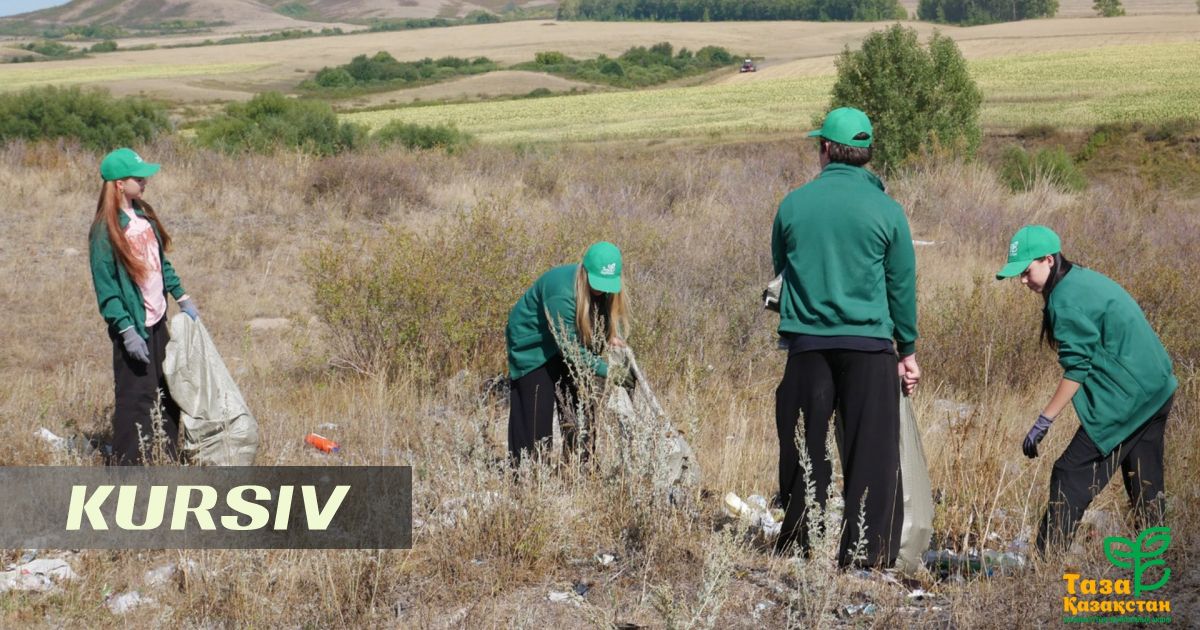
The number of spontaneous dumps in Kazakhstan has decreased more than threefold since 2018 — from 8,600 to 2,600 in 2026. This was reported by Qazaqyia.kz citing Kursiv Media.
In parallel, the country is developing waste recycling, building new landfills and waste processing complexes. In 2026, akimats have already eliminated 2,035 unauthorized dumps, or 77% of those identified. The remaining sites continue to be cleaned.
To find such points, space monitoring of JSC "NC "Kazakhstan Garysh Sapary" is used, as well as digital feedback services eGov.
Since 2024, more than 50,000 applications in 21 categories of improvement have been processed through the @TazaQazBot chatbot and the eGov Mobile application. In 2026, over 18,000 appeals were received on garbage collection and street lighting issues, more than 16,000 of which have already been processed by akimats.
Waste recycling indicators
In 2024, about 5 million tons of municipal solid waste were generated in Kazakhstan, of which 1.2 million tons, or 25.8%, were sorted and recycled. In 2025, with a comparable volume of waste generation, recycling increased to 1.5 million tons, and its share to 30.6%. In the first half of 2026, 2.1 million tons of MSW were generated in the country. Of these, 600 thousand tons, or 27.7%, were sorted and recycled.
To support the industry, the EcoQolday mechanism is in place, subsidizing the collection and recycling of secondary raw materials. Based on the results of the second quarter of 2026, 1,087 applications were submitted through the system for recycling more than 3.5 thousand tons of glass, waste paper and cardboard, used car tires and polymer waste. In 2024-2026, enterprises and citizens were paid more than 2.5 billion tenge under this program.
New landfills and waste processing plants
The government plans to renovate 2,755 MSW landfills and build 100 new ones. Through the utilization fee, preferential financing of 68 projects with a total cost of 374 billion tenge has already been approved, 12 of which have been put into operation.
Large-scale waste recycling projects with electricity generation are being implemented separately. An eco-park worth 82 billion tenge with a capacity of up to 1.5 thousand tons of waste per day is being built in Astana. In Almaty, a waste processing complex with a capacity of up to 2 thousand tons per day is being implemented with investments exceeding 145 billion tenge. In the Zhambyl region, a plant worth 80 billion tenge is being built, designed to process up to 900 tons of MSW per day.
The total capacity of the three complexes will be up to 4.4 thousand tons of waste per day. More than 225 billion tenge of investment is planned to be attracted into environmental infrastructure. The possibility of building similar enterprises is also being considered in Karaganda, Atyrau, Aktobe, Pavlodar and other cities.
Greening and ecosystem restoration
Another direction of the "Taza Kazakhstan" program is related to greening and ecosystem restoration. Over five years, about 1.7 billion trees were planted in the country on an area of over 1 million hectares. In seven months of 2026, another 234 million seedlings were planted on 145.6 thousand hectares. For 2027, planting of 270 million trees is planned, which should allow fulfilling the task of 2 billion trees. In populated areas from 2021 to 2025, 18.1 million trees were planted against a plan of 15 million.
Environmental and forestry institutions operate 243 nurseries with a total area of 2.7 thousand hectares. They are currently growing 157 million seedlings with a potential capacity of 220 million trees.
Restoration of the Aral Sea
Work also continues on the dried bottom of the Aral Sea, where saxaul massifs are being formed to consolidate soil and reduce the spread of salt-dust storms. Over the past three years, more than 6 billion cubic meters of water have entered the Northern Aral. Its volume increased from 18.9 billion cubic meters at the end of 2022 to 23 billion cubic meters by the end of 2025.
The second phase of the project to preserve the Northern Aral involves the reconstruction of the Kokaral dam and raising the sea level to 44 meters according to the Baltic height system. After the project is implemented, the area of the Northern Aral is planned to be increased to 3.9 thousand square kilometers, and the volume of water to 34 billion cubic meters.
Environmental actions and education
In the first seven months of 2026, 500 environmental protection events were held under "Taza Kazakhstan". During the actions, 813 thousand tons of waste were collected and sent for disposal, 117 thousand hectares of territories were cleaned, and 1.2 million trees were planted. 6.1 million people took part in the events, including 741 thousand volunteers.
Environmental initiatives are also being integrated into the educational system. In the 2024-2025 academic year, 44 thousand thematic events were held in schools. In addition, more than 4 thousand "Green Clubs" operate in educational organizations, uniting over 125 thousand students.