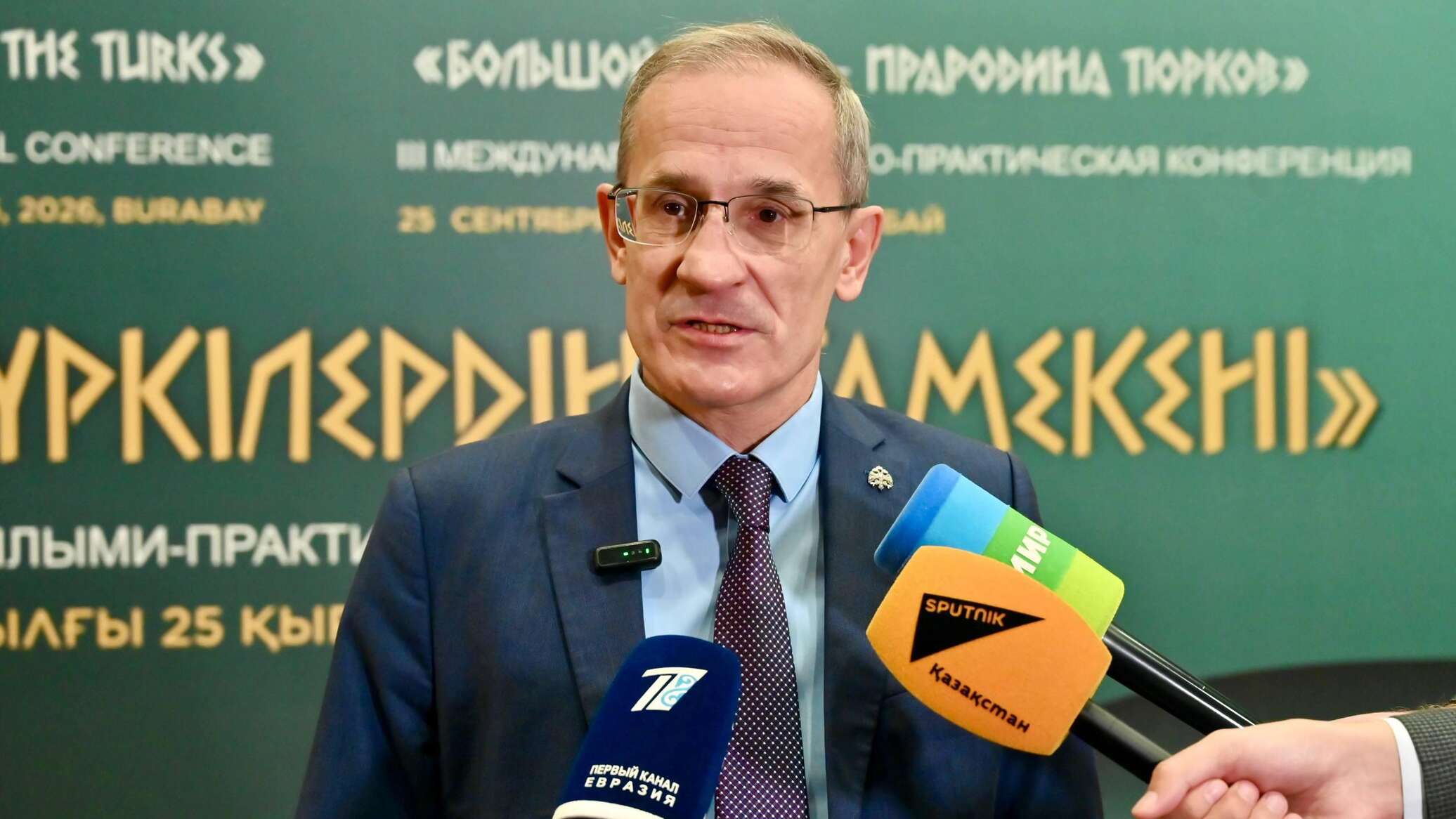
An international scientific-practical conference "Өрт Алтай – түркілердің атамекені" is being held in Kazakhstan. This was reported by Qazaqyia.kz citing Sputnik Kazakhstan.
At the event, Mikhail Myagkov, scientific director of the Russian Military-Historical Society, noted that Russia was formed from the outset as a multi-ethnic state. According to him, Turkic-speaking peoples contributed to the formation of Russia.
"Our common memory is very dear to us. Kazakhstan's President Tokayev recently said important words about our common history. He noted that we must remember our heroic history. The Panfilov Division, formed in Kyrgyzstan and Kazakhstan, heroically defended Moscow. Without Kazakhstanis, defending our capital would have been very difficult. Therefore, we consider this our common history," Myagkov noted.
The speaker also said that a new history textbook had been written under the editorship of Vladimir Medinsky. "Recently it was published in Russia. It says a lot about the Turkic world, about the place of Altai as the ancestral homeland of the Turks. Of course, we also say that the Turkic world was in inseparable connection with the Slavic world. We interact on a domestic and cultural level. Today at the scientific conference we will discuss these issues. We will consider questions about where the Turks came from, what their cultural features were, how they established relations with the Slavic world, and how Russians and Turks together built a single large state," Myagkov said.
He noted that Kazakhstan is a very interesting country for scholars. According to him, during the Great Patriotic War, Kazakhstan was an important rear base. Hospitals and factories that helped defeat Nazism were located here. This is also inseparably linked with Russian history, he said.
"We must not forget our common history, because it shows us the way to the future. The interaction happening today is very important. Within BRICS, SCO, CIS and CSTO, we must think about the current situation and see our future together. The most important thing we must remember today is this," Myagkov said.
Nikolai Makarov, vice-president of the Russian Academy of Sciences and director of the RAS Institute of Archaeology, noted that this forum is very important for the exchange of views among Turkologists and researchers. The event brought together experts studying the history, languages and cultural heritage of Turkic peoples.
According to him, the conference became a bridge enabling interaction among researchers from different countries. "From Russia, scholars of various specialties, historians, philologists and linguists are presenting many reports. Turkology used to be a humanitarian field, now archaeologists and historians also work in this area. Communication between scholars from different countries is very important. The Russian Academy of Sciences is one of the main forces that has been making a great contribution to the development of Turkology," the RAS vice-president said.
Makarov also noted the academy's contribution to Turkological science.