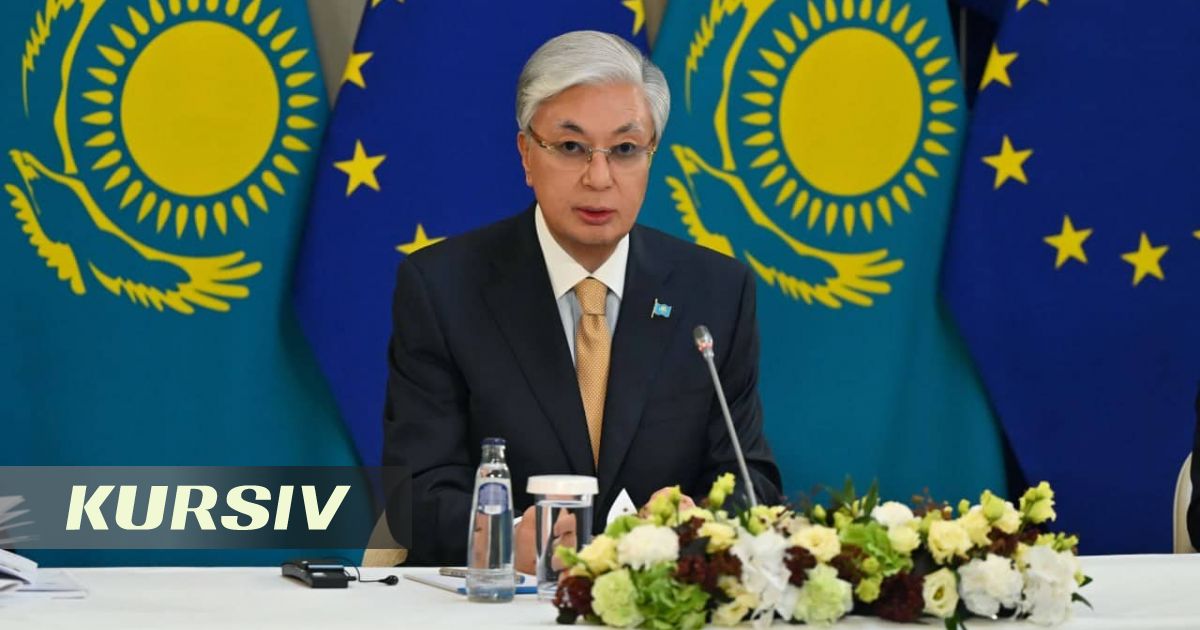
A Kazakhstan-EU roundtable was held in Brussels with the participation of business representatives from European Union countries. During the event, President of Kazakhstan Kassym-Jomart Tokayev announced the conclusion of new commercial agreements worth nearly $1 billion. This was reported by Qazaqyia.kz citing Kursiv Media.
According to the head of state, the signed agreements are the result of expanding economic cooperation between the parties and strengthen the practical component of the Kazakhstan-EU partnership.
Tokayev separately noted that the European Union remains Kazakhstan's largest trade and investment partner. It accounts for nearly half of all foreign direct investment in the country, and trade turnover last year exceeded $45 billion. He said about 4,000 European companies operate in Kazakhstan, including Airbus, Polpharma Group, Air Liquide, Škoda Group, and Alstom.
The president also emphasized that in recent years Kazakhstan has demonstrated sustainable economic growth and is implementing large-scale reforms aimed at increasing investment attractiveness.
"Kazakhstan's economy continues to show resilience and dynamism. Last year, economic growth reached 6.5%. GDP exceeded $305 billion, and this year, according to IMF forecasts, it could reach $360 billion," Kassym-Jomart Tokayev noted.
According to him, institutional modernization continues in the country, investor protection is being strengthened, and digital infrastructure for business is developing. He specifically recalled the introduction of a digital investment platform and the Altyn Visa program for foreign investors.
Considerable attention in the speech was paid to the transport sector. Kazakhstan has invested more than $35 billion over the past 15 years in developing transport and logistics infrastructure, including expanding transit routes and modernizing the ports of Aktau and Kuryk.
Tokayev stressed that the development of the Trans-Caspian International Transport Route aligns with the European Global Gateway initiative and strengthens Kazakhstan's role as a key logistics hub between Europe and Asia. According to him, cargo volume along the Middle Corridor has increased fivefold in six years and continues to grow.
The president also welcomed new agreements between the Development Bank of Kazakhstan, the European Investment Bank, and international financial institutions, signed during the visit and aimed at developing logistics infrastructure.
Earlier, Kursiv reported that Kazakhstan and the EU signed a number of documents in the presence of Kassym-Jomart Tokayev, António Costa, and Ursula von der Leyen. These include an agreement on certain aspects of air transport, the ceremonial signing of an order for up to 50 aircraft between Air Astana and Airbus, as well as memorandums on the digital platform "E-joldary," road restoration on the Middle Corridor route, and the creation of a Center of Excellence in minerals and metals.
It was also reported that following the talks, Tokayev, Costa, and von der Leyen adopted a joint statement. In it, the parties noted the strengthening of the strategic partnership between Kazakhstan and the EU, the role of the European Union as Kazakhstan's leading trade and investment partner, and the importance of cooperation in transport, energy, critical raw materials, digitalization, aviation, education, and regional security.