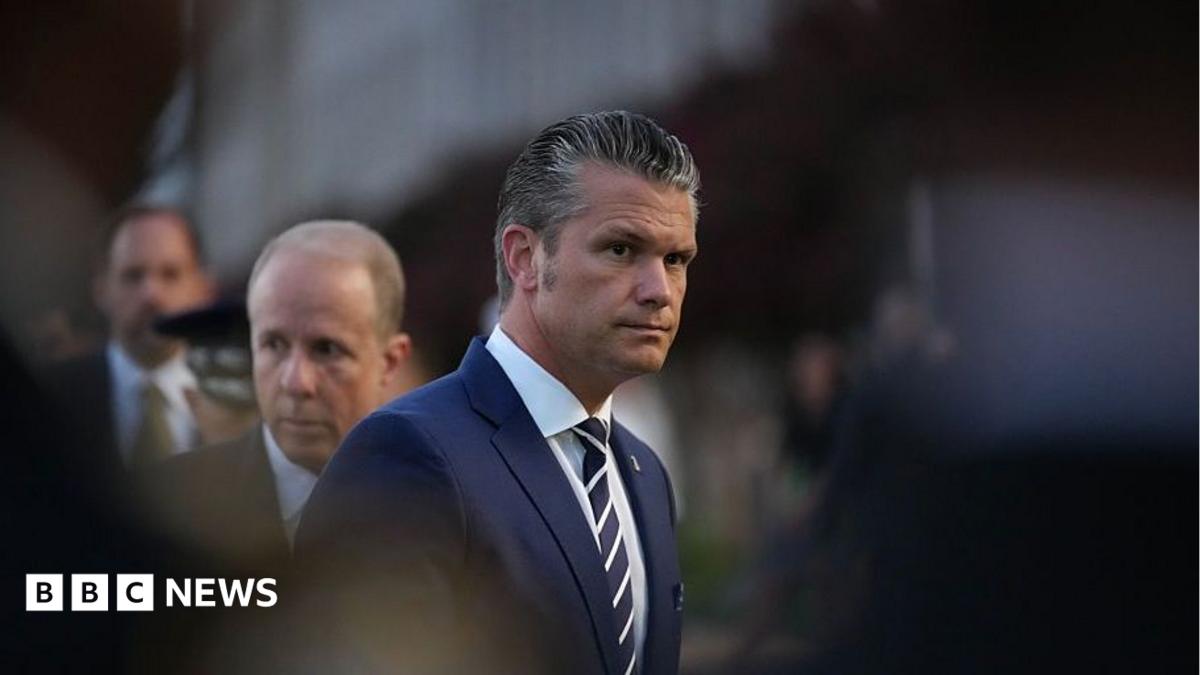
The United States military is at the centre of a fight on two fronts. First is President Donald Trump's attempt to prise the Strait of Hormuz from Iran's grip; the latest phase of his stalemated war in the Gulf which is drawing in US forces and equipment from around the globe. The second is a culture war at home in which Defence Secretary Pete Hegseth is conducting a promised shake-up at the Pentagon, sparking bitter recriminations and a string of departures including the top civilian in charge of the US Army last week. This was reported by Qazaqyia.kz citing BBC News.
The upheaval has triggered questions that could shape the legacy of Trump's second term. Is the US military being stretched to a point that could risk global security? And are these shifts leaving America's extraordinary global network of alliances vulnerable?
Last Monday there was dramatic news from the Pentagon. One of its most senior political leaders, Dan Driscoll, stepped down as US Secretary of the Army. Driscoll is not exactly a household name in America, let alone outside it. But his departure mattered. It was the latest twist in a power struggle within the fortress-like walls of the Pentagon over the future of the world's most formidable fighting force.
Driscoll had clashed repeatedly with Hegseth over the nature and speed of military reform. His departure was the latest in a long line of top leaders removed or sidelined by Hegseth. The level of concern became clear as one Republican Senator Thom Tillis - a frequent Trump critic - called for Hegseth to be fired. "I have never witnessed more inept management of the brave men and women who serve our country," he said.
"This is not good news. You know, for our nation, for the army," H.R. McMaster, who served as Trump's National Security Adviser during his first term, told CBS when asked about Driscoll's departure. "Secretary Driscoll was pushing… a modernisation agenda to catch the army up."
The backstory of Driscoll's resignation cut deep into issues about the readiness of the US Army. Driscoll wanted urgent modernisation by adding drones throughout ordinary army formations to make it adept for 21st Century warfare. He said the Ukraine war had shown how the battlefield had changed, with cheap drones and anti-missile systems challenging the US military with its vast bureaucracy and expensive procurement processes.
Hegseth had in fact initiated much of this modernisation plan but subsequently came into conflict with Driscoll, according to reports, as well as with others advocating its rapid expansion. A source familiar with last week's departure said Driscoll had raised concerns within the administration about army readiness and transformation, which Driscoll said Hegseth was "blocking" specifically by firing the generals responsible.
Jon Duffy, a retired Navy captain and former White House defence policy official, said Driscoll's resignation showed how far Hegseth had "hollowed out" the military leadership at a critical moment. "You lose the [army] secretary, the chief of staff and other senior leaders driving modernisation, it creates a lot of uncertainty and it disrupts momentum," he said. "That uncertainty at leadership levels has downstream effects on the force," added Duffy, who had a 30-year career and commanded US warships before joining the White House during the second Obama administration.
In public, Hegseth - a former Army National Guardsman and Fox News pundit - has spent much of his time calling for cultural change to the US military. He has vowed to end what he called "woke" initiatives and scrap "stupid" rules of engagement he said constrained war fighters' "lethality". He tore up diversity programmes, banned beards and railed against seeing "fat generals in the halls of the Pentagon".
He removed or sidelined the top uniformed officers in charge of the Army, Navy and Air Force as well as at least two dozen generals, admirals and civilian defence leaders, including some of the US military's most decorated officers, often with little explanation.
One critic compares the changes in the top ranks to President Xi Jinping's political purges of the Chinese military which are said to have left serious deficiencies in command structure and readiness. "We've been conducting a military purge as well, and that has real effects on the ability of our military to be able to discharge its responsibilities," Michael Schiffer, a former top Pentagon official who covered East Asia from 2009 to 2012 under the Obama presidency, told the BBC. "The way in which [Hegseth is] shaking them up… is bringing on board an awful lot of risk without any apparent way to be able to address or ameliorate it," said Schiffer, who is now a senior fellow at the liberal think-tank the Center for American Progress.
Asked last week about Driscoll's departure, Vice-President JD Vance defended Hegseth, saying he was in "strident agreement" about the need for a culture shift after what he called 40 years of lost wars and "military misadventures". "What Pete came in wanting to do was revive the warrior spirit in the United States of America," Vance said.