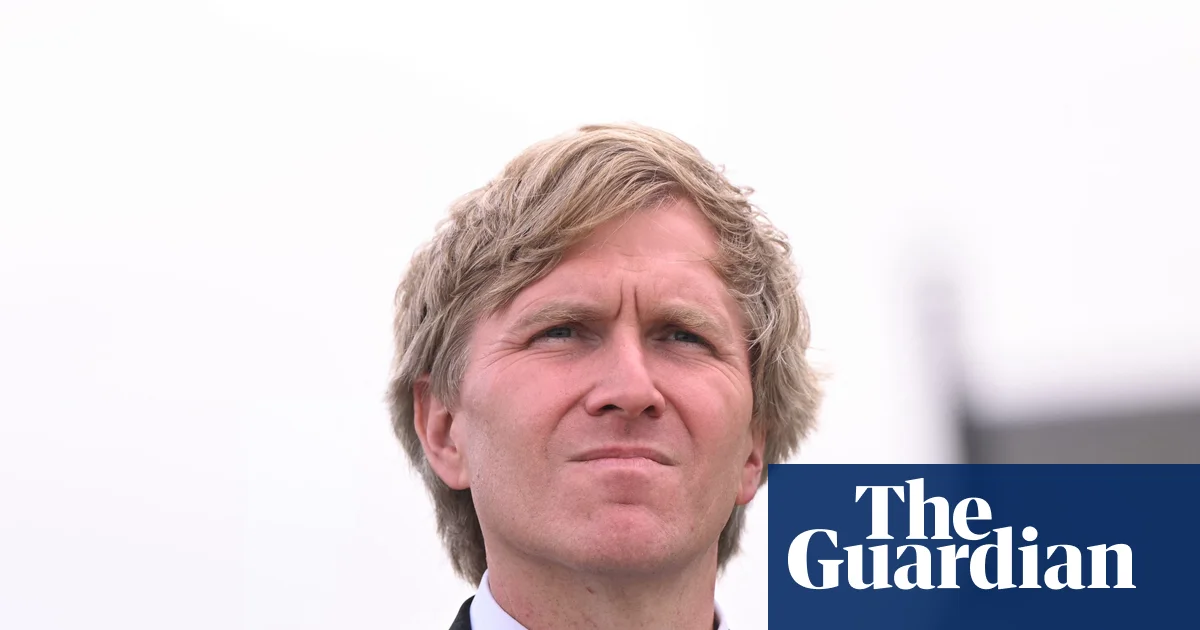
Elbridge Colby, the third-highest-ranking official at the Pentagon and formerly an avowed Aukus sceptic, has mirrored his president’s language on the nuclear submarine deal, saying it is “full steam ahead”. This was reported by Qazaqyia.kz citing The Guardian.
Colby, a US under secretary of war, was the author of the Trump administration’s review of the Aukus deal, which would see the US sell three in-service Virginia-class submarines to Australia, before the development of Australia’s domestically built Aukus-class submarines.
The original draft of Colby’s review was understood to be sceptical about the Aukus agreement’s prospects of success, but was rewritten – on some accounts twice – to more closely align with the president’s position that Aukus was “full steam ahead”.
Colby told an Asia-Pacific press briefing on Thursday “we’re very pleased to say that Aukus is – as the president said – full steam ahead”.
He said the Pentagon was “very pleased with the progress that has been made since the conclusion of the Aukus review which … has provided a roadmap for the success of the Aukus program.
“We all know this is an historic endeavour on the part of both countries, but particularly for Australia.”
The first Virginia-class submarine is slated to be sold to Australia in 2032.
“We remain optimistic but also clear-eyed about what we all need to do,” Colby said. “We will just keep knocking down the targets on our side. We have every expectation the Australian side will do the same.”
He said the US had “no better ally” than Australia, and that the US and Australia enjoyed a “deep alignment of thinking”.
“Australia really sees things through the lens of collective defence and a strategy of deterrence by denial designed to sustain a balance of power in this key region.”
Colby was asked about production rates of Virginia-class submarines, and also the potential presence of nuclear-armed submarines at Australian ports.
US boat-building rates have remained stubbornly laggard. It is currently manufacturing Virginia-class submarines at a rate of 1.1 to 1.2 a year.
That rate needs to be lifted to two boats a year to service US needs alone, and 2.33 boats a year in order to sell any to Australia.
Pillar one of the Australia-UK-US (Aukus) agreement involves Australia being given the technology to command its own fleet of conventionally armed, nuclear-powered submarines. There are two stages:
• First, Australia will buy between three and five Virginia-class nuclear-powered submarines from the US, the first of these in 2032. But before any boat can be sold to Australia, the US commander-in-chief – the president of the day – must certify that the US relinquishing a submarine will not diminish its navy’s undersea capability. The US submarine fleet now has only three-quarters of the submarines it needs (49 boats of a force-level goal of 66). And there are significant concerns the US cannot build enough submarines for its own needs, let alone any for Australia.
• Second, by the “late 2030s”, according to the "optimal pathway" outlined in Australia’s submarine industry strategy, the UK will launch the first specifically designed and built Aukus submarine for Britain’s Royal Navy.
The first Australian-built Aukus submarine, for the Royal Australian Navy, will be in the water “in the early 2040s”. Australia will build up to eight Aukus boats, with the final vessels launched in the 2060s.
Each of Australia’s nuclear submarines is forecast to have a working life of about three decades. Australia will be responsible for securing and storing the nuclear waste from its submarines - including high-level nuclear waste and spent fuel (a weapons proliferation risk) - for thousands of years.
Aukus is forecast to cost Australia up to A$368bn to the mid-2050s.
Colby said the Pentagon was “very focused on submarine production, submarine maintenance, and making sure that that’s in as strong a place as it can be”.
He said the Pentagon and broader Trump administration had “a very clear understanding” with Australia about its expectations under the Aukus agreement.
“They know what is required, we’ve been very clear in private with them.
“[Those discussions were] designed to give everybody a reasonable, stable and realistic set of expectations to achieve this historic ambition that will put us all in a stronger place.”
Colby did not comment on the potential of nuclear-armed US submarines docking at Australian ports.
The US maintains a policy of “strategic ambiguity” around its nuclear capabilities, refusing to confirm or deny whether its nuclear-capable platforms – including aircraft submarines – are carrying nuclear warheads.
The Australian Department of Defence says it respects the US policy and does not ask whether platforms – such as B-52 bombers landing on Australian soil – are nuclear-armed.