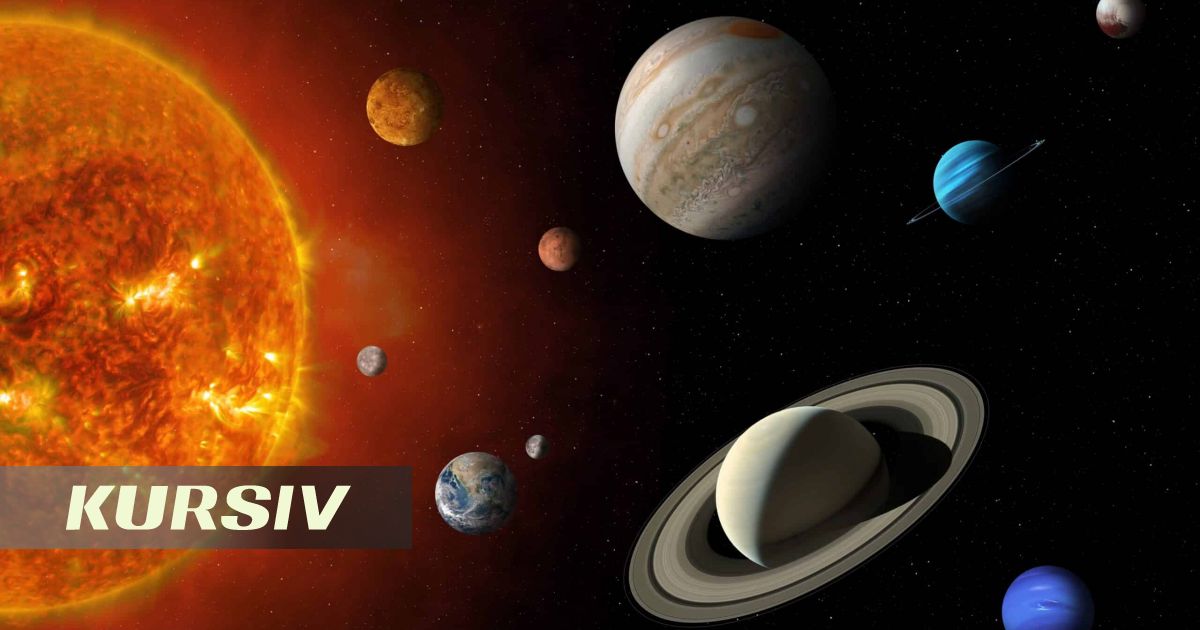
Earthlings are preparing to witness the main astronomical event of the year — a great parade of planets. In the pre-dawn hours, several planets will be visible simultaneously, and with favorable weather, observations can be combined with the peak of the Perseid meteor shower. This was reported by Qazaqyia.kz citing Kursiv Media.
According to astronomers' calculations, Mercury, Mars, Jupiter, Saturn, Uranus, and Neptune will participate in the August alignment. Observing conditions will vary for each planet.
Planets Visible to the Naked Eye
As Gismeteo writes, Jupiter, Mars, and Saturn will be best visible to the naked eye. These planets have high brightness and are usually well distinguishable even under moderate urban light pollution.
Mercury will be more challenging. It will be low above the eastern horizon shortly before dawn, so an open horizon without buildings, trees, or other obstacles is required to observe it.
Uranus and Neptune will be even more difficult objects. Their brightness is insufficient for confident observation without optical instruments. To distinguish these planets, experts recommend using at least powerful binoculars, or better yet, a small telescope.
Observing Conditions in Kazakhstan
Part of the "parade" can be observed throughout Kazakhstan under clear skies. However, seeing all six planets simultaneously will not be possible everywhere.
A location with a wide view from east to southwest is needed. An open eastern horizon is especially important: Mercury and Jupiter will be very low and may hide behind buildings, trees, hills, or a layer of haze.
In northern Kazakhstan, longer twilight will complicate observations, while in the south, the pre-dawn sky will be darker, making faint objects easier to find.
Total Solar Eclipse
Another important astronomical event will be a total solar eclipse. It occurs when the Moon passes between Earth and the Sun and temporarily covers the solar disk.
The path of totality will pass through a small part of northern Russia, Greenland, Iceland, the Atlantic Ocean, Spain, and the far northeastern part of Portugal. The maximum duration of totality will be about 2 minutes 18 seconds.
The solar eclipse of August 12, 2026, will not be visible from Kazakhstan. The country is outside the visibility region of both the total and partial phases.
Looking directly at the Sun without special protection is not allowed even when the Moon covers most of its disk. Regular sunglasses, X-ray film, smoked glass, and dark plastic are not suitable. Cameras, binoculars, or telescopes must not be pointed at the Sun without a special filter installed in front of the lens. Light focused by an optical instrument can damage eyes almost instantly.
The eclipse of August 12 belongs to Saros 126. The previous eclipse of this series occurred on August 1, 2008, and the next will take place on August 23, 2044. The duration of one Saros is about 18 years and 10–11 days.
The next solar eclipse visible from Kazakhstan is expected on August 2, 2027. It will be partial in the country. The next total solar eclipse whose path of totality will cross Kazakhstan will occur on April 30, 2060.
Perseid Meteor Shower
On the night of August 12–13, astronomical events will continue with the Perseids — one of the most famous annual meteor showers.
It occurs when Earth passes through dust particles left by comet 109P/Swift-Tuttle. Entering the atmosphere at about 59 km/s, particles heat up and leave bright light trails. Colloquially, they are called shooting stars, though they have nothing to do with actual stars.
The shower's name is associated with the constellation Perseus. If you mentally extend meteor trajectories backward, they appear to radiate from a region of the sky near this constellation. This point is called the radiant.
The shower is active from about July 17 to August 24. The main calculated maximum in 2026 is expected on August 13 from 7:00 to 9:00 Kazakhstan time.
The Perseids have a fairly broad maximum: increased activity can be observed from the evening of August 12 to the morning of August 13.
In Kazakhstan, observations can begin at about 22–23 hours on August 12, when the radiant rises high enough. They can continue until the start of morning twilight.
The calculated maximum from 7:00 to 9:00 Kazakhstan time will fall during daylight hours. Therefore, in Kazakhstan, it is better to observe the Perseids in the second half of the night from August 12 to 13, before dawn.
Earlier, Kursiv reported that a dangerous asteroid is heading toward Earth.