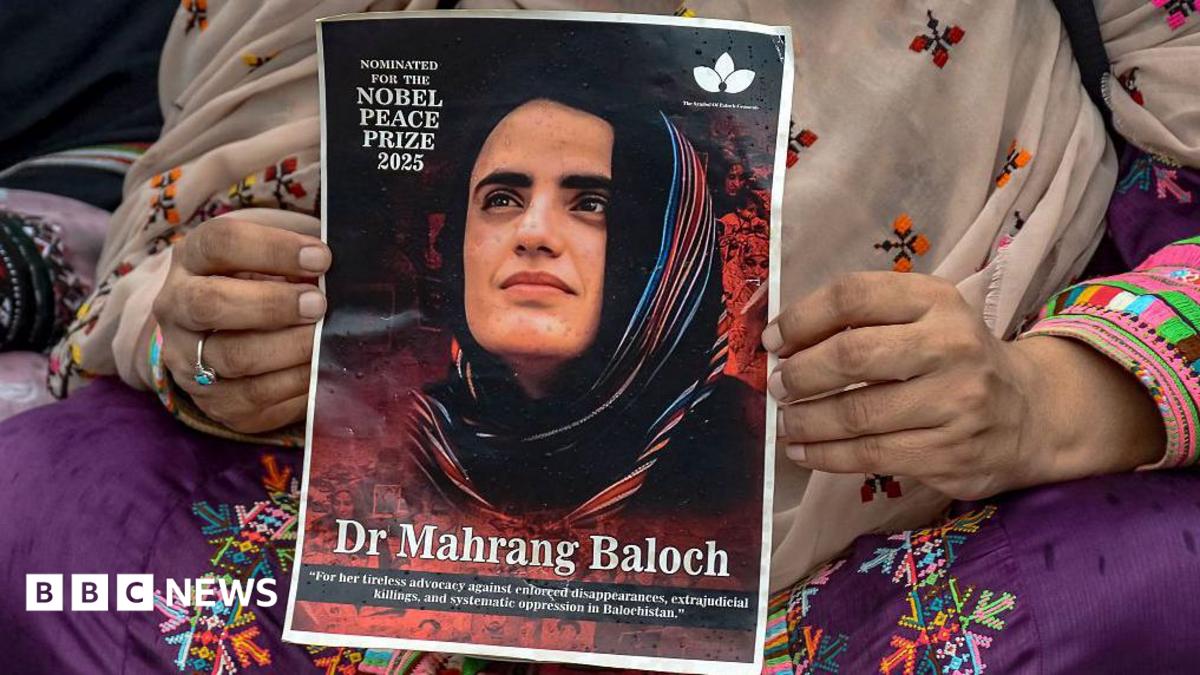
Dr Mahrang Baloch, a prominent activist who fought against enforced disappearances in Pakistan's south-western province of Balochistan, has been sentenced to life imprisonment. This was reported by Qazaqyia.kz citing BBC News.
A Pakistani anti-terrorism court sentenced Mahrang and fellow activist Sibghatullah Shah to life imprisonment on Monday after convicting them of terrorism, sedition and murder in connection with the death of a paramilitary soldier during a protest in the town of Gwadar in 2024. The pair deny the charges and are expected to appeal.
Speaking to the BBC after the ruling, Mahrang's sister Nadia Baloch said the family remained defiant. "We will challenge this decision in the higher courts," said Nadia, who is also part of her sister's legal team. Asked whether she had visited her sister in prison, Nadia paused. "I don't have the courage to see her," she said, because she feels she has failed her by not getting Mahrang justice.
For Mahrang, 33, the issue of enforced disappearances is not merely political. It is deeply personal. Her father, Abdul Ghaffar Langove, who was also a political activist, disappeared in 2009, when she was 16. Nearly three years later Mahrang's family received a phone call informing them that his body had been found in Lasbela district, in the south of the province. "When my father's body arrived, he was wearing the same clothes, now torn. He had been badly tortured," she told the BBC in her last interview before her arrest in 2025.
In the following years, Mahrang became involved in campaigns demanding information about missing persons in Balochistan. Activists and rights groups say thousands of ethnic Baloch people have disappeared over the past two decades, alleging many were detained by security forces without due process or abducted, tortured and killed as part of operations against a long-running separatist insurgency. The Pakistan government denies the allegations, insisting that many of the missing have joined separatist groups or fled the country.
Some come back after years, traumatised and broken - but many never return. Others are found in unmarked graves that have appeared across Balochistan, their bodies so disfigured they cannot be identified. And then there are the women across generations whose lives are defined by waiting. Their grief, and the search for their relatives, became a central focus of Mahrang's activism. Nominated for the Nobel Peace Prize last year, she has become one of the movement's most prominent leaders over the past decade.
Balochistan is the largest of Pakistan's provinces, covering about 44% of its national territory. The land is rich with gas, coal, copper and gold. But Balochistan has been locked out of progress. Access to many parts of the province is restricted for security reasons. Infrastructure is poor, electricity is sporadic and water is scarce. Foreign journalists are often prohibited from visiting.
Balochistan became a part of Pakistan in 1948, in the upheaval that followed the partition of British India - and in spite of opposition from some influential tribal leaders, who sought an independent state. Some of that resistance turned militant, and has been stoked over the years by accusations that Pakistan has exploited the resource-rich region without investing in its development. Militant groups like the Balochistan Liberation Army (BLA), designated a terrorist organisation by Pakistan, the United States and several other countries, have intensified their attacks in recent years.
Disappearances in the province are widely believed to be part of Islamabad's strategy to crush the insurgency - but also to suppress dissent and weaken nationalist sentiment and support for an independent Balochistan. Many of the missing are suspected members or sympathisers of Baloch nationalist groups that demand more independence. But a significant number are ordinary people with no known political affiliations. Many in the government deny that enforced disappearances are happening on a large scale, calling it "systematic propaganda".