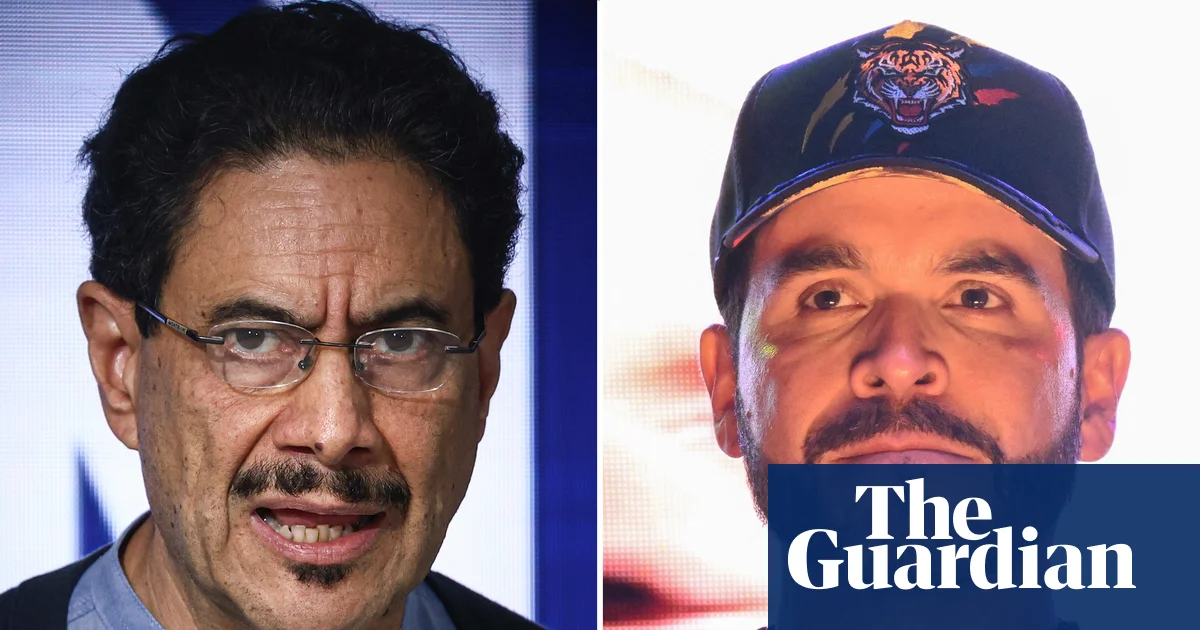
Whoever wins Sunday's presidential runoff vote in Colombia, the country's next leader will have a personal history intertwined with one of the criminal forces at the heart of a decades-long armed conflict that claimed nearly half a million lives. This was reported by Qazaqyia.kz citing The Guardian.
The lives of Iván Cepeda and Abelardo de la Espriella have, in very different ways, been shaped by their relationship with Colombia's paramilitaries – private armies originally established by rightwing landowners, drug traffickers, businessmen, mining magnates and politicians to fight leftwing guerrilla groups.
De la Espriella, 47, a far-right admirer of Donald Trump and self-styled outsider, launched his legal career defending paramilitary leaders.
Cepeda's father was assassinated by army officers linked to a paramilitary group, and the 63-year-old leftwing senator forged his public career as a human rights activist exposing those groups' crimes.
The winner will take office on 7 August and inherit the country's worst violence since the landmark 2016 peace agreement between the government and most of the Revolutionary Armed Forces of Colombia. The two candidates advocate opposing strategies for dealing with the surge in crime.
De la Espriella, who has led the polls since defeating Cepeda in the first round, supports a return to the kind of full-scale military confrontation that has done little to curb violence in the past.
Cepeda, who is backed by the current president, argues for a modified continuation of Gustavo Petro's strategy of "total peace". Petro, who is barred by the constitution from running for re-election, has proposed negotiations to dismantle all armed groups, including leftwing rebels, paramilitaries and organised crime factions. Violence has surged, however, and security experts say the strategy has broadly failed.
Sunday's vote "reflects the reality of a country shaped by drug trafficking," said Gustavo Duncan, one of Colombia's leading scholars of paramilitarism.
Paramilitary groups were first formed in the 1960s in response to the emergence of leftwing rebel groups and often operated with the collusion of the Colombian military. By the 1980s, as the cocaine trade grew central to the conflict, the paramilitaries also protected trafficking routes and drug lords such as Pablo Escobar. A major faction later broke with the Medellín cartel leader, helped bring about his downfall and used the resulting power vacuum to expand.
"At its peak, these groups had more than 30,000 members. It was an enormous army spread throughout the country," Duncan said.
In the 1990s, the paramilitaries "became notorious for massacres" – choreographed displays of extreme violence designed to terrorise entire communities – said María Teresa Ronderos, the author of major investigations on the private militias.
Their fighters would enter towns and rural communities and kill anyone suspected of sympathising with or providing information to the guerrillas, including peasants, Indigenous people and Afro-Colombians. They also carried out what they called social cleansing, targeting people deemed undesirable by paramilitary far-right culture, including LGBTQ+ people, sex workers, homeless people and drug users.
Massacres frequently involved extreme forms of torture, including rape followed by murder, dismemberment of victims with chainsaws while they were still alive and decapitations carried out with axes.
In 1994, paramilitaries and members of the army murdered the senator Manuel Cepeda as part of a campaign against the communist Patriotic Union party. Iván Cepeda, then a university professor, came across his father's car riddled with bullet holes.
In the early 2000s, the younger Cepeda founded and led a movement representing the death squads' victims, investigating cases and visiting prisons to collect testimony from former paramilitaries.
At the same time, De la Espriella was rising to prominence as a lawyer defending leaders of the country's main paramilitary organisation, the United Self-Defence Forces of Colombia (AUC by its Spanish acronym), while the group negotiated its demobilisation.
The AUC no longer exists, but the Gulf Clan, widely regarded as Colombia's largest and most powerful illegal armed group, was founded by its former members and inherited much of its territory and many of its trafficking routes.
Cepeda filed a criminal complaint against De la Espriella last week, alleging that he had not only represented the AUC in court in the past but had also acted as a "possible recruiter" for the group through a foundation he created.
De la Espriella dismissed the accusations as a "smokescreen" and hit back by claiming that Cepeda maintained a "narco-political" alliance with guerrilla groups in order to secure votes.