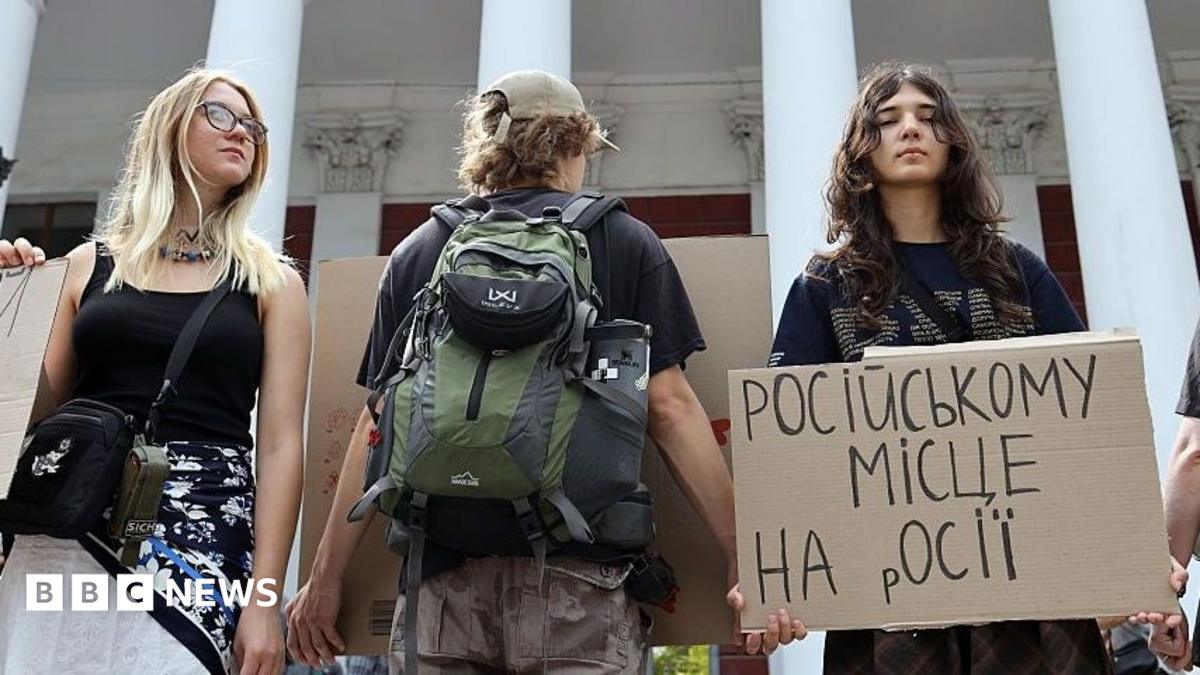
Ukraine's third-largest city Odesa will decide this week whether to back a controversial plan to ban the Russian language in the arts. This was reported by Qazaqyia.kz citing BBC News.
The proposal being considered by councillors in Odesa on the Black Sea coast aims to add to existing restrictions on Russian imposed by national legislation. It is particularly significant because Odesa is overwhelmingly Russian-speaking, although the ban would only affect public spaces and everyday usage of Russian would remain unaffected.
For millions of Ukrainians, Russian is their first language including many of the troops defending the country in its war with Russia. But Ukrainian is the only state language and spoken by the majority, and some see Russian as a tool of Russian influence.
The proposal in Odesa, which is targeted daily by Russian drone and missile strikes, calls for a complete halt to Russian-language content in music and literature, in streets, parks, public institutions and state-run arts and entertainment venues. It would also recommend a ban in privately owned spaces.
In a city famous for Russian-language writers and musicians, it has provoked strong passions.
The ban would extend in public spaces to old Odesa songs almost universally known throughout the former Soviet Union. All Russian-language books would be removed from display in public libraries. Currently, they can be shown, but not prominently.
"The Russian language is a weapon of Russia, and we need to try to fix that," says Odesa lawyer Artem Kartashov, who has advised local authorities on an official programme to "decolonise" the city of its historic Russian legacy. "With Russian-speaking music and other things, Russians try to deconstruct Ukrainian identity and influence especially young people, because they grow up in a Russian-speaking environment."
But comic actor Borys Barsky, one of Odesa's best-known entertainers, says: "Russian isn't [only] the language of Putin, it's the language of [writers like] Dostoyevsky and Bulgakov. Who benefits from setting people against other people who love Ukraine just as deeply, only love it in a different language? Only Putin benefits from this."
Russian President Vladimir Putin has often referred to what he falsely describes as repression of the Russian-speaking minority in Ukraine as one of his justifications for launching his invasion of the country.
Russian and Ukrainian are closely related, but distinct in many ways. Many in Ukraine speak a mixture of the two, known as surzhyk.
Russian is the native language of President Volodymyr Zelensky, which he used often in his election campaign but has since used only Ukrainian in public.
But a 2019 law requires use of Ukrainian in many public and professional contexts including education, public services and customer service. Public-facing workers - including waiters, shop assistants and doctors - must address customers or patients initially in Ukrainian, though they can later switch to Russian if the client prefers that.
Odesa's Mask Theatre, run by Barsky, has been fined for infringements of the legislation including using Russian in publicity materials. A later inspection found further violations such as a cafe sign with the Russian word for coffee. "This isn't even like Orwell or Kafka, it's just madness," he says.
Barsky has been able to continue to perform in Russian because it is a private theatre.
The new language proposal - similar to one already in force in the capital Kyiv and some other cities – would urge but not require private premises including shops and cafes to adopt the ban.
Odesa's state-appointed language ombudswoman, Anna Nerush, who inspects premises to check on alleged violations of the rules, thinks if passed it will put pressure on them to comply. "All businesses interact in one way or another with local government," she told the BBC. "They rent premises, they need advertising permits, and so on. So for many entities it's important to comply with a council decision, even if doesn't provide for sanctions for non-compliance."
Public playing of songs by Russian citizens is already illegal across Ukraine, with exceptions for some artists who have publicly condemned the war, but Russian-language songs composed or performed by Ukrainians are still allowed. Under the proposals they would also be banned in public places.