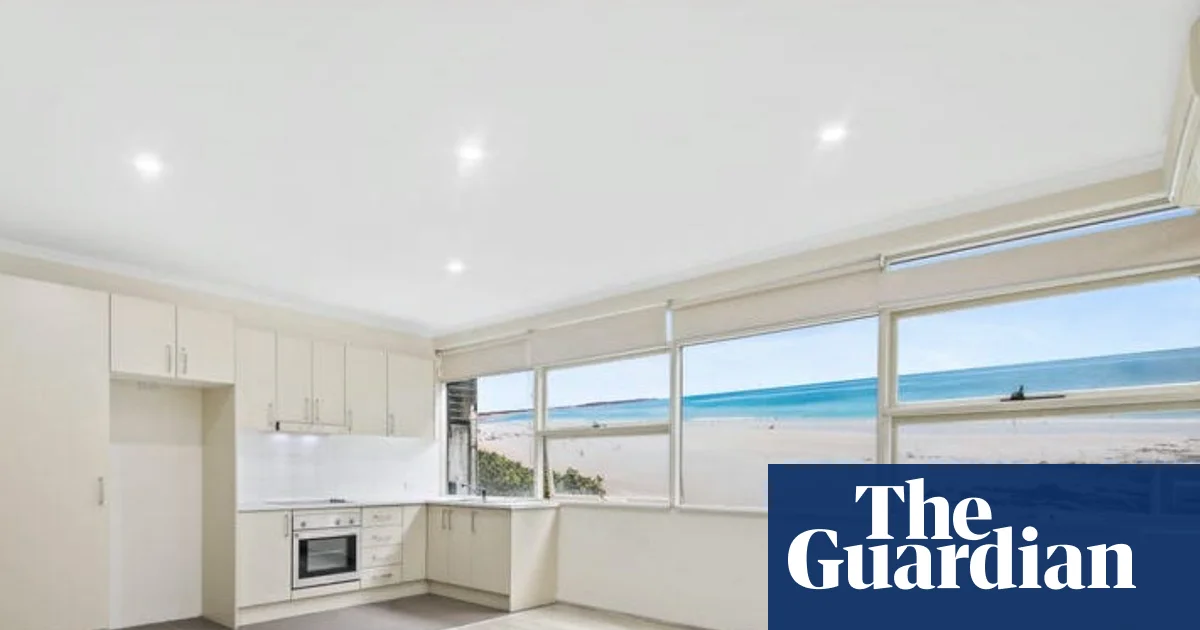
The New South Wales government’s crackdown on “AI-doctored” rental listings has hit a wall, after it made an example of a supposedly manipulated ad that turned out to be a genuine photograph of a $5,000 courtyard mural of Bondi beach. This was reported by Qazaqyia.kz citing The Guardian.
In a media release on Friday announcing protections against misleading rental ads, the state government provided a link to a property in Leichhardt, claiming it was an “AI-doctored rental listing in Sydney’s Inner West”.
But the listing agency IB Property denied the images were altered.
A spokesperson confirmed the photograph shows a mural of Bondi beach on an internal courtyard wall visible through the unit’s windows, rather than a false digital depiction of coastal views.
“We can confirm that the image has not been altered or digitally generated using AI, Photoshop or any other image-editing software,” the spokesperson said.
Leichhardt is about 12km away from Bondi beach.
When Guardian Australia visited 2/14 Norton Street, the artwork was not visible from the street. IB Property explained the mural sits within an internal courtyard and provided photos taken inside the unit confirming it remains in place.
“The mural was commissioned and paid for by the landlord at a cost of approximately $5,000, and we can also confirm that there are no plans for it to be removed,” the spokesperson said, adding that the property was leased in February 2026 and has not been advertised since.
The better regulation and fair trading minister, Anoulack Chanthivong, whose office issued the media release, didn’t respond directly to questions from Guardian Australia, but did issue the following statement:
“Every renter knows the frustration of seeing a property online, only to turn up and find it looks nothing like the listing.
“These laws are about putting an end to misleading practices and making sure renters get a fair go. We will always stand on the side of renters.”
Despite the mix-up, the new laws target an increasing market issue.
Under the legislation, real estate businesses in NSW will face fines of up to $22,000 for failing to disclose digitally altered or AI-generated property images.
The bill targets the rapid rise of “housefishing” – where digital alterations distort the true size and condition of a home.
Chanthivong said the new laws would establish strong protections against misleading property marketing and support ethical AI use. The regulations take effect in early 2027.
The legislation arrives as generative AI embeds itself in property marketing nationwide.
Tim McKibbin, the chief executive of the Real Estate Institute of NSW, said generative AI complicates pre-existing digital enhancement in the industry.
“This technology has been available for some years now … people have used Photoshop,” he said. “People were removing trees and removing telegraph poles … clearly that is false and misleading.”
McKibbin draws a line between virtual staging and false advertising. “I’ve seen instances where agents have put furniture into the photographs … Now, that is merely giving you an indication of what you could do,” he said.
Stewart Bunn, of First National Real Estate, said consumer trust is being tested by poor industry examples, referencing a 2024 instance where an LJ Hooker branch used AI to generate a listing with nonexistent schools.
“We have seen examples across the industry where AI-generated images have depicted renovations that have not occurred, furnishings that create an unrealistic impression of scale, landscaping that does not exist or finishes that materially differ from the actual property,” Bunn said.
“The best practice is simple: if a buyer would be surprised by what they see when they arrive at the property, the advertising has gone too far.”
An RMIT University report led by Dr Leah Li, funded by the Australian Property Institute, found a “significant lack of sector-specific AI frameworks to guide responsible AI practice within the property profession”.
Public confidence remains fragile: a 2026 Cotality study showed only 40% of Australians trust AI-generated outputs, compared with 62% in Canada, 52% in the US, and 46% in the UK.
Dr Shuai Wang, a research fellow at the University of Queensland, said generative AI systems prioritise visual appeal over accuracy. In real estate, this can manifest as “hallucinations”.
“AI hallucinations can occur when AI-generated images introduce features that were never part of the property,” Li said, fundamentally changing a prospective tenant’s perception of “size, layout, condition, or amenity”.