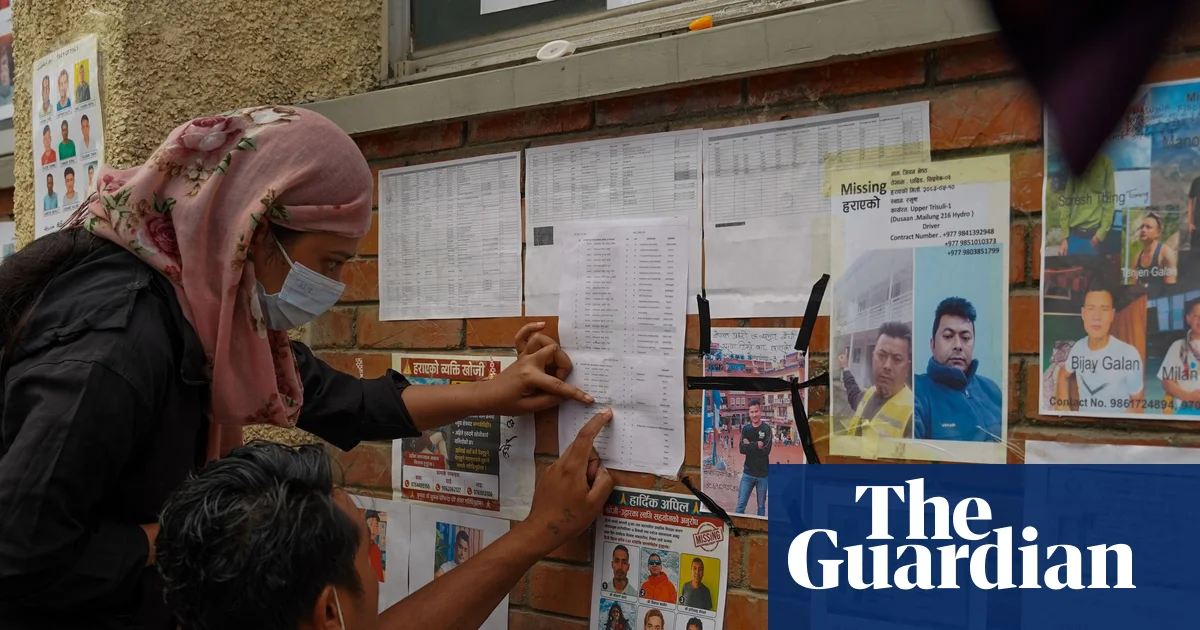
The walls of a teaching hospital in Kathmandu are covered with pictures of unidentified victims. Every few hours, Nepalese authorities hang photos of the deceased. This was reported by Qazaqyia.kz citing The Guardian.
Saluja, a young woman who did not give her last name, stood among a group of more than 100 people watching. Her cousin, 31, was not on the wall that day. "It's very hard to identify their faces," Saluja says. Her cousin worked at a hydro power plant and has been missing since the flood. "It was the first area to get affected, so we really don't know. But we are hoping for the best," she says.
Since Wednesday, Kathmandu has swelled with international visitors – not tourists but people looking for their loved ones. The Nepalese government has deployed about 15,000 personnel – from the army to the police – to move up the valley and into the areas decimated by the flood, hoping to find survivors. Search conditions are arduous: areas completely cut off, roads destroyed, bridges washed away, and a new lake threatening to burst.
It's been four days since the glacier collapsed high in the Himalayas, sending a wall of water, ice and mud down to destroy everything in its path. The number of people killed has risen to 669, with nearly 3,000 people lost. On the Chinese side, more than 550 people are unaccounted for. Forty-one Australians are still missing.
On Saturday, New South Wales man Michael Keats was confirmed to be one of them. He had reached the Nepal-Tibet border just moments before disaster struck. His family said: "Confusion around the timing of the floods initially led us to believe our beautiful Michael would be safe in Kathmandu, preparing to fly home. Unfortunately, it was confirmed relatively quickly by the Isha Foundation that Michael and his Kailash travel group had arrived at Gyirong Port on the Nepal-Tibet border just 10 minutes before the tragic floods hit."
Sagar Shrestha, director of the Disaster and Crisis Management Department at the Nepal Red Cross Society, said the death toll could climb into the thousands. "But they are still finding survivors," he says. "Some of them are being found in the jungle; they've gone up the mountain and are being helicoptered out." There are 14 hydropower plants along the river, six of which were under construction. It's believed people could still be alive in the majority of them.
One of the key issues has become "the dignified management of the dead," as morgues and hospitals have filled up. According to local media, officials in the Chitwan district will collect DNA samples from 229 bodies that are starting to decay and are no longer identifiable, before burying them. "It is now the major concern," Shrestha says. "And the second thing is that if we are not being able to manage the dead bodies, there could be some kind of health issues."
Since the crisis started, Sagar Pandey, CEO of the Himalaya Glacier Company, has barely slept. He says 47 people from the trekking service are lost, including 15 Australians. He had Australians in two different locations: five in one, ten in another.
Families balance hope and despair as they race to find survivors. Some take videos to send to relatives, comparing photos to identify loved ones. The bodies have a piece of paper lying on top of them, showing which district they were found in, with a number to contact. International searchers are also arriving. This disaster has shaken the world, and Nepal continues rescue efforts.