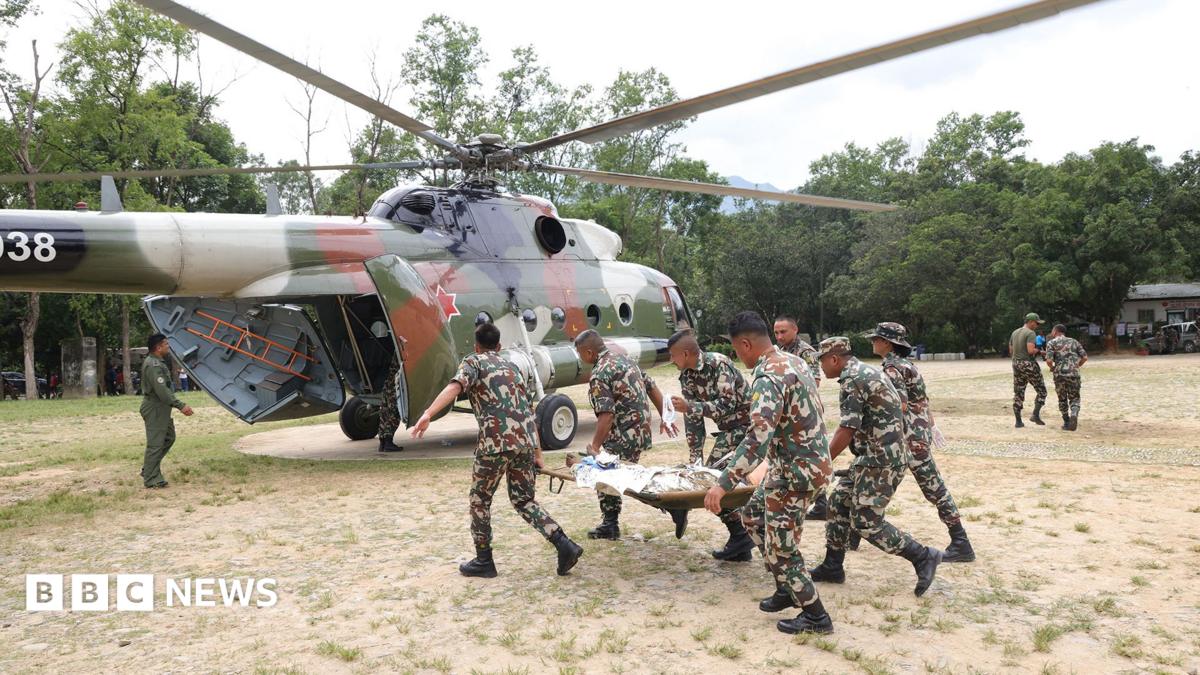
Massive landslides and flash floods on the Nepal-Tibet border have caused widespread damage and left hundreds dead or missing. This was reported by Qazaqyia.kz citing BBC News.
Search and rescue operations are under way. Chinese state media has said there are significant casualties, while Nepalese officials anticipate "huge scale loss".
Nepal's foreign minister initially said an earthquake was reported on the Tibet-Nepal border shortly before the landslide, suggesting it may have triggered the disaster.
The United States Geological Survey (USGS) had first reported the event as a magnitude 4.4 earthquake on Wednesday, but later confirmed the incident "was instead a glacial collapse and debris flow" that "caused subsequent catastrophic impacts downstream".
"Additional analysis of nearby seismic stations, long period seismic waves, and satellite imagery led to the determination that the seismic event was instead a glacial collapse and debris flow, and that no earthquake had occurred," USGS said on Thursday.
Earlier Nepali authorities had also told the BBC that a massive chunk of ice may have collapsed from a mountain, pulling down rocks and other sediments with it.
Climate change is known to be driving faster glacier melt in the Hindu Kush Himalaya region and, as rescue efforts continue, scientists are trying to piece together the exact order of events.
Simon Cook, senior lecturer in energy environment and security at the University of Dundee who specialises in glaciology, said "climate change could have an impact".
Cook said his team had detected that the lower part of a glacier in Nepal near the Langtang Lirung peak - which is approximately 15km (9 miles) west of the site of the floods - had collapsed.
He estimated that the glacier collapsed in a northwesterly direction and then travelled westwards downstream.
He told the BBC "permafrost is partially holding some mountainsides together, this permafrost is warming and thawing and degrading so you are going to get more landslides".
Mike Searle, professor of Earth sciences at Oxford University, said the glacier could have collapsed "hours or days" before the flooding hit Nepal and Tibet.
He told the BBC: "I think the sheer wave of debris suggests there was a landslide first, the water built up, (which) dammed the river, and then it burst in one huge great flood."
One possibility is that water from rainfall or melting ice may have destabilised the ground or ice, triggering a chain reaction.
Scientist will be looking at satellite images of exactly where the landslide occurred, whether any glacial lakes suddenly drained, and where the river might have become blocked, as well as data on recent rainfall.
A deluge of material careered towards northern Nepalese towns, including areas popular with mountaineering tourists and pilgrims. The border is around 40 miles (64.4km) north of Nepal's capital city Kathmandu.
Footage showed a wall of mud and rock sweeping away buildings, roads and vehicles, as people fled the fast-moving wave of material in the Nuwakot region.
In one video, a towering wall of water and mud was seen rushing down a gorge along the Trishuli River and enveloping the Rasuvagadhi Border check point, a multi-storey building.
Severe flooding has been reported along the Bhote Koshi, Trishuli and Narayani rivers.
Deaths have also been reported in villages on the Tibetan side of the border.
The International Centre for Integrated Mountain Development (ICIMOD) has warned secondary flooding could occur in the coming days as a result of the debris that washed into the river systems.
In a report, the ICIMOD said they are in the process of assessing whether the Trishuli River has been temporarily blocked in narrow sections. If it has been blocked, it is at risk of forming a landslide dam - and a second flooding event.
Authorities and scientists are continuing to evaluate the size, location and stability of any potential blockages.
The number of people killed or missing is still becoming clear.
Nepali police say at least 270 people have died. Among those killed, 64 were found in downstream areas in the Chitwan district while another 26 were found in Nawalparasi East.