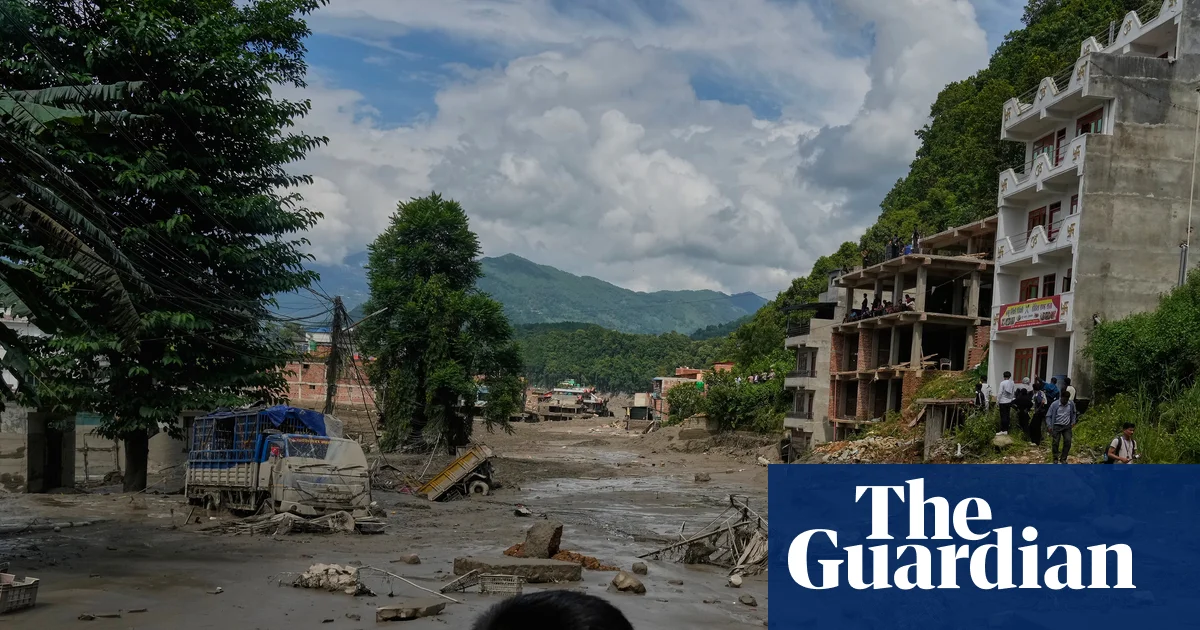
Over the weekend, rescue workers in Nepal and Tibet raced to find people still trapped in villages affected by catastrophic flash floods. As of Monday morning, the death toll stands at 903, with more than 4,000 people missing. This was reported by Qazaqyia.kz citing The Guardian.
For those reading this in a place where life continues as usual, the scale of devastation is hard to fathom. In a matter of minutes, a torrent of mud and debris engulfed entire villages, snapped bridges and swept away people's homes and families. Some survivors are marooned on top of buildings that rescue workers can't reach. Others are trapped in tunnels beneath the ground. Many have no idea if their loved ones are still alive.
The floods exemplify a wider threat. The delicate processes that have shaped our climate for centuries are unwinding at a terrifying pace. Scientists are still investigating the precise sequence of events that caused these floods, but as the planet heats up and glaciers melt, events like this will keep happening.
The Guardian has been covering the floods extensively – you can read our visual guide to the disaster and our latest report. Our south Asia correspondent Hannah Ellis-Petersen is on the ground in Kathmandu. She has been speaking to survivors and reporting on the rescue operation since Thursday.
UK politics
PC Andrew Harper's killers will remain in prison after Andy Burnham announced changes to the early release scheme that will see anyone convicted of unlawful killing, including all forms of manslaughter, excluded from the scheme.
Milo Yiannopoulos
Far-right British media provocateur Milo Yiannopoulos has been deported from the US back to the UK by Immigration and Customs Enforcement (ICE) in connection with what the agency said was expired authorisation to be in the country.
US-Iran
Iran has launched retaliatory strikes on airbases in Jordan after the United States attacked Iranian rocket launchers on an island in the strait of Hormuz, the first such strikes in a month.
Iceland
In a blow to Brussels, Iceland has held a referendum that has narrowly rejected the government's proposal to hold accession talks with the EU.
Nepal-Tibet disaster
A headteacher in Nepal evacuated 900 children from a school moments before a deadly wall of water struck their town amid the devastating flash floods that have killed almost 800 people and left thousands missing.
Cause of the disaster
At 8:37am on Wednesday morning, an enormous chunk of ice from a glacier in the Himalayas broke off and crashed on to a mountain near the border between Nepal and Tibet. It caused a fearsome avalanche of ice and rock, which surged downstream into the Bhotekoshi and Trishuli rivers, submerging villages and sweeping roads away.
At first, the scale of damage was unclear. Nepal is prone to natural disasters, and many of the villages affected by these floods are extremely remote. Early satellite images of the region were obscured by thick clouds of dust, and scientists initially assumed that an earthquake must have caused the flood, rather than a glacier collapse. By Wednesday night, as more images and reports emerged, it became clear that the floods were an "absolute catastrophe," Hannah says. On Thursday, she boarded a flight to Kathmandu, the capital city near the destruction.
Situation in Bidur
When Hannah arrived in Bidur, a small city two hours from Kathmandu, on Friday morning, most of its buildings had been destroyed, their carcasses exposed like matchsticks. A team of rescue workers in yellow hard hats were working to clear the roads. "There was a bank, an ATM machine, and a truck that was lying on its side," she says. "Everything else was either submerged in mud, or mangled."
The Nepali army has been organising the rescue operation from a military base in Bidur. Large sections of the road that links Bidur to villages higher in the valley have been washed away, so rescues are happening by air, and the sound of helicopters is nearly constant. Every two to three minutes, a chopper lands, deposits survivors, and sets off again. The mud is so thick in some places that helicopters have struggled to land. Rasuwa, an area where entire villages were destroyed, was still inaccessible when Hannah spoke to us on Sunday afternoon. "The ground zero of the floods has still not been reached by journalists, and is only just being reached by the army," she says.
Rescue and search efforts
Hundreds, if not thousands, of people have been rescued, and hundreds of people are now waiting outside the army base in Bidur scanning lists of survivors posted on the walls. At hospitals in Kathmandu, health workers have put up photos of bodies that are so disfigured their families have struggled to identify them. Authorities have begun burying human remains because there isn't enough mortuary space to prevent them from decomposing. "I've spoken to people who have up to 12 relatives who have gone missing," says Hannah, who visited hospitals in Kathmandu on Saturday. "And there's no phone signal in the more remote villages. So another big cause of suffering is this huge uncertainty."
So far there are 4,247 people who are missing, according to Nepal's disaster agency (592 of whom are foreigners, including 43 Australians).