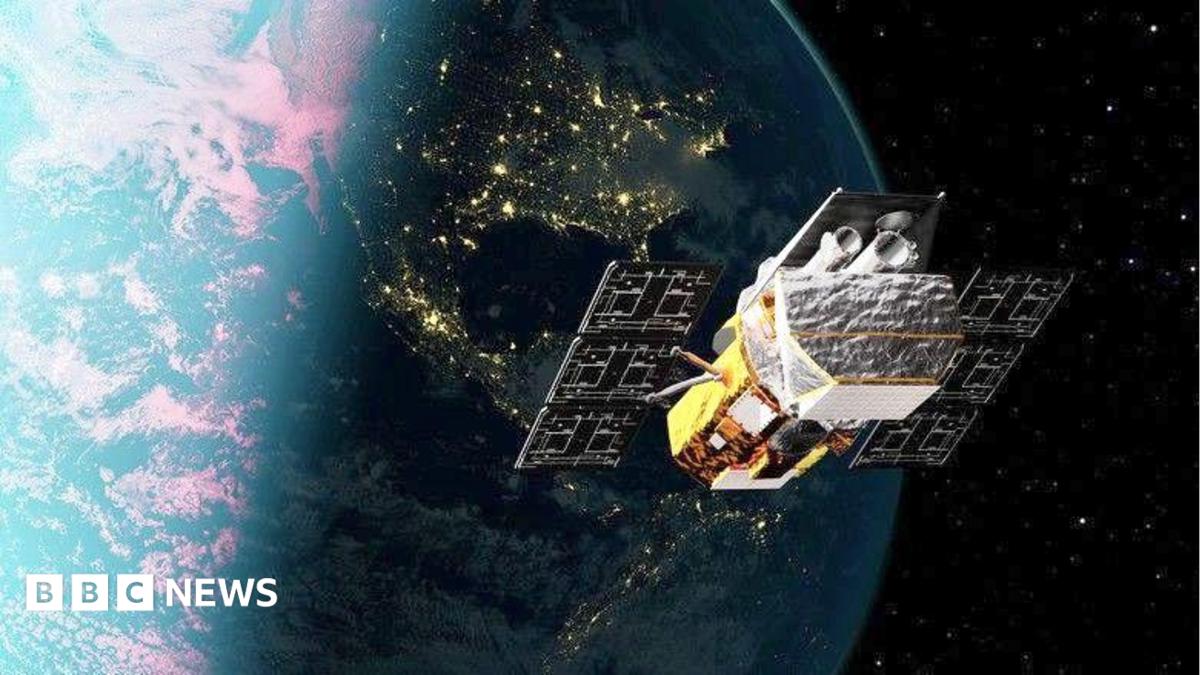
A NASA-funded spacecraft has been sent into space to catch a falling telescope. This was reported by Qazaqyia.kz citing BBC News.
The Swift observatory detects some of the most powerful explosions in the Universe but is at risk of crashing back to Earth in the coming months. The small space telescope will be intercepted by the LINK craft, which will attempt to grab it with three robotic arms and try to lift it back to a safe orbit.
The rescue mission, launched on Friday, has never been attempted before, and Dr. Simeon Barber, a space scientist at the Open University, has said it is "high risk". "But NASA obviously thinks it's worth a go. And the science community is hopeful about this because it's an important telescope that enables us to study super high-energy phenomena that we have no other means to study," said Barber.
The Swift observatory is falling because increased solar activity has pushed out the Earth's atmosphere such that it touches Swift. This drags on the observatory and slows it down as it orbits the Earth, lowering its altitude. When it was first launched it sat in an orbit at 373 miles (600 km) and has now lowered to around 220 miles (360 km), with most of that descent in the past two years.
Satellites fall to Earth and burn up on re-entry all the time. But Swift is scientifically special, beloved by the researchers who use it to peer into the very dawn of the cosmos. The observatory, which is the size of a large car, was launched in 2004, with three telescopes aboard, to study the most powerful explosions in the Universe. These are caused by the final, violent deaths of giant stars and by the collisions of the embers they leave behind. They release in just a few seconds the same energy as the Sun will give out over its entire 10-billion-year lifetime. And because these precious cataclysmic moments are so brief the spacecraft has to be quick and nimble – hence its name.
In short, there is nothing like Swift, and NASA deemed that it was a spacecraft worth saving. The engineers of a young company, Katalyst Space Technologies, from Flagstaff, Arizona, were given the task of saving the observatory. They had less than a year to launch their mission before Swift fell below the altitude of 186 miles (300 km) where a rescue becomes impossible, according to the firm's Chief Executive Ghonhee Lee. "What the Katalyst team has accomplished in just eight months is extraordinary. The team designed, built, tested, and integrated a robotic spacecraft capable of performing one of the most ambitious commercial servicing missions ever attempted," he said.
The LINK spacecraft, which Lee's team came up with, is a three-armed robot, about the size of a fridge, bristling with cameras and guidance systems and driven by small thrusters. Launched on Friday, the spacecraft will spend the next few weeks waking up its systems one-by-one: power, navigation, the cameras and sensors it will rely on, and check that each one survived the ride. Although the Pegasus XL rocket on which it rode has flung LINK close to Swift's orbit, there is still much work for the three-armed robot to do to get close to Swift. The rescue spacecraft, itself moving, has to home in on a moving target. But about three to four weeks after launch it should finally draw alongside.
Using its cameras and sensors, LINK will slide in close and circle the telescope, photographing it from every angle. Engineers have guessed at where to grab hold, but Swift must have been altered by twenty years in orbit, according to Barber. "The Swift telescope was never designed to be caught in space and have its orbit changed. So, the rescue craft is going to approach it very slowly and attach itself to the telescope." Then comes the nail-biting moment: the catch, when LINK's three arms reach out. If all goes to plan, LINK will take hold of Swift and take it back to where it can continue its vital work. "LINK will fire its engines to slowly raise the orbit of the telescope again to an altitude where it becomes stable for a long period of time," said Barber. Over the following two to three months, LINK will fire its small thrusters and gently haul the pair back uphill, from around 220 miles (360 km) towards Swift's old home 373 miles (600 km) above the Earth. The mission is ambitious and has never been carried out before. A lot will have to go right if it is to succeed. If it does, attention will turn to whether the next rescue mission could be to save the even more famous Hubble Space Telescope.