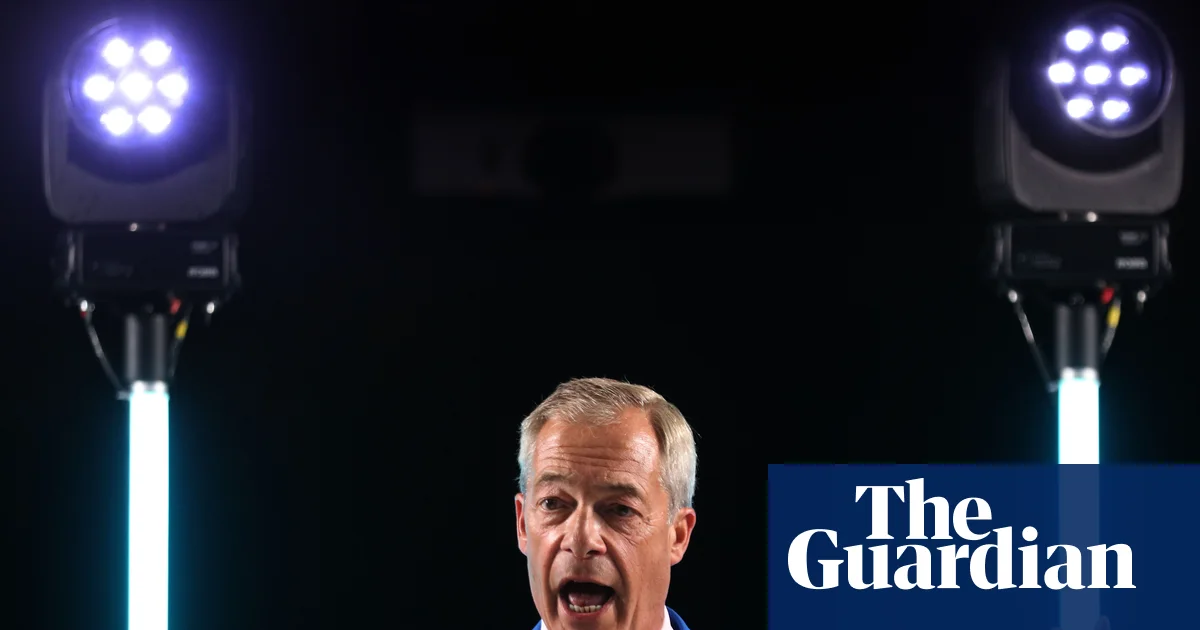
The rise of Nigel Farage has prompted political leaders across Ireland, Northern Ireland, Scotland and Wales to game the unthinkable: the break-up of the United Kingdom. This was reported by Qazaqyia.kz citing The Guardian.
Unionists who wish to save the union and nationalists who wish to end it are bracing for constitutional turmoil if Reform UK emerges triumphant – with Farage as prime minister or official leader of the opposition – after the next election.
Representatives from each side believe a Farage-led government could trigger a hasty referendum on Irish unification and usher in Trump-style anti-immigration crackdowns that alienate the Celtic nations. The possibility of a strong Reform opposition or coalition spooks the nations just as much.
Mark Drakeford, the former first minister of Wales, said: “It is conceivable that in just a handful of years’ time, people on the island of Ireland will be looking across the Irish Sea to a country where ICE-like snatch squads are arresting people off the streets.” He worries that politics in Britain has irrevocably changed and fears there “may not be time” for a considered debate about the UK’s future if Farage reaches Downing Street.
Speaking at a conference in Belfast, Drakeford said: “The United Kingdom is a voluntary association of four nations, and in any voluntary association there must be choices that people can make to stay in and choices that people can make to leave.” He warned that English nationalism risked pushing out Scotland and Northern Ireland, leaving Wales a ‘progressive pimple’ in a rump UK.
Ireland’s justice minister, Jim O’Callaghan, said Dublin should begin preparing for unification rather than wait for English nationalism to set the timetable. “The future may not go down the predictable pathway of discussions and harmony,” he said.
Irish leaders think the UK’s annual subvention for Northern Ireland, estimated to range between £6bn and £20bn, could become a rallying cry for Farage, similar to the Brexit-era claim that the EU cost Britain £350m every week.
Claire Hanna, the SDLP leader, said: “Wait till he sees our bill. I think if English nationalists really dive deep into the resources that Northern Ireland requires, that could become a political football, a political problem.” She noted that Brexit was a lesson in how not to do constitutional change, and that the Nigel Farage phenomenon is “a feature now of UK politics.”
Sinn Féin has campaigned for a unification referendum but wants consultation and preparation. Conor Murphy, a former Stormont Sinn Féin finance minister who is now an Irish senator, said: “We can’t afford to take chances on what might come next from London.” He estimates the subvention is lower than £6bn but said Farage could weaponise the £20bn estimate, saying: “He could say: ‘We’re going to save that by letting the Irish go and good luck to you and goodbye.’”
Murphy urged Dublin to engage with UK counterparts “while there might be someone sensible in Whitehall” to clarify the terms of a referendum. “Establish the groundwork, establish the ground rules and make sure that they at least are insulated from whatever chaos might arise,” he said.
Fine Gael, part of Ireland’s ruling coalition, recently said it would publish a blueprint for a unified Ireland at its annual conference in November. Leo Varadkar, a former taoiseach and Fine Gael leader, said he did not think a Farage-led government was likely but if it did come to pass, Ireland could be “bounced” into a border poll. “An accelerator could be a UK government led by Reform that doubles down on Brexit,” he said.
Farage has said he wishes to leave the European Convention on Human Rights (ECHR) and renegotiate the Good Friday agreement it underpins. In their 15th survey, Queen’s University Belfast professors Katy Hayward and David Phinnemore found support for removal of ECHR much higher in Northern Ireland (36%) than the wider UK (29%).