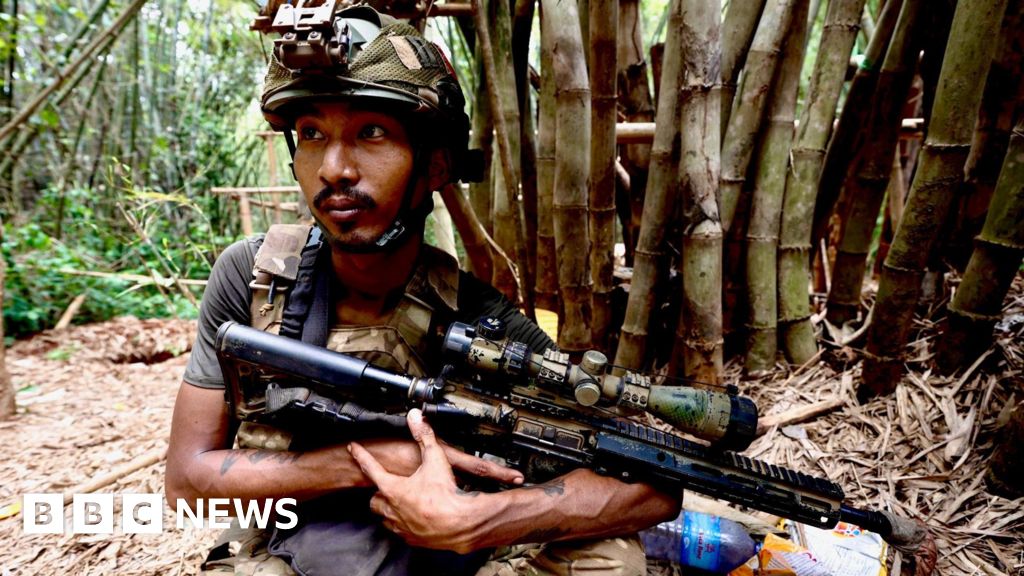
Four young men in a rebel camp hidden in jungle-covered mountains never wanted a part in Myanmar's civil war. They didn't choose to be soldiers for the military either. One had been a chef on his way home from work when he was grabbed off the street. His lack of ID was enough for the military to detain him and force him to sign up. Another was taken on his way back from a late-night karaoke session; a third had been working for the forestry department when he was arrested. The fourth man says on being arrested, drugs were slipped into his shoe, and he was framed and made to enlist. This was reported by Qazaqyia.kz citing BBC.
"Before we even understood what was happening, we were sent straight to the front lines," one of the men – all between the ages of 19 and 25 – tells the BBC. "They made us do all kinds of things we didn't want to do. We never got any real rest, not in the morning, not during the day, and not even at night." They spent four months in basic training and then were sent to the front in Karen state - one night, on their way to get washed, they decided to make a run for it. But after escaping they walked into a nearby rebel patrol of People's Defence Force (PDF) fighters, and were detained. They are happier here, they say, being treated "like brothers, not strangers." They'll stay with the PDF for now, but will be taken to the border with Thailand eventually, "because if we return now, the military could still track us."
The military's forced conscription policy has shifted the junta's fortunes in the civil war. In many parts of the country, the rebels are now on the back foot. More than two years ago, an alliance of ethnic and rebel groups made sweeping gains. Now the military still only fully controls less than half the country, but it has been making gains - including key townships and retaking a critical road from Mandalay to Myitkyina in the north. Thousands of soldiers are advancing in an attempt to re-establish control of several border areas including Kachin, Chin and Karen states.
PDF battalion commander Ko Kaung says it is men like the four deserters – those required to enlist after the military began enforcing a conscription law in 2024 - who have made the most difference. "Military forced conscription became the main challenging factor for us on the battlefield as it enabled the military with limitless manpower," he explains. "For us, despite having technology and intellectual advantages, our resources are very constrained. With limited funds, we cannot source required components as much as we want and cannot recruit new soldiers as easily as the military." Ko Kaung and his men took control of Hpapun, a town in Karen state, and a sprawling military base two years ago. But now he's braced for the worst – junta drones hover in the sky, and as many as 2,000 soldiers are advancing towards Hpapun.
Back in the mountain camp, PDF commander Da Wa agrees the conscripts are a problem. The former political activist – who spent four and a half years in a government prison – says that while many of the junta's forces aren't willing recruits, they are improving as fighters because they "are getting better at following orders." He takes me on patrol through winding jungle tracks, and we must seek cover when a junta drone is heard above us. Eventually we make it to a hilltop, where his fighters speak in hushed tones as there is a military sniper on the next hill. There too is a base the rebels captured back in April, but they were only able to hold it for a couple of days until overwhelming artillery and airstrikes forced them back. Da Wa says tactics have changed and that, since the junta signed a security pact with Russia, it has more air power too. "We see pairs of aircraft now, before it would be a single fixed wing." He says the junta now also has the edge "both in terms of technology and in terms of quantity" when it comes to drones – something Ko Kaung agrees with. "The [drone] danger is definitely increasing. It would be easier for us if we also had jammers..." Added to all this, there are the ceasefires that China has brokered with several rebel groups, while also throttling the supplies of weapons and ammunition to resistance forces.