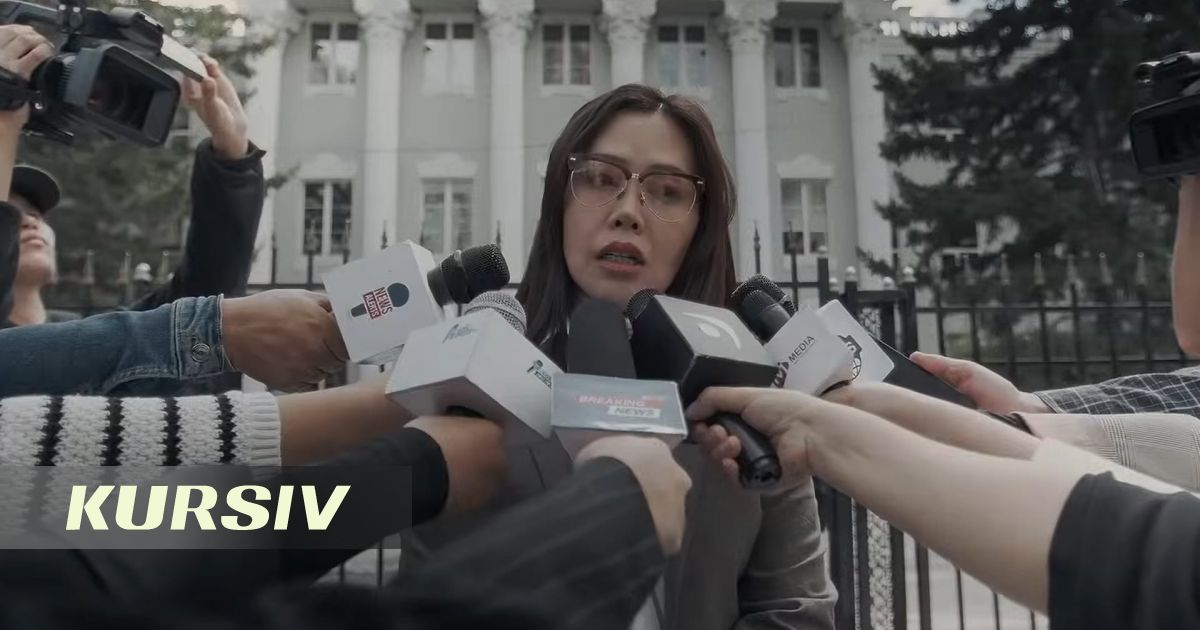
A rare guest has arrived in Kazakhstani cinemas – a Mongolian film. It was hard to miss such a chance to get acquainted with Mongolian cinema, especially since, as a viewing of 'The Lawyer. Enemy of Society' by director Garamkhand Bayanjargal showed, the two countries share similar problems: violence against children, lack of trust in the judicial system, and publicity through social networks as a way to achieve justice. This was reported by Qazaqyia.kz citing Kursiv Media.
Getting to know Mongolian cinema
Over the more than twenty years the author has been writing about cinema, 'The Lawyer. Қоғам жауы' (the film is dubbed into Kazakh and screens with Russian subtitles) is the first Mongolian picture he has seen. Although the countries are located close to each other, Ulaanbaatar itself looks very much like a Kazakhstani city – Soviet influence there was great, and its traces are still visible. That is why, looking at the poster and trailer, one might at first get the impression that this is a Kazakhstani film. Plus, its plot could well take place in Kazakhstan.
The plot
A successful lawyer, Tengis, having won another high-profile civil case, allows himself a small but foolish liberty, which is immediately spread on the internet. Tengis faces being barred from legal practice, but the director of his firm proposes a rather strange arrangement to the professional board. Tengis will be reprimanded and lightly fined if he takes on a criminal case: he will become the lawyer of a man accused of a high-profile brutal murder of a girl. One defense attorney, having barely taken on the work, has already refused, a new one cannot be found, and the head of the board agrees to such a trade-off. As assistants to Tengis, in addition to his usual assistant, they assign a veteran of the legal profession, Tsoodol. The relatives of the deceased believe the trial is being deliberately dragged out, and a family friend, Galt, helps create public resonance through social networks. Tengis begins to build a defense scheme, not suspecting what consequences this case will have for his personal life as well. After all, he also has a wife and a small daughter.
Contrived situations
From the very beginning, the development of the plot is built on a series of frankly contrived situations that later lead to inexplicable twists. The director of the law firm seems to know something and have something planned, but this deliberate mysteriousness of his ends in nothing. The accused behaves almost like a serial maniac, but for some reason hopes for a minimal prison term. Tsoodol snorts too theatrically on his chair and sips tea from a glass in a Soviet podstakannik, but we, of course, understand that it is he who will play the final key role (actually, no). The girl's family is sure that the alleged murderer is being covered up, although he is an ordinary taxi driver, not the son or relative of a rich man or a high-ranking official. Tengis seems to do everything right – in words, but as a result, what was planned turns into outright foolishness, such as instructing his inexperienced assistant to hand over monetary compensation to the relatives of the murdered girl.
The role of social media
At the same time, the first and larger part of the film is devoted to the influence of social networks and news on public opinion in general and on the subjective perception of the situation in particular. This is a most interesting aspect of modern society, where few are capable, and most importantly willing, to do fact-checking and try to understand what actually happened and is happening. As a result, the internet and social networks turn into a serious tool for manipulation.
Tengis, although he is only doing his job, becomes the object of real harassment. And not only him, but also his family. The flip side of cancel culture is shown here in all its 'splendor,' although again it does not avoid completely contrived situations, such as Tengis refusing to go to the police even when his family is openly attacked – not verbally, but physically, and more than once.
Imbalance of screen time
And the main thing – this part is given far too much screen time. We have already understood that society can succumb to emotions, ignoring facts, can be blind and ruthless, and fall for fakes – thank you, let's move on somewhere, repeating for the third round is unnecessary. Moreover, we still have the actual courtroom drama ahead – with a prosecutor, witnesses, debates, judges, and so on. Alas, it got very little time, as did the investigation conducted by Tengis and his small team. From a detective standpoint, the picture also does not hold up to criticism: it is almost immediately clear who the murderer is, but even despite this, the topic remains, by and large, unresolved – although here it seems the authors made a bid for a sequel.
The acting
However, the film has a backbone that holds the entire picture together. This is Ariunbyamba Sükhbaatar – the performer of the role of Tengis. The author is not a specialist in Mongolian cinema, but they say he is a very famous actor there. A wonderful fit for the image of a slightly star-struck but still great professional lawyer who, at the decisive moment, despite everything, finds the strength not to let the case slide but to see it through to the end.
An interesting visual image that complements Tengis's image unexpectedly becomes… a necktie. First as a symbol of belonging to an above-average society, then as a tool of help, and closer to the finale – as a symbol of liberation and an attempt to be 'closer to the people.'