The Italian Grand Prix takes place this weekend at Monza, arguably the most historic venue on the calendar. This was reported by Qazaqyia.kz citing BBC News.
Monza has hosted Formula 1 races more times than any other circuit, staging grands prix in all but one year since the inaugural season in 1950. The only time Monza was absent was 1980, when it was being renovated.
Located in a royal park and surrounded by woodland, it is known as the 'cathedral of speed'. It is the spiritual home of Ferrari and the devoted tifosi who adore the Italian team.
It is all but impossible to imagine F1 without Monza - it was where the first world championship was decided 76 years ago and where, last year, Red Bull's Max Verstappen set the fastest lap in F1 history during qualifying.
Throughout the years, Monza has been the scene of thrilling finishes, Ferrari glory, title wins, controversy and tragedy. Its story is F1's story.
Historic moments
The 1950 Italian Grand Prix was the final race of Formula 1's first season. The race and inaugural drivers' title was won by Italian Giuseppe Farina, in an Alfa Romeo. Farina is the only driver to win the title in his home country.
Ferrari's Giuseppe Farina, Maserati's Juan Manuel Fangio and Ferrari's Alberto Ascari lined up before the start of the 1953 race. These three men shared the first eight Formula 1 world championships. Fangio won this race but Ascari took the title that year.
Juan Manuel Fangio is followed by Stirling Moss and Peter Collins on the steep banking during the 1956 Italian Grand Prix. The banking was used up until the 1961 race and remains in place at Monza. Maserati's Moss won the race. Ferrari pair Fangio and Collins shared second place, after the Briton handed over his car to his Argentine team-mate. The points ensured Fangio won the fourth of his five world titles.
Italian Maria Teresa de Filippis, the first woman to compete in F1, drove for Maserati at her home race in 1958.
Ferrari's Wolfgang von Trips was on the verge of winning the world championship when he collided with Jim Clark's Lotus on the second lap of the 1961 race. His car flew into a crowd of people on an embankment, killing him and 14 others. The German is pictured before that fateful race.
Spectators inside a grandstand watched the action through the Lesmos corners in 1962.
Scotsman Jim Clark was presented with a garland after winning the 1963 grand prix to secure his first of two drivers' championships for Lotus.
Lotus' Graham Hill adjusted his race helmet and visor in the pits before the 1967 race. Gathered around the Englishman was his family, including wife Bette and his children. The 1996 world champion Damon Hill, six years old when this picture was taken, stood at the front.
Speed and tragedy
Before chicanes were installed, Monza's layout ensured races were a battle of slipstreaming with regular changes of position. In 1969, Matra's Jackie Stewart crossed the line to win just ahead of Jochen Rindt's Lotus, Matra's Jean-Pierre Beltoise and Bruce McLaren, representing his own team. The top four were separated by less than two tenths of a second.
Nina Rindt sat in the pits, timekeeping for her husband Jochen during a practice session in 1970. Shortly after this picture was taken, the Austrian driver was killed on the approach to the Parabolica corner, almost certainly because of a suspension failure on his Lotus. A few weeks later, Rindt became F1's only posthumous world champion.
Another thrilling finish saw BRM's Peter Gethin cross the line to win in 1971, just ahead of March's Ronnie Peterson, Tyrrell's Francois Cevert, Mike Hailwood in a Surtees and BRM's Howden Ganley. There was just six tenths of a second between the top five.
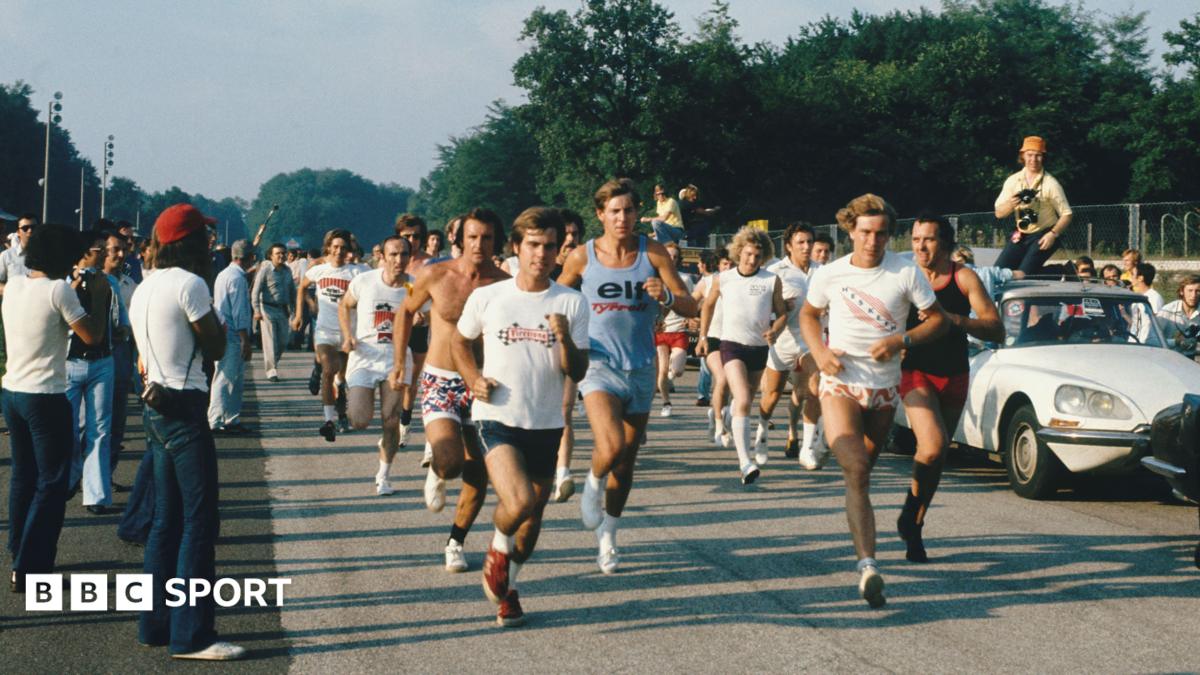
Drivers and team members set off on a race around the circuit in 1973, organised by team owner Frank Williams. At the front of the pack was James Hunt but it would be Williams - who could be seen behind the bare-chested runner - who won and took the £750 prize.
Niki Lauda showed the scars of his near-fatal accident at the 1976 German Grand Prix at the Nurburgring. The Austrian Ferrari driver returned to action just six weeks later at Monza, in significant pain, to continue his title battle with McLaren's James Hunt. Lauda finished fourth in Italy to extend his lead over the British driver but Hunt ultimately prevailed by a single point at the end of the season.
Behind the leaders, there was a multi-car accident at the start of the 1978 Italian Grand Prix. The Lotus driver Ronnie Peterson was trapped in his wrecked Lotus with serious leg injuries and had to be freed by other drivers, but his injuries did not appear life-threatening. After significant delays in getting him treated, the Swede died from an embolism the following morning. His team-mate Mario Andretti won the world title on the day of Peterson's accident and after his death remarked: "Unfortunately, motor racing is also this."
The Italian Grand Prix was the only race not won by McLaren in 1988. It would have been a clean sweep if Jean-Louis Schlesser, deputising for Nigel Mansell at Williams, had not punted off Ayrton Senna as the Brazilian attempted to lap him with two laps to go. Senna's misfortune meant Ferrari finished one-two, with Gerhard Berger leading home team-mate Michele Alboreto in front of a thrilled home crowd.