The UK's security service MI5 has published its annual threat update. It notes that the terror threat has become more diverse, with far-right anti-migrant threats on the rise, while Iran has now firmly emerged alongside Russia as a country seeking to undertake violent and deadly plots in the UK. This was reported by Qazaqyia.kz citing The Guardian.
"There is no law of physics dictating that rising state threats will be accompanied by diminishing terrorist threats," MI5's director general, Ken McCallum, said. One of his core messages was that people and the country at large needed to focus on being more resilient. "In this new world, we should expect to be tested," he added.
A key issue highlighted by McCallum was that years of anti-migrant, anti-Muslim hostility had now led to an increase in cases where people were "tipping into terrorist intent" – that is crossing the line from rhetoric to violence. It is a complex area, but one certainly fuelled by political hate narratives and online subcultures.
It is also fuelled by toxic rhetoric from abroad. Authoritarian regimes, McCallum said, were investing heavily "in trying to distort and divide our society" – although he was too polite to mention that there is plenty of evidence that voices from the US led by X owner Elon Musk are keen to sow division in the UK too, as they post about flashpoint events such as the June rioting in Belfast and Southampton.
A second trend is that seemingly far-off conflicts, such as the wars the UK did not start in Ukraine or Iran, have a habit of rippling back home. It is less than eight months since the US and Israel attacked Iran, subsequently with a little help from Britain, but already Iran is trying to direct terror plots in the UK.
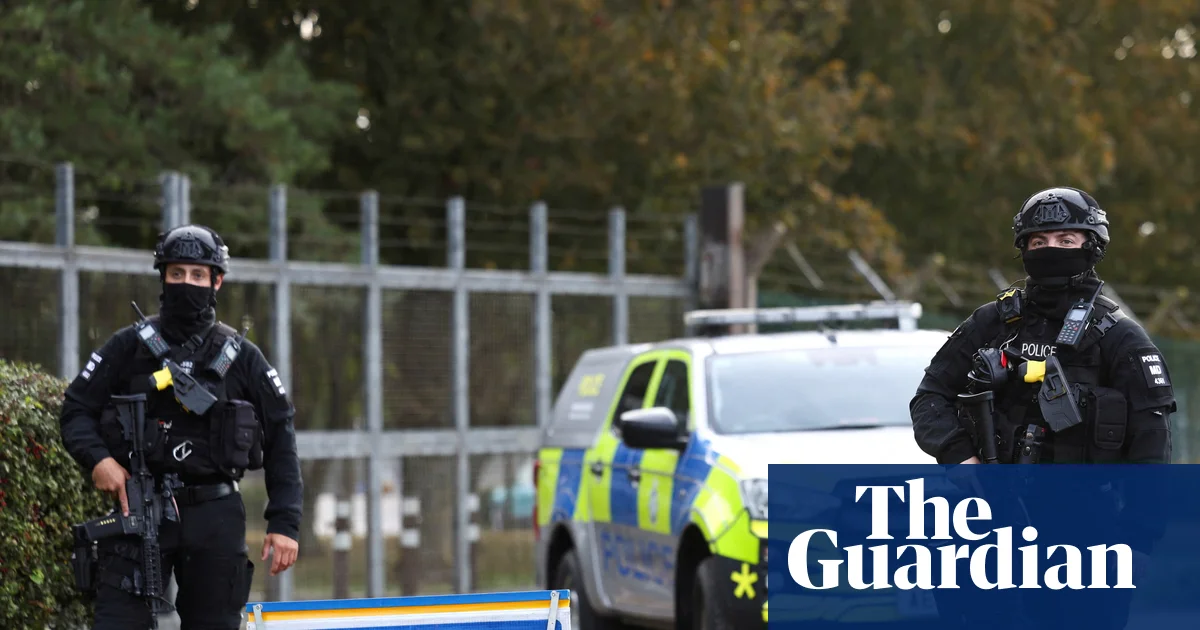
Both MI5 and the counter-terror police may have to do a little better to explain precisely what five men from London were doing in a village next to RAF Fairford in three white vans shortly after midnight on 27 September, given that nothing of significance was found in the vans and nobody has been charged.
But McCallum warned that Iran had "ambitions to come at harder targets, like military sites" – a likely reference to Fairford. That came a day after the British prime minister, Andy Burnham, said Iran's Revolutionary Guard Corps (IRGC) was "almost certainly" behind the episode. It would be surprising if both were wrong.
That is not the only possible example. At the beginning of October, two Iranians from Liverpool and Salford, were charged, accused of trying to make a chlorine powder bomb to target Jewish sites in Manchester. Prosecutors alleged they were directed by a third party, believed to be in Iran. The two have not yet pleaded to the charges; a trial at the Old Bailey is scheduled.
Yet, if these fast emerging threats were not enough, the normally sober McCallum decided to reference AI. He warned that AI could refine terror plots, supercharge hackers, produce individually targeted propaganda – and even help develop a novel bioweapon. This he added, with emphasis, was a subject on which they were "particularly focused," as if it was episode one of a TV thriller.
While concerns were recently raised about scientists who have used AI to design viruses as Anthropic warned of five examples of scientists who had used Claude for researching novel pathogens, both instances provoked a scientific debate as to what is actually possible. And what McCallum did not mention was that AI is also an extraordinary and potentially intrusive tool for MI5 to seek out threat.
There is already enough for the intelligence agencies to think about, as the MI5 review makes clear: a country made more dangerous by blowback from strongmen starting what they think will be short wars; a rising tide of hatred that may start online but is morphing into violent intent in real life; a complex cocktail of external and internal threats that could have real-life consequences.
As McCallum himself recognised: "The protection of democracy – its institutions, its representatives, its principles – has never felt more vital."