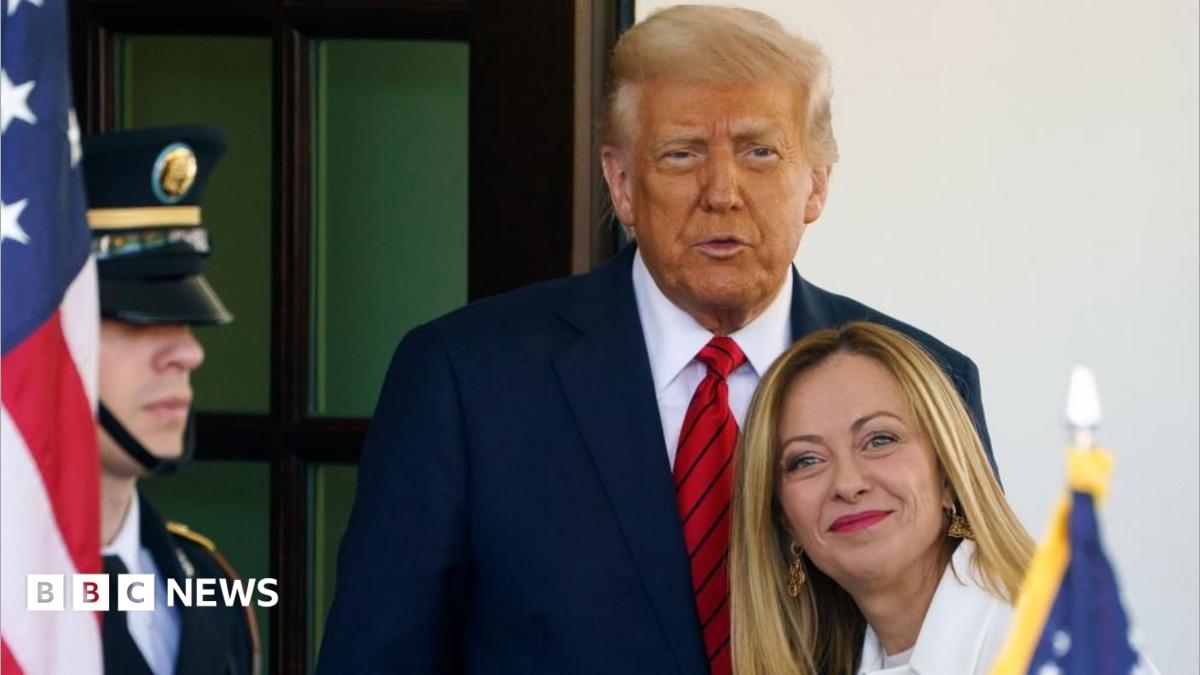
There is an AI-generated meme doing the rounds on social media in Italy that shows Giorgia Meloni doing all the things you might expect from someone fresh out of a tough break-up. In one fake photo she has a new haircut; in others she is imagined booking herself on a singles' holiday, training for a marathon and creating a profile on a dating app. Of course none of the images are real, but the joke has landed because it captures the very public political fall-out between the Italian prime minister and US President Donald Trump. This was reported by Qazaqyia.kz citing BBC News.
Their relationship has over the past few months gone from public attacks to personal insults and back again, cooling what used to be one of the most watched alliances in European politics. It was not that long ago that Meloni was being called the "Trump whisperer", and she was the only European leader with a front-row seat at his January 2025 inauguration. Last April, she was also the EU leader of choice to head to the White House for a meeting aimed at easing tensions over US tariffs on European goods.
For someone who started out on the fringes of Italian politics, with her roots in Italy's post-fascist tradition, and who has spent years trying to rebrand herself as a moderate, credible face of the European right, that closeness to Trump was never just seen by observers as a useful diplomatic tie. It was proof, on the biggest stage available, that she belonged there. But Trump's unpredictability has proved difficult for Meloni to handle, denting her credibility both nationally and internationally.
The first real fracture came in late March, when Italy's defence ministry refused to let US military aircraft bound for the Middle East use the Nato airbase at Sigonella in Sicily without parliamentary approval, a decision rooted in Italy's constitution and the public's deep opposition to the war. Trump attacked Pope Leo XIV on Truth Social in April over the pontiff's criticism of the war, calling him "weak on crime". Meloni, governing a deeply Catholic country, called the attack "unacceptable". Trump did not take it well. "I'm shocked at her," he told Italian daily Corriere della Sera. "I thought she had courage, but I was wrong." He added: "She is unacceptable... she is not the same person, Italy is not the same country."
By June things seemed to be getting better. At the G7 summit in Évian-les-Bains in France, Trump and Meloni were photographed deep in conversation on a sofa, and Italian officials spoke of a "clarifying discussion". Meloni told reporters the atmosphere had been "very positive," with "no friction". Journalists barely had time to file the story before it fell apart again. Days later, Trump told Italian broadcaster La7 that Meloni had "begged" him for a photo at the summit, in a phone interview dubbed in Italian and never aired in English. "She wanted a picture with me so badly," Trump's Italian voiceover said. "I wouldn't have taken it, but I felt sorry for her."
Meloni did not wait long to respond. She posted a video, delivered in Italian, calling Trump's account "completely fabricated." "I don't know why the president of the United States behaves this way toward his own allies," she said. "I can only say it's a pity he doesn't show the same resolve toward the enemies of the West... But there's one thing he must remember: neither I nor Italy ever beg." Italy's foreign minister, Antonio Tajani, cancelled a planned trip to Washington. Reaction in Italy was swift and across the political spectrum. Italian President Sergio Mattarella phoned her to express solidarity. Meloni's government colleagues and MPs called the remarks offensive, damaging to Italy's dignity and deserving of an apology, while opposition members condemned the comments as an unacceptable affront to the country as a whole. Trump doubled down from Camp David, insisting on Truth Social that she had asked "over and over" for the photo and accusing her of trying to be "friends again" now that the US had "defeated Iran militarily".