Mexico's largest and most prestigious university has announced that about 58,000 students will have to resit their entrance exam after abnormally high test results raised suspicions of widespread cheating. This was reported by Qazaqyia.kz citing The Guardian.
The National Autonomous University of Mexico (UNAM) said the exam would take place in person after its first attempt at a fully remote online version led to a debacle and thousands of annulled results.
“The UNAM, the home of science, humanities and understanding, knows how to recognize mistakes and self-correct,” the university’s rector, Leonardo Lomelí, said on Monday. “There is no evasion or complacency. There is responsibility and we act accordingly.”
Nearly 160,000 students took the entrance exam earlier this summer. The at-home test included an AI-powered webcam to monitor candidates with voice and facial recognition to ensure no cheating took place. But the results indicated that the checks had failed to stop fraud.
Between 2021 and 2025 only 3.5% of applicants obtained a score of 100 or more out of 120, but this year the figure was 16%. The proportion of students who achieved a score of 110 or more increased sixfold from 0.9% to 5.5%.
Almost 30% of candidates for the medicine programme, among the most competitive undergraduate tracks in the region, obtained a score of 100 or more, compared with 9% last year.
The results sparked a national scandal, leading the country’s president, Claudia Sheinbaum, to suggest the country’s attorney general may have to investigate. “Support is always available, but in any case if a crime has been committed it is a matter for the prosecutor’s office,” she said.
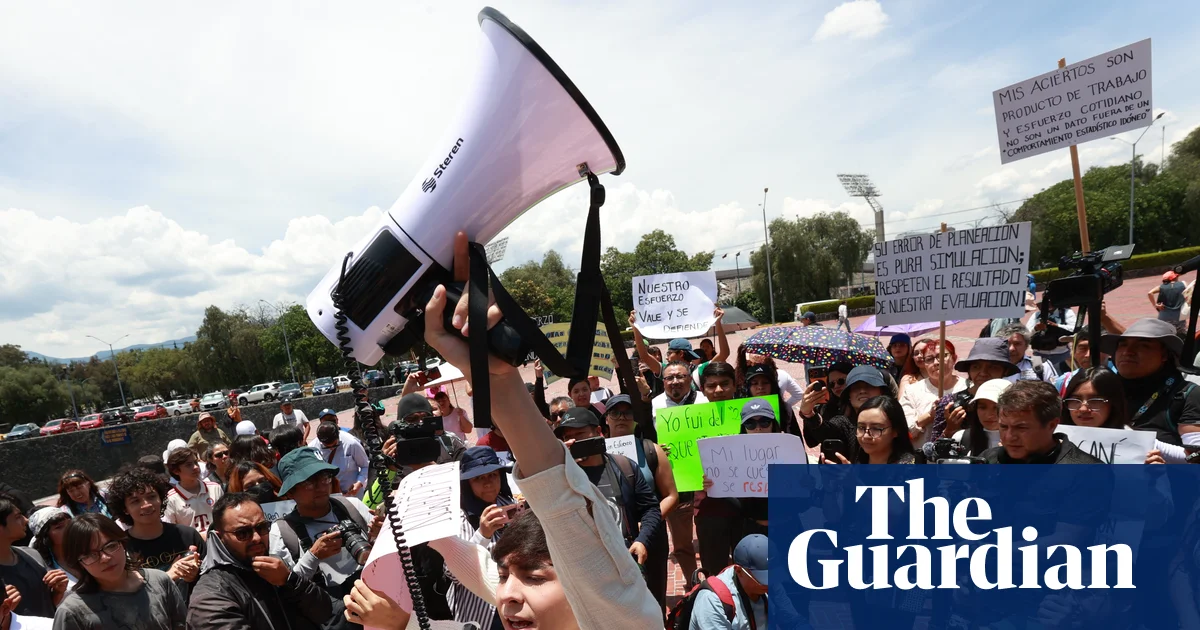
Hundreds of UNAM applicants protested in Mexico City on Monday against having to take the control exam, blocking major thoroughfares in the south of the capital.
Lomelí said: “I offer an apology to the candidates who, having been fairly accepted, will be called upon to take the control exam. However, it is necessary to ensure certainty and guarantee equity in access.”
The drive for more equitable access led the university to offer the exam online for the first time this year. Students previously had to travel to Mexico City from their home states, sometimes many hundreds of miles away.
The entrance exam is notoriously competitive. The more than 150,000 applicants this year were competing for 21,962 places.
Just before the results were to be publicly released, the university announced it had annulled the results of 2% of tests – 3,174 exams – after detecting irregularities such as identity impersonation, external assistance and the use of AI.
A technical expert who reviewed the results told the New York Times (NYT) that nearly half of the exams – 75,000 tests – could have involved some degree of cheating. AI may have played a role, but test questions were also leaked and even sold online while the exam was open in May and June.
Cheating tips were also widely passed around before the test went live, according to the NYT.
The UNAM announced in July that it had filed a criminal complaint after detecting the alleged irregularities. It said authorities would investigate potential misconduct involving individuals or companies that allegedly offered fraudulent services to applicants and their families.
The cheating scandal compelled the institution to halt all admissions and appoint a technical committee to decide the fate of the 158,712 young people who took the exam, an unprecedented measure in the university’s 115-year modern history.
Lomelí also announced that the academic year for new students would begin on 31 August, rather than 10 August as originally scheduled.