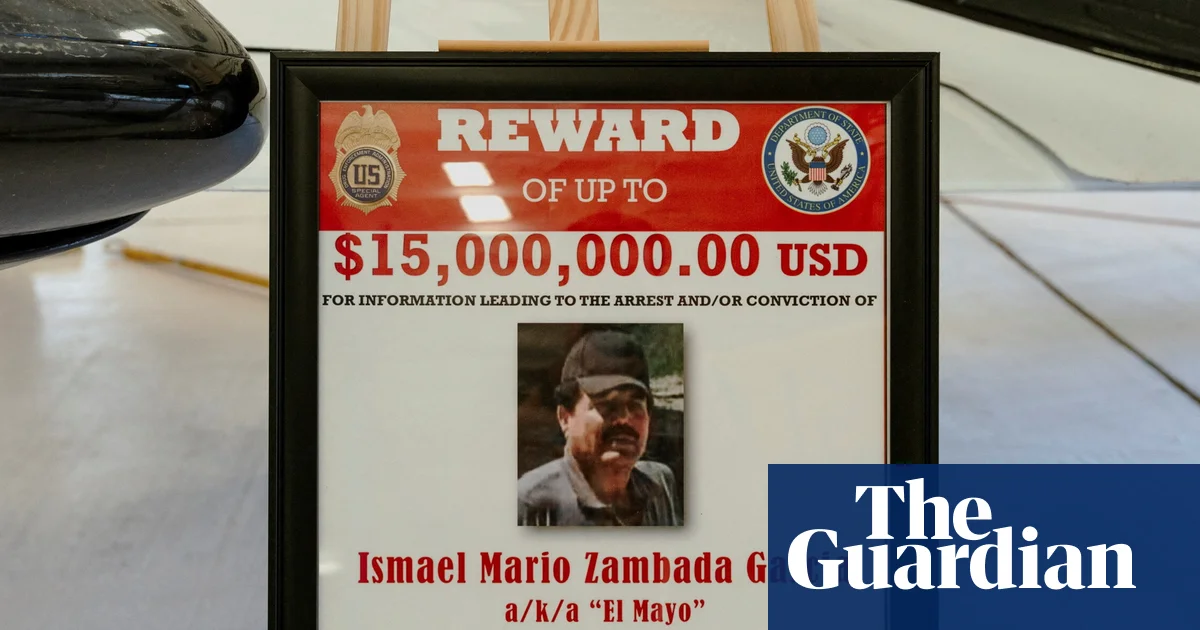
Mexican drug kingpin Ismael Zambada García, known as "El Mayo," was sentenced in a US federal court on Monday to life in prison, after a plea deal last year in which he admitted to shipping vast amounts of cocaine and other substances as leader of the violent Sinaloa cartel. This was reported by Qazaqyia.kz citing The Guardian.
Zambada is 76 and one of the most high-profile Mexican drug traffickers to be sentenced in a US court since his fellow Sinaloa leader Joaquín "El Chapo" Guzmán was sentenced to life in prison in 2019. The case unfolded in federal court in Brooklyn, New York.
Zambada helped co-found and lead the cartel, becoming one of the most wanted targets by US intelligence and law enforcement agencies for decades.
He signed a plea deal last August, admitting charges including racketeering conspiracy and continuing criminal enterprise, after the US justice department said it would not seek the death penalty. The court also ordered him to forfeit $15bn from drug trade profits as part of his punishment.
Prosecutors also accused him of being one of the leaders of a violent organization that led to corruption among Mexican politicians, military officials and law enforcement agents.
Before his sentencing, Zambada read a public letter, saying that he took responsibility for his crimes and calling for an end to the violence that has plagued Mexico for decades. "I did not go to trial because I did not want to deny the truth," Zambada read aloud in court, adding that "violence must end" and urging the next generation of drug traffickers to "choose a different path."
El Mayo's arrest in the US in 2024 came as a surprise. He was kidnapped by one of El Chapo's sons, Joaquín Guzmán López, and flown across the US border to New Mexico, where he was arrested by US federal agents. Guzmán López pled guilty in an abduction case late last year and has become a cooperating witness for the US justice department.
El Mayo's sentencing comes at a tense time in US-Mexico relations, as the Trump administration has escalated its pressure on the Mexican government to crack down harder on criminal groups. Last year, the Trump administration designated the Sinaloa cartel as a terrorist group and has threatened US military intervention.
US district judge Brian Cogan, who also presided over El Chapo's trial, acknowledged that the sentencing hearing was "anticlimactic" because of the plea agreement. All parties involved understood that Zambada would spend the rest of his life in prison, the judge said.
Frank Perez, a lawyer for El Mayo, had said in a 6 July court filing that his client was fully aware he would receive a life sentence. Perez asked Cogan to recommend to the US Bureau of Prisons that his client be placed in a facility where he would receive adequate medical care.
Prosecutors with the Brooklyn US attorney's office said the prisons suggested by Perez may not be equipped to handle the security concerns posed by Zambada. "Those security concerns will continue for the foreseeable future because individuals loyal to the defendant continue to control the cartel," the prosecutors wrote in a 13 July filing.
Zambada's defense attorneys on Monday requested that the judge recommend a federal medical facility, rather than a traditional prison, due to his medical conditions. Health details are redacted in court records, but the judge mentioned during the sentencing hearing that Zambada is "drifting" towards being "cognitively impaired." Mexican outlets have reported Zambada is dealing with the early stages of dementia.
El Chapo is serving his life sentence at a maximum-security prison in Colorado.