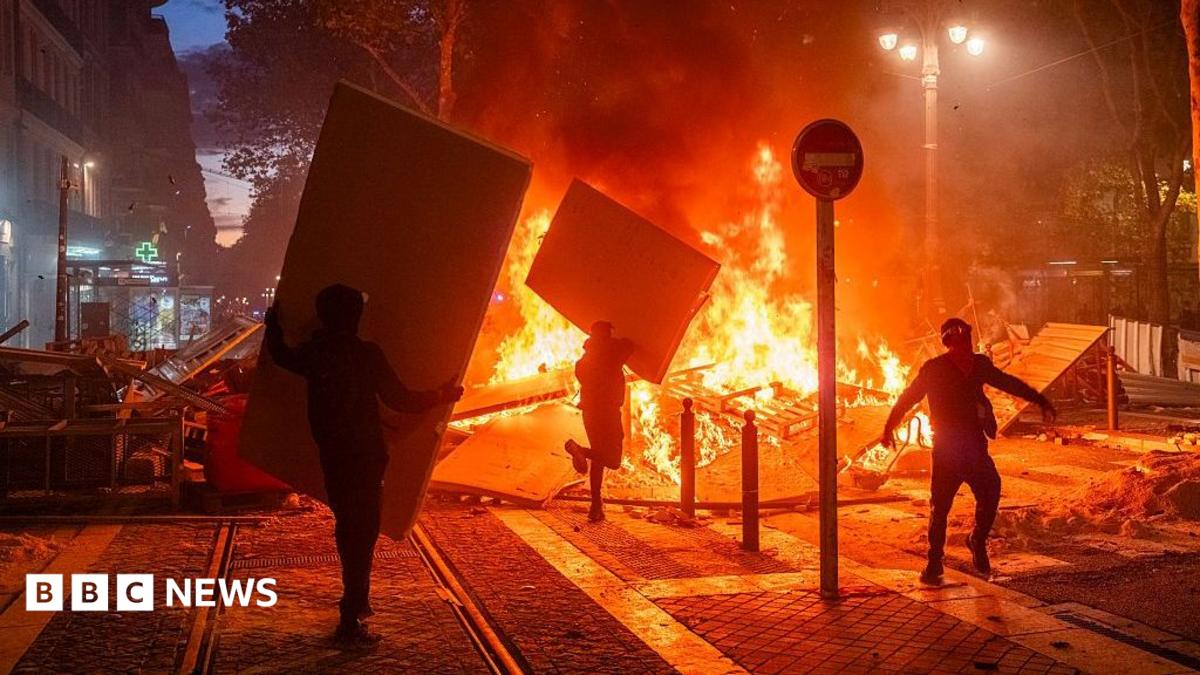
Marseille is bracing for further unrest after protests gave way to what police described as 'apocalyptic' disorder, with more than 500 businesses damaged and 118 officers injured. This was reported by Qazaqyia.kz citing BBC News.
Local business leaders say more than 500 premises were damaged, and the majority looted. A police union boss told the BBC that the weekend had been an "apocalyptic" hell for his colleagues. 118 officers were injured, representing more than a tenth of the national figure.
So far, 101 arrests have been made in the port city, a quarter of them children.
But by Monday, it was police who were most conspicuous on the city's streets, not protesters. For eight hours, demonstrations and gatherings were banned in an effort to avoid a third consecutive day of disorder.
It seemed to work; the largest central gathering we witnessed was a posse of weather-beaten tourists trudging around the quayside.
Nonetheless, an overnight curfew for minors is expected to be announced for some parts of the city from Tuesday.
Marseille is one of France's most ethnically diverse cities – a place where generations of new arrivals have landed.
18-year-old student Maryame only arrived in the southern city a few weeks ago, albeit from the countryside not too far away.
"It was very scary because it's my first time in a big city, and also my first time demonstrating," she said.
Maryame said violence engulfed the student demonstration her friends had joined as looters began attacking shops.
She said the solidarity of the earlier march was "beautiful" and the subsequent disorder "terrifying", but went on to say that she was conflicted as to whether even more violence would make the government sit up and listen.
"It is a very complicated question if violence is legitimate," she began.
"But the thing is, France, our history is really based on revolution, and sometimes we really have to make a really big impact.
For the police, the extent to which order disintegrated was a shock, according to one organisation representing rank and file officers.
"It was a war," said Arnaud Blaise from the UN1TE police union. "An unheard-of level of violence. Unprecedented."
Looting was reported across the city centre, including along La Canebière - Marseille's equivalent of Paris's Champs-Élysées - Rue Paradis, and at the Centre Bourse shopping centre. Businesses were also hit further afield, such as in the Grand Littoral and Le Merlan shopping malls to the north.
Blaise said he was concerned that future protests could follow the same destructive pattern as Saturday, with young people from the deprived northern suburbs seizing the opportunity to steal amid chaos that, in his view, was stirred up by far-left agitators - referred to in France as the Black Bloc.
"The Black Blocs provoked, and the youngsters took advantage to start looting," Blaise said. "That created chaos, with police officers running right, running left, and in effect, we got overwhelmed."
I put it to Blaise that the police had been accused of heavy-handedness with peaceful students but sitting back as the most violent protesters pillaged local businesses.
"That is not the case at all," he replied, arguing that more police than students had been injured.
"Four thousand tear gas grenades were fired and then we ran out of ammunition. So at a certain point, you have no choice but to retreat."