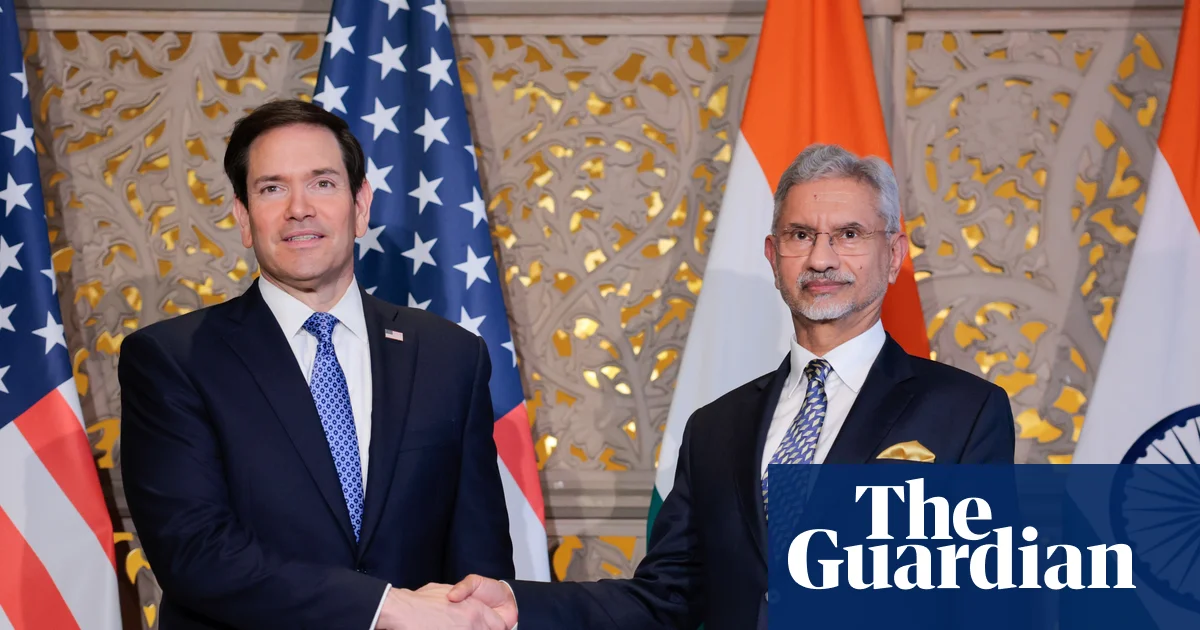
When US Secretary of State Marco Rubio visited India for the second time this year, headlines concentrated on who he met and where he went. The fact that Rubio bypassed New Delhi and did not meet the prime minister, Narendra Modi, during his trip last week, and instead traveled to the financial capital, Mumbai, where he met India's foreign minister, Subrahmanyam Jaishankar, and business leaders, did not go unnoticed. Nor did his decision to travel to Jamnagar, the small Gujarati town that is home to Reliance Industries' colossal oil refinery complex. This was reported by Qazaqyia.kz citing The Guardian.
Bilateral ties between the two countries have come under strain under the second Trump administration, particularly over tariffs and India's purchase of Russian oil. Yet, Rubio's return to India just five months after his first visit as secretary of state signals that the country remains useful for president Donald Trump's ambitions after all.
As director of the South Asia Program at the Carnegie Endowment for International Peace, Milan Vaishnav has spent a decade tracking India's place in the world, particularly its ties with the US. Vaishnav has described Trump 2.0 as "unbound" marking a new era in India-US relations.
Tracking foreign affairs, he told me, is a minefield right now. From the White House's transactional approach to global alliances, ongoing conflicts in the Middle East and consequential elections around the world, politics is changing at a pace that means all predictions are off the table. "I think anyone who tells you they know exactly what is going on and how it fits into their neat theory of the world is lying to you," says Vaishnav.
I asked him about the many confusing aspects of the US-India relationship, from the hostile political rhetoric to the US embrace of Pakistan, as well as Rubio's latest visit.
Trump the deal-maker
Ahead of Rubio's visit, several commentators noted the secretary of state's "unusual" itinerary. Vaishnav thought the pre-visit chatter about Rubio skipping Delhi to visit Mumbai and Jamnagar was overblown. "Not every bilateral meeting has to take place in a national capital," he says.
But that doesn't mean it wasn't noteworthy. "I do think the choice of venues was intentional. This administration and, particularly, this president, sees foreign policy through the lens of 'deal-making'. And if you're trying to drum up business deals, what better place to visit than Mumbai?" he says.
The Jamnagar visit, where Rubio met Mukesh Ambani, the chair of Reliance, also indicates some politicking. "At a time when petrol prices are extremely high in the United States and are likely to be a major issue in the 3 November midterm elections, the administration wants to show that it is doing everything it can to bring them down. India is a major consumer of oil, but it is also a major exporter of refined petroleum products," says Vaishnav. "One of Rubio's objectives was to encourage Reliance and, by extension, India to process more Venezuelan crude [oil]," he added.
While this could present an opportunity for India to advance relations, it's not a given: the US president remains, after all – and to put it lightly – mercurial.
"The biggest plot twist for me has been the Trump administration's embrace of Pakistan after the May 2025 conflict with India," says Vaishnav. Pakistan's standing in Washington had eroded over the years, especially under Joe Biden, who left office without ever having made a presidential phone call to his counterpart in Pakistan. "Many officials in Congress had grown exhausted with Pakistan's double game, speaking the language of partnership on the one hand while undermining US interests on the other," says Vaishnav.
But, after coming to power the second time, Trump thanked the country for its help in nabbing a suspect linked to a 2021 bombing in Afghanistan that killed 13 US service members. This reversal in Pakistan's fortunes gathered pace after the May conflict with India, which Trump took credit for ending. In June, he welcomed Asim Munir, Pakistan's army chief, to the White House, after Munir called for the president to be nominated for the Nobel peace prize.
"I chalk up the reversal to a few factors: Trump's well-known strongman envy, Pakistan's savvy diplomacy, and the prospect of energy and crypto deals involving members of Trump's inner circle," says Vaishnav. For him, it is yet another demonstration of how much weight Trump places on deals, transactions and short-term wins. "For New Delhi, this means Modi's personal rapport with Trump and 25 years of investment in the bilateral relationship offer no guarantee against a 180-degree reversal in US policy," he adds.
In a recent piece, Vaishnav's colleague Sameer Lalwani pointed out that the US relationship with India remains important.