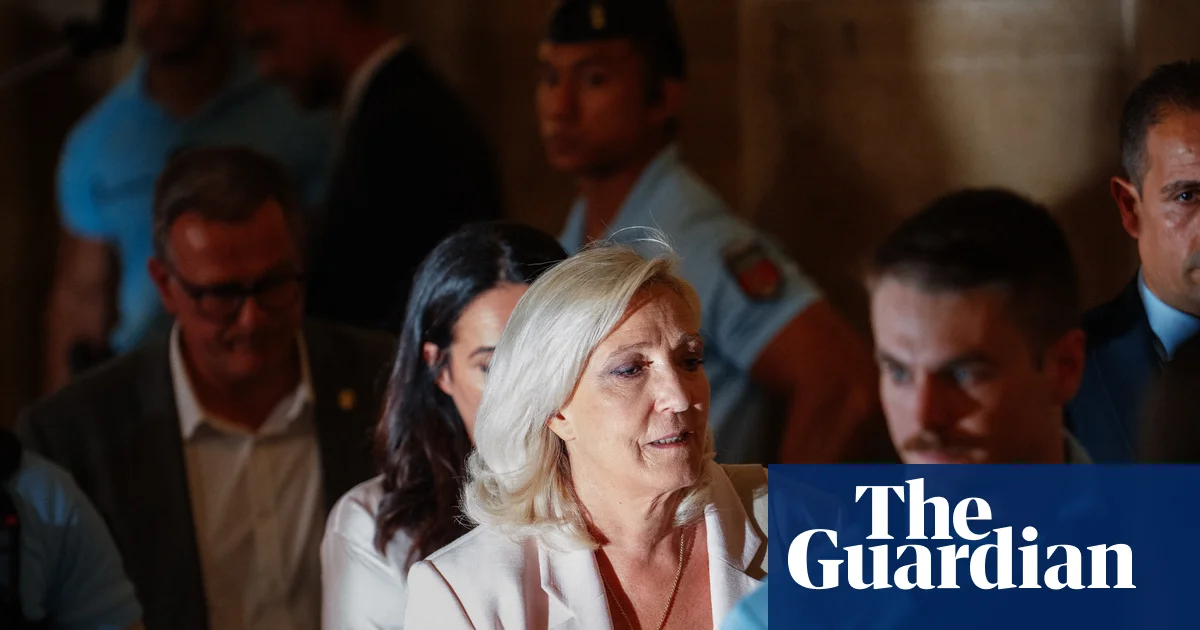
Marine Le Pen has announced she will run for the French presidency in 2027. This was reported by Qazaqyia.kz citing The Guardian.
Written off by many after her conviction last year for embezzling public funds, Marine Le Pen insisted yesterday there was "no scenario in which I will not be a candidate" for the French presidency in next year's elections. Hours earlier, a Paris appeals court had confirmed she was guilty of overseeing a scheme that misused more than €4m of EU money. But the court cleared a way for Le Pen to mount her fourth tilt at France's highest office.
Her decision, which involves taking her case to the country's highest court, is fraught with risk and raises as many questions as it resolves – the chief of which is how voters will react to a candidate convicted of a serious white-collar felony. But all that is for later. Right now, Le Pen's move launches France's 2027 presidential election in earnest, with the far-right leader, 57, running on what she called a "dream ticket", with her protege (and potential future prime minister), 30-year-old Jordan Bardella.
Many had written Le Pen off after her lower court conviction in March 2025. Along with 23 others, she stood accused of running a system that used €4.4m of money meant for European parliamentary assistants to pay staff of her National Rally (RN) party in France. The court found she played a "central role" in the scheme and sentenced her to a five-year ban from public office, plus a four-year prison term with two suspended – scuppering any run for France's top job in next spring's election.
The appeals court upheld the guilty verdict. But crucially, it reduced the length of both her ban on holding public office and the part-suspended jail term. It handed Le Pen a 45-month ban from office, of which 30 months were suspended. Since that ban began straight after the lower court decision, Le Pen has already served it. However, it also ruled that she must serve three years in jail – two of them suspended, with the third under house arrest with an electronic ankle tag.
Le Pen had repeatedly said she would not run if tagged, which would require a magistrate to approve when – and for where – she could leave home, saying it would be impossible to campaign with her movements curtailed. After far-right outrage at the original verdict, which nationalists led by the RN portrayed as a "political decision" and "denial of democracy", the court said it had taken into account "voters' freedom of choice", a "prerequisite" of democracy.
The verdict was, indeed, finely balanced: on the one hand, it allowed Le Pen to run by removing the eligibility bar. On the other, it made it difficult for her to do so, politically and logistically. In effect, it left the decision to the far-right leader. She did not hesitate for long, announcing after a three-hour meeting with colleagues and lawyers, to appeal against the conviction at France's highest court. "This evening, I am a candidate in the presidential election," she announced last night on French television. "The appeal to the Court of Cassation suspends the effects of the judgment, so I will campaign without an electronic ankle bracelet."
She's right about that: her appeal absolves her of the requirement to wear a tag. But her move remains a roll of the dice. Her path to the first round of the presidential election, scheduled for 18 April, is strewn with obstacles. First, she has to hope France's highest court either overturns the current verdict, which legal experts consider unlikely, or that if it does not, she will be able to mount enough of a legal challenge to delay electronic monitoring. The Court of Cassation said on Wednesday it could deliver a judgment "by April 2027 at the latest". Whenever its ruling comes, if it upholds the earlier decisions, Le Pen could – in theory, at least – be obliged to start wearing a tag within days.
The extent to which the terms of the monitoring – which are decided by a different judge – are negotiable is unclear. Le Pen would doubtless argue that she has been campaigning for months; that the election is imminent; that democracy is at stake; that civil unrest could follow if her campaigning became restricted. If, on the other hand, she can emerge victorious in the final runoff on 2 May, Le Pen would in principle be covered by presidential immunity. But besides the risks of a campaign (and a candidacy) that may depend on court decisions, Le Pen has also handed her opponents a powerful attack line: she has previously said on national television that politicians found guilty of embezzlement should be banned for life. Quite how all this will play out is anyone's guess.