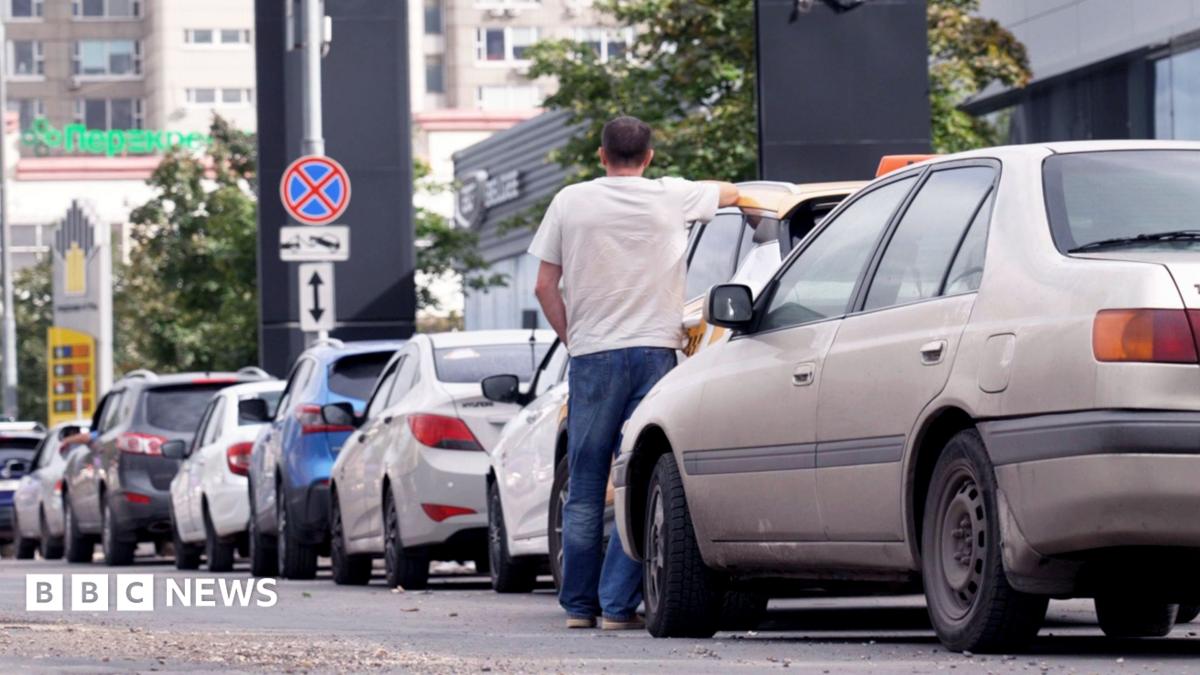
At a petrol station in south-east Moscow, Svyatoslav has been queuing in his car for two hours. The sign board ahead has just changed to show there's no fuel. "They say there will be petrol here," Svyatoslav tells me optimistically. "They just don't know when. Maybe today, maybe tomorrow." He says he hasn't got enough fuel in the tank to drive off and look elsewhere. This was reported by Qazaqyia.kz citing BBC News.
This was reported by Qazaqyia.kz citing BBC News.
This week, across Moscow and other parts of Russia, there have been long queues for petrol. Russian officials explain this as "unscheduled repairs at oil refineries." These repairs have been triggered by Ukrainian drone strikes on Russian oil facilities. Such long-range attacks sparked major fuel shortages earlier this summer. The targeting of oil refineries has continued apace.
This time, queues in Moscow are even longer than before. The authorities appear to be struggling to resolve problems with refining capacity and logistics. "The second wave of the fuel crisis is building," declared broadsheet Nezavisimaya Gazeta this week.
Driving around Moscow this week, two things catch the eye: patriotic announcements on giant billboards about Russian Flag Day... and giant petrol queues. Outside one Moscow petrol station, I count 80 vehicles waiting in line.
"Last night I went to get petrol at 11pm," says Elizaveta, who's queuing again for fuel. "By midnight I'd reached the front of the queue. Then they shut the petrol station until 2am."
"I drove into Moscow yesterday from the provinces," says Lyubov. "It was empty petrol stations all the way." To stay calm in the queue, Lyubov is stroking her pet dog Agatha. "Everyone says there is a difficult situation in the country," Lyubov tells me. "Everyone connects this to that situation."
Before Russia's full-scale invasion of Ukraine in 2022, there were no drone attacks on Russian oil refineries - or on any facilities inside Russia. These strikes haven't forced the Kremlin to U-turn. It's continuing what it still calls the "special military operation," Russia's war on Ukraine.
To ease the crisis, Russia has begun importing petrol. That is extraordinary for a country widely recognised as an energy superpower and one of the world's leading exporters of crude oil.
To reduce the fuel shortage, the government has also temporarily authorised the production and sale of lower-grade petrol, like Euro 2, which is faster to produce. Euro 2 contains up to 50 times more sulphur than modern Euro 5 and was banned in Russia in 2013.
"For modern cars," wrote the government newspaper Rossiyskaya Gazeta, "regular use of lower-grade petrol can increase the pressure on the fuel injector, spark plugs, oxygen sensors, the catalytic converter and soot filter. Euro 2 won't kill an engine on one re-fuelling. But it sharply reduces the margin of safety."
It's not just the targeting of oil facilities which have brought the war home to Russians. Ukrainian strikes on distribution centres of Wildberries, Russia's equivalent of Amazon, are causing disruption to shoppers and economic pain for sellers.
This week, President Vladimir Putin conceded that attacks on industrial facilities and infrastructure "do inflict damage; this is obvious. We understand this, we see it." But the Kremlin leader played down the problems: "There are no critical consequences from such attacks. There have not been and cannot be."