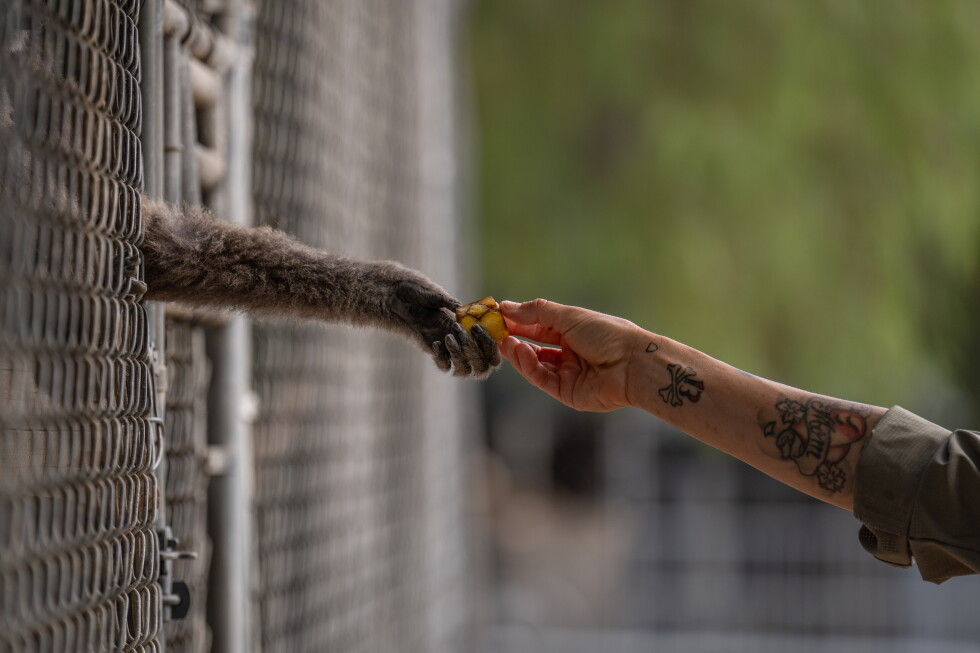
In the hot, dry hills of the Santa Clarita Valley, north of Los Angeles, gibbons begin to sing loudly during morning feedings. This was reported by Qazaqyia.kz citing Associated Press.
Their vocalizations, ranging from the sound of emergency sirens and birds screeching to low grunts and guttural hoots, reverberate across the sanctuary.
Over the past 50 years, the Gibbon Conservation Center has transformed from housing a small assortment of animals to becoming a globally recognized institution dedicated solely to the care and well-being of gibbons. Known for their signature singing, they are among the rarest and most critically endangered primates on Earth.
Today the center cares for some 40 gibbons across five species. Their singing can sometimes be heard a mile away.
The center's daily operations are captured in photographs taken by Associated Press photographer Jae C. Hong. The images, taken on Aug. 14, 2026, show on-site caretaker Jodi Kleier handing a piece of banana to a gibbon, two gibbons eating in an enclosure, a gibbon named Rocky hand-raised by Kleier, an aerial view of the center, and director Gabi Skollar feeding a gibbon.
The center's work is focused on preserving rare gibbon species. Gibbons are primates that inhabit tropical forests in Southeast Asia. Habitat destruction and poaching have led to a sharp decline in their numbers.
In addition to protecting gibbons, the center runs research and breeding programs. Such efforts help reduce the threat of extinction for gibbons.
Gibbon singing is their way of communicating. Each gibbon has its own voice, which they use to mark territory and find mates.
The center's work is highly regarded both locally and internationally. It has received various awards for its contribution to gibbon conservation.
The history of the Gibbon Conservation Center began in the 1970s. Initially, it housed various animals, but over time it specialized exclusively in gibbons.
Currently, the center houses five species of gibbons: the Cambodian gibbon, Bornean gibbon, siamang, hoolock, and concolor gibbon. All are endangered species.
Center specialists monitor the health of the gibbons and provide necessary medical care. They also study gibbon behavior to understand how they live in the wild.
The Gibbon Conservation Center's work is aimed not only at preserving these primates but also at protecting their natural habitats. To this end, the center implements various environmental programs.
Visitors to the center can observe the gibbons and listen to their songs. It is a great opportunity to see rare primates and learn about their protection.
The Gibbon Conservation Center is an institution that plays a vital role in the future of gibbons. Its work helps prevent the extinction of these amazing animals.