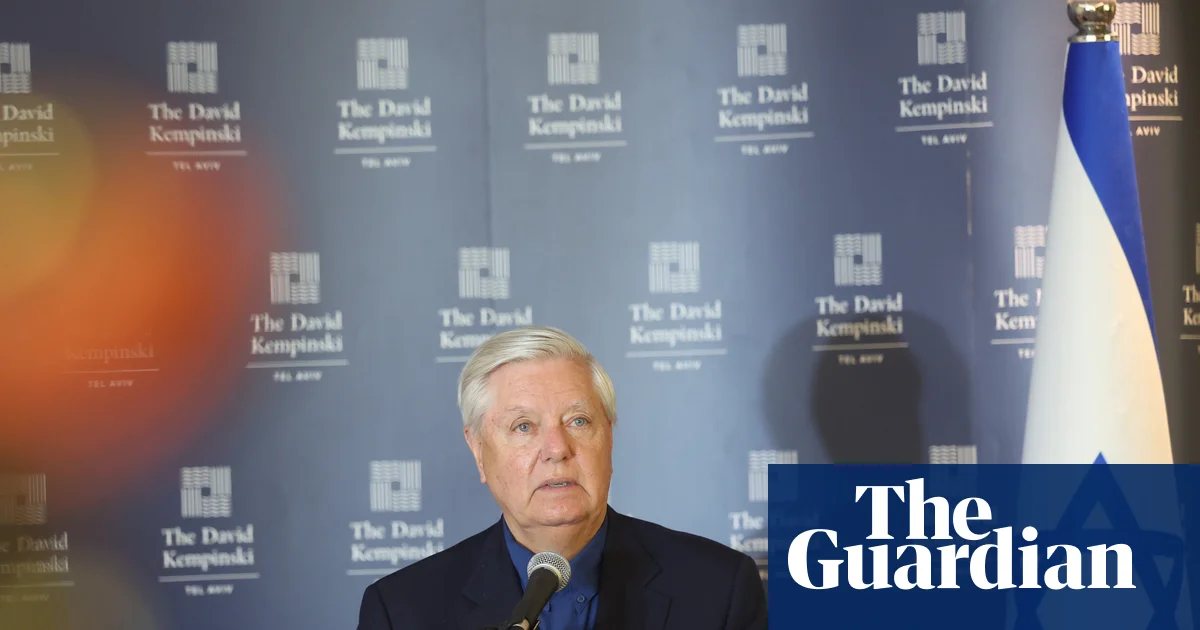
It was revealing that one of the first tributes to Lindsey Graham, a US senator who died on Saturday aged 71, came from Itamar Ben-Gvir, Israel's national security minister, a far-right provocateur who recently caused widespread anger by sharing footage of himself taunting bound activists who had been trying to sail to Gaza with aid. This was reported by Qazaqyia.kz citing The Guardian.
Benjamin Netanyahu, the Israeli prime minister, was not far behind, calling Graham a "great friend of Israel and a cherished friend of mine", and he was quickly followed by Ukraine's president, Volodymyr Zelenskyy, who described him as "a true defender of freedom and the values that make our world safer".
With eulogies also flowing from Nato allies and Taiwan, it was evident that Graham, one of 100 senators in Washington, had a global reach that few could match. He travelled the world to advocate for a muscular US foreign policy, frequently visited American troops stationed overseas and was vital in shaping Donald Trump's worldview. But his legacy was complicated and often bloody.
"There's no doubt Lindsey Graham was a central figure in Republican foreign policy circles and played a significant role in broader conversations about America's place in the world," says Brett Bruen, a former director of global engagement in Barack Obama's White House. "He was certainly similar to his old pal John McCain and in many ways he inherited that mantle, albeit not with the same moral clarity that McCain seemed to hold on to despite the way that Trump had upended Republican politics."
A former air force lawyer and member of the South Carolina air national guard, Graham was a leading neoconservative hawk whose political career came full circle in the Middle East over two decades. In 2003 he was a cheerleader for George W Bush's war in Iraq. In 2026 he was a crucial influence on Trump's war in Iran.
After a spell in the House of Representatives, Graham had only been in the Senate for a month when in 2003, Colin Powell, then the secretary of state, made a presentation to the United Nations security council arguing that Iraq's Saddam Hussein was secretly pursuing weapons of mass destruction. Graham was vocally supportive, stating: "The Iraqi response of, 'We have no weapons of mass destruction,' is a flat-out lie. I hope the world will get behind President Bush in making sure this man cannot continue his weapons program. He either needs to be disarmed or replaced."
Hundreds of thousands of lives were lost and no weapons of mass destruction were found. Bush's decision to go to war has been described by one influential thinktank as the worst foreign policy blunder in US history.
Undeterred, Graham argued that Iran was exploiting the Iraq conflict to strengthen its position across the Middle East. For years he promoted policies aimed at isolating Iran and limiting its missile and nuclear programmes. He opposed Obama's nuclear deal and in 2015 called for pre-emptive military action that would leave Iran's military "a shell of its former self".
Those instincts often appeared incompatible with Trump's "America first" rhetoric, which cast suspicion on overseas military adventures. Yet once Trump's nomination for president became inevitable in 2016, Graham steadily transformed from fierce adversary to close ally, personal friend and golf partner. He became a frequent visitor to the White House and adviser to Trump on foreign affairs, especially Iran, Israel and Ukraine.
Adam Schiff, a Democratic senator for California, told NBC's Meet the Press programme on Sunday: "Many of us considered him the Trump whisperer. If we wanted to know what the president's thinking was or how he might be moved on something, you would go to Lindsey to discuss it."
Graham applauded Trump's decision to strike Iranian nuclear sites last year. Along with Netanyahu, he was arguably one of the most persuasive voices in encouraging Trump to go to war in February despite the reported reservations of JD Vance and others.
Speaking to the Politico news site in March, Graham said he had spent months encouraging the president to view the overthrow of Iran's leadership as a defining second-term achievement, comparing it to the fall of the Berlin Wall. And once the conflict had begun, he continued trying to influence it and made clear that he had no regrets. Graham posted on social media last month: "To those who say Iran is stronger now than before, that is an insult to the American military and it is delusional thinking because the Iranian economy is in shambles."
It was a stance that reassured more traditional Republican foreign policy hawks but caused unrest in the "Make America great again" movement, which had supported Trump in part because of his promise to keep the US out of "forever wars", similar to the quagmire in Iraq.
Iranian state television announced Graham's death during a live broadcast in openly hostile terms.