As Germany investigates how a drone loaded with explosives reached a runway at Leipzig airport, there is renewed talk in Europe of hybrid war. This was reported by Qazaqyia.kz citing BBC News.
The interior minister is warning of a "new level of danger" from an attack that "may involve foreign powers". There is no proof at this stage to link the flying bomb directly to Russia, which denies any role. But as well as the means and the motive, Moscow does have form.
The BBC has seen details of the investigation into a plot in 2024 in which Russian-linked proxies in Poland and Lithuania not only handled drones and explosives but also delivered them to Germany.
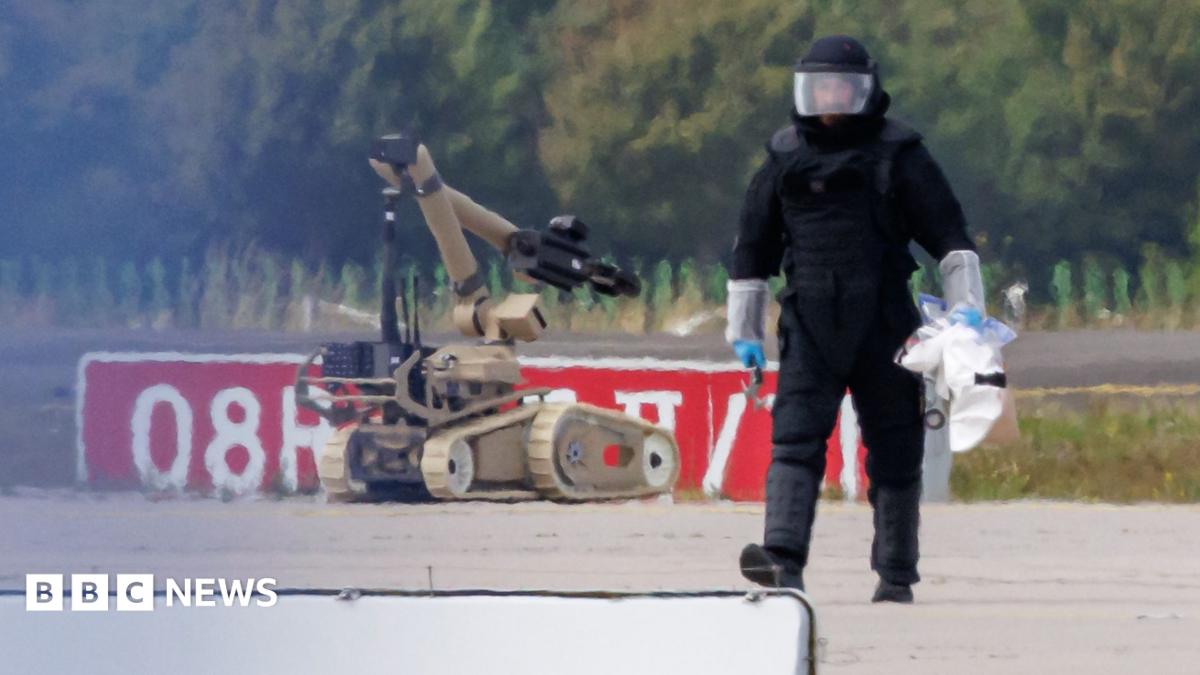
The quadcopter was discovered at Leipzig airport late on Tuesday night, forcing one runway into lockdown as a bomb disposal robot rolled into action. On the tarmac close by were several Ukrainian Antonov cargo planes, stripes along their enormous bodies in the blue and yellow of the country's flag. One reads, "Be Brave Like Kherson", the southern city now on the frontline of Russia's invasion.
Pictures published by German media suggest the drone was a relatively small device which airport staff spotted "floating" between the Ukrainian planes. Around the same time, a DHL cargo plane collided with an "unidentified object" as it pulled up into the sky, unable to land in Leipzig. Teams are still working to establish whether that was a second drone. They are also trying to trace who launched the devices and why.
A previous Russian-backed plot involving Leipzig airport could provide clues. In 2024, a parcel containing a sophisticated incendiary device caught fire at the airport's DHL hub shortly before it was loaded onto a plane. Similar packages then ignited in the UK and Poland, causing extensive damage. A group of men are currently on trial in both Lithuania and Poland, where prosecutors believe they were part of a substantial network of proxies recruited by Russian military intelligence.
But there was a subplot that has been little discussed before. Last September, Lithuanian prosecutors said that investigators had also seized RDX explosives meant for "other terrorist attacks". The amount was significant: equivalent to 6kg of TNT. "Some of the devices were manufactured to intensify the blast," the prosecutor added.
The BBC has since had access to case documents that describe how several of the men on trial were paid to transport those explosives around Europe, concealed in cans of sweetcorn and chopped tomatoes. The detonators were hidden inside headphone sets. The suspects also handled drone parts and the case talks specifically of attachments, suitable for holding a bomb.
Prosecutors allege that some of the items were brought into the EU from the Russian exclave of Kaliningrad. Almost two dozen suspects have been charged with terror offences, but with the men's handlers still at large, believed to be in Russia, it is not clear whether the entire network was disbanded or all the hidden material found.
While there is no evidence of a link to the Leipzig drone bomb, the 2024 plot certainly highlights the potential.
One of the suspects charged in Poland, a Ukrainian called Vladyslav D., described in detail to investigators how he made multiple long car trips in July 2024 following instructions from someone he knew as "Warrior". He has since pleaded not guilty in court. One message sent him to the edge of a Lithuanian forest where he found a carrier bag containing "three or four packs of headphones", soggy with rain. He had already collected two cans of corn "lightly covered with soil" from another location, telling investigators he had no idea what was inside. He was ordered to leave the headphones many hours' drive away in Poland where he noticed "a guy on a bicycle" collect them from beside the road. For another assignment he received a pin for a location inside a Lithuanian cemetery and was told to dig beneath some plastic flowers. He quickly uncovered a bin bag wrapped in brown tape.