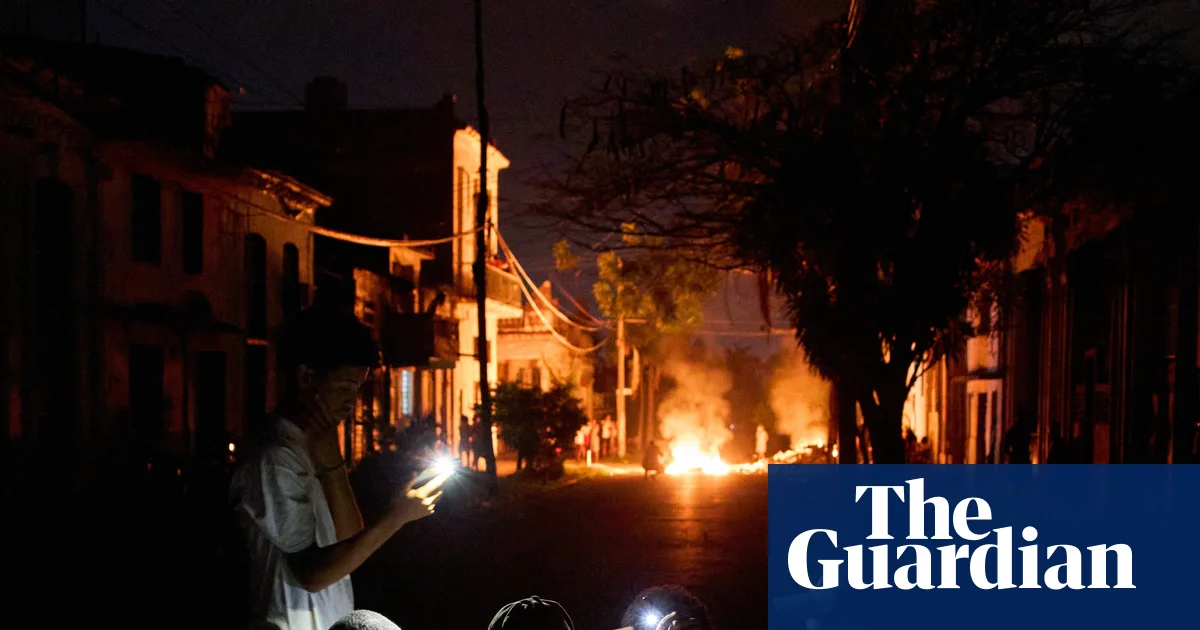
When Cuba's national grid collapsed for the third time in 10 days on Tuesday, a collective groan spread across its cities and people wondered, again, whether the island's antiquated electricity system may soon become unrecoverable. This was reported by Qazaqyia.kz citing The Guardian.
The 777-mile Caribbean island of 9.5 million people has been sweltering under a six-month-long oil blockade imposed by the US, part of a pressure campaign to bring down its communist government. But the parlous state of Cuba's infrastructure goes far further back.
"The backbone of the system is still the big power plants," said Jorge Piñon, a senior energy researcher at the University of Texas. "And they're old, broken and tired."
With summer temperatures now in the mid-30s and humidity at 80%, tempers on the street have begun to break. For many, the nationwide collapses mesh seamlessly with already withering local blackouts. Where once salsa filled the streets, now the drumming of pots and pans has become the country's soundtrack, cacerolazos that represent the shared misery of no sleep, ruined food and fading hopes of reprieve.
Electricity returns only sporadically. "An hour isn't enough time to run the pump to get water or to charge phones," Alberto, a middle-aged man, yelled through a cacophony of pans in Havana's Vedado neighbourhood last week. "People want the government to act right now."
The government, however, says it has few options. "We've said it before, there is a total absence of fuel," said Vicente de la O Levy, the minister of energy. "And we do not have access to spare parts for our thermoelectric units."
Ever since 3 January, when the US military abducted President Nicolás Maduro of Venezuela, Donald Trump has promised Cuba will fall. "Whether I free it, take it, I think I can do anything I want with it," he told reporters at the White House in March.
In its efforts to achieve this, Washington has used sanctions to destroy Cuba's industries. Foreign companies doing business on the island, from hotel operators, airlines, miners and shipping companies, have been driven out (or in cases such as the Canadian nickel miner Sherritt, have drawn up plans to stay in by selling its interests to Ray Washburne, a former adviser to Trump).
"We have seven containers in Kingston and another 40 in China, but we have no idea when, or if, they will arrive," said an electric car importer.
In May, a court in Florida charged 95-year-old Raúl Castro with murder, 30 years after the shooting down of small planes out of Miami dropping leaflets on Havana, and opening the possibility of a Venezuela-style extraction.
Even before the US cranked up the pressure, the Cuban state was weak, having fallen into the grip of hyperinflation during the pandemic. Now, services are faltering. Cuba was for years one of the safest countries in Latin America, now crime is blossoming with fights on the streets, cars and houses being broken into, and muggings with violence. Police, once ubiquitous, are hard to find, and victims complain they take hours to turn up.
They are still there though. Prisoners Defenders, a Madrid-based group, said the number of political prisoners had risen to 1,306, with newcomers such as Héctor Ochoa Vergara "detained after taking part in a peaceful demonstration against blackouts and water shortages in Ciego de Ávila".
But Cuba's most famous political prisoner, the artist Luis Manuel Otero Alcántara, was on his way to exile in the US on Saturday after serving a five-year term for disorderly conduct, is being held in an unknown location for a week while his visa is arranged.
The Cuban government's determination to appear united has appeared to be under strain. For months now, the US has been leaking its discussions on a possible deal over political and economic reforms, negotiations channelled through Raúl Guillermo Rodríguez Castro, the grandson of Raúl Castro.
Last week, the 42-year-old Rodríguez Castro gave an interview to USA Today, inviting reporters to one of his grandfather's old offices in Havana, then to Antojos, a smart city restaurant. He was wearing Hermès sneakers, a Rolex and carrying official documents in a Salvatore Ferragamo bag. "It pains me that many people can't live the way I do," he told the reporters, adding that while he had no interest in politics, "if at some point the revolution needs me to step up, I will do it".
The result was an uproar from musicians, academics, former diplomats and just people on the street, who were outraged by such a display from someone who is, in the words of the respected academic Julio César Guanche, "without recognised institutional public functions".
Most telling, though, was the anger of younger Cubans associated with the government. "To usurp the functions of government, to assume a public role for which no one elected you, to proclaim yourself spokesperson for measures or new directions for the country … would anyone else be allowed to do that?" wrote Michel Torres Corona, whose Con Filo programme on Cuban television.