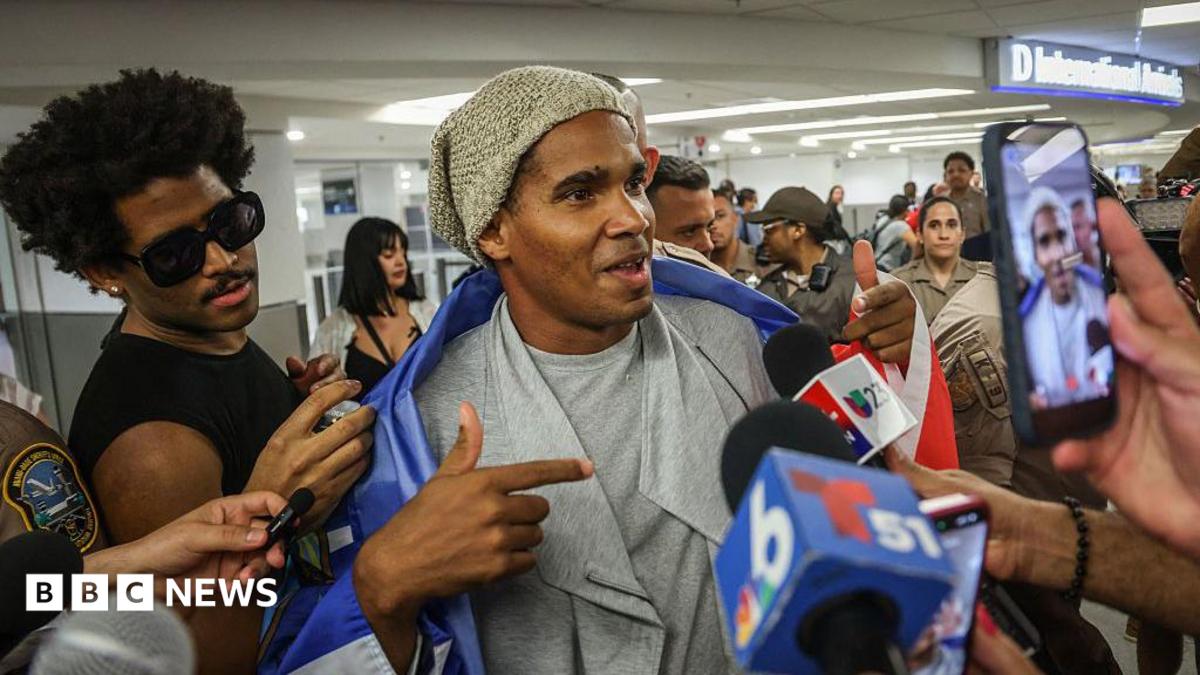
One of Cuba's most prominent dissidents has gone into exile in the US, after leaving Cuba where he had served a five-year prison sentence. This was reported by Qazaqyia.kz citing BBC News.
Luis Manuel Otero Alcántara, 38, is the leader of the San Isidro Movement (SIM), a group of artists, journalists and intellectuals who have campaigned for freedom of speech and democracy in the communist country.
He was arrested in 2021 during Cuba's largest anti-government protests in decades and spent five years in the maximum-security Guanajay prison near Havana.
His whereabouts have been unclear in recent days as Cuban authorities held him in an unknown location while the US approved a parole request.
Emerging from the airport in Miami, the 38-year-old was greeted by supporters who sang the Cuban national anthem as he held up his forefinger and thumb in the shape of the letter L to represent 'Libertad' - meaning freedom, a recognised anti-government symbol.
"I believe the dictatorship has to end, and the Castro dynasty has to end, as well," Otero Alcántara later told journalists. "Because as long as there is a Castro in power, there will be corruption."
Cuban authorities allege the SIM is funded by Washington and has been used to subvert the state, claims the movement denies. Many members say they have been constantly targeted by the security forces, and some arbitrarily detained.
US Secretary of State Marco Rubio said the Cuban government's "brutal crackdown against its own people five years ago is yet another reminder of the unique misery and evil that is innate to the communist system".
"Otero Alcántara's only 'crime' was refusing to stay silent and using his art to demand the basic freedoms everyday Cubans have been denied for almost seven decades," he said in a statement.
The cases of Otero Alcántara and fellow SIM member Maykel Castillo, known as "Osorbo", who is serving an eight-year prison sentence, have been a recurring source of diplomatic tension between Washington and Havana.
That tension has swelled in recent months, with the Trump administration hitting Cuba with an oil blockade, sanctions and openly threatening military intervention.
Last week the BBC's US news partner CBS reported that the Pentagon was looking at military options in Cuba, although it quoted officials as saying the briefings did not mean any decision to carry out an operation had been made.
The US oil blockade has exacerbated an ongoing fuel crisis, with Cubans facing extended blackouts and food shortages in recent months.
The US also announced in May an unprecedented murder indictment against former Cuban leader Raúl Castro, over the 1996 downing of two planes, an incident that killed four people. Russia and China condemned the move.
Tourism has taken a major hit amid the US sanctions, with fewer than 360,000 people visiting the island in the first five months of 2026, a decrease of nearly 60% compared to the same period last year, according to Onei.
Washington warned in May that a peaceful agreement with the Caribbean nation was unlikely.