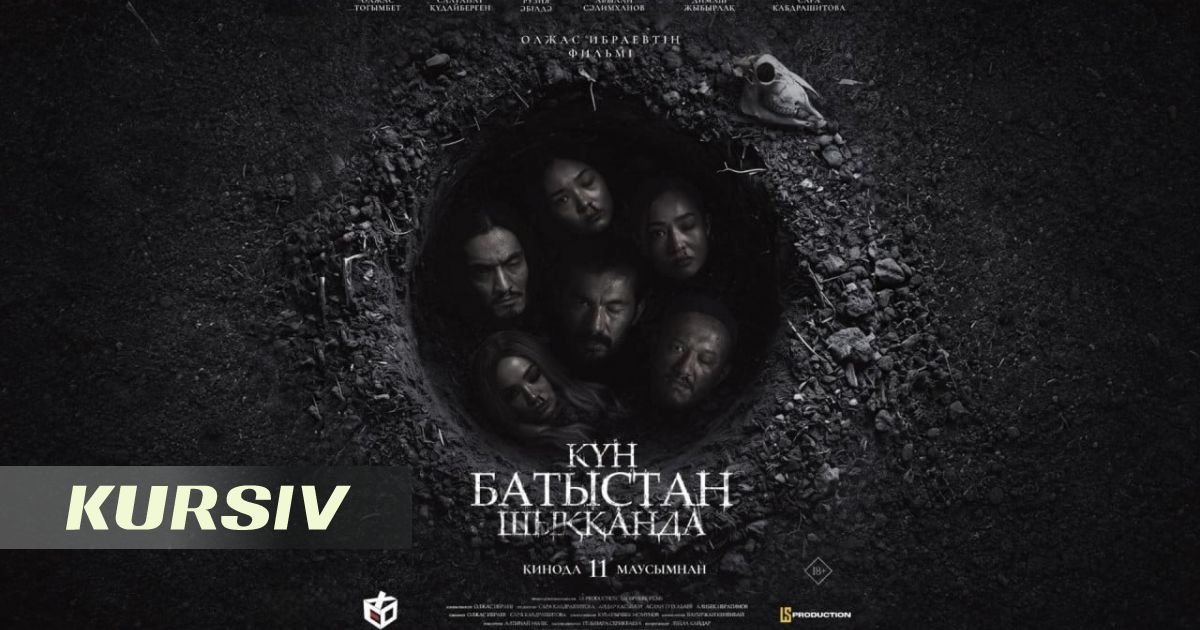
The domestic horror film 'Kүn batystan shyqqanda' is now in theaters with a strict 21+ rating. Even the notorious 'Dastur', known for its brutal scenes, did not receive such a restriction. Meanwhile, two films this week have received the maximum age limit — the second being a new installment of the 'Scary Movie' franchise. Although formally they are on opposite poles of horror and comedy, an unexpected similarity can be found, contrary to the creators' intentions. This was reported by Qazaqyia.kz citing Kursiv Media.
Plot and Characters
Dirty cop Aman (Olzhas Togymbet) routinely collects bribes from debtors and then goes home to his beloved daughter Lanaya (Ruzia Abilda). One day, he and investigator Lina (Saltanat Kudaibergen) are assigned to investigate a strange murder near the forest sanctuary 'Zhar Aulie'. Simultaneously, blogger Sara (Sara Kabdrashitova) participates in a documentary project about 'Zhar Aulie', assisted by Lanaya. Nearby lives healer and clairvoyant Isham (Abylai Salimkhanov), who seems to know more about current events than anyone — especially when the sun rises in the west, heralding the end of the world.
Direction and Style
The filmmakers clearly aimed to create a modern post-horror variation. The seemingly meaningful plot about an impending apocalypse and the heroes' sins, mysterious murders at an ancient monolith, colorful characters like a paralyzed healer — there is room for creativity. The film tries to surprise and shock from the first frames, opening with a chaotic black-and-white montage of a madman in a straitjacket jumping on a bed and muttering nonsense: a prologue in the spirit of the recent experimental 'Bride!'. There is also the folk horror atmosphere beloved by Kazakh horror filmmakers in recent years.
Why 21+?
However, what seems like an interesting set for a horror film on paper turns out to be a confusing and helpless spectacle on screen, unable to engage or scare properly. The film is no scarier than 'Babai', a film about a ghost animator for a little girl playing in neighboring theaters. It is unclear where the strict 21+ rating came from, which sends the film to late-night screenings after 10 PM, unless it was a hidden desire to save viewers from watching a low-quality product. The film uses the most primitive techniques: flickering lights, broken dishes, slamming doors, bleeding eyes, and a couple of mystical ghost creatures — the makeup is far from top-notch. There is a final nauseating plot twist, but compared to what 'Dastur' did a couple of years ago, one wonders: 'For this — 21+?'.
Social Message
Like Kuanysh Beisek, director Olzhas Ibrayev and co-writer Sara Kabdrashitova try to enter the territory of social messaging. Kabdrashitova's character, the spoiled blogger Sara engaged in charity for PR, hints at convicted Perizat Kairat, while the bad cop Aman resembles typical heroes of Adilkhan Yerzhanov, questioning justice. But the plot and stylistic mess (sometimes it seems that various film school techniques are used without purpose — black-and-white shooting, overhead shots, expressionistic frames) based on pseudo-parable motifs and pseudo-surrealistic images fails to say anything coherent. Aman is given several ghosts from the past (ex-wife, tyrant father, unclear court case), but none are brought to a logical conclusion.
Conclusion
'Kүn batystan shyqqanda' is frankly bad as a horror film, but partially reveals itself as a ridiculous black comedy — Ibrayev has shown himself best in this genre, directing films like 'Mission Possible' and 'Super Courier'. Pompous dialogues trying to give a lofty, mystical-religious level (the concept of the sun rising in the west is considered one of the main signs of Judgment Day in Islam), mediocre acting, and an overcomplicated plot evoke laughter rather than fear. When choosing a movie, one should not confuse it with the new 'Scary Movie' installment, which also received a merciless 21+ rating. Kazakh horror has recently shown signs of life, but not always successfully — the Kyrgyz film 'Cassandra', which has become a mini-sensation, offers a much better example of horror about clairvoyants and human mistakes.