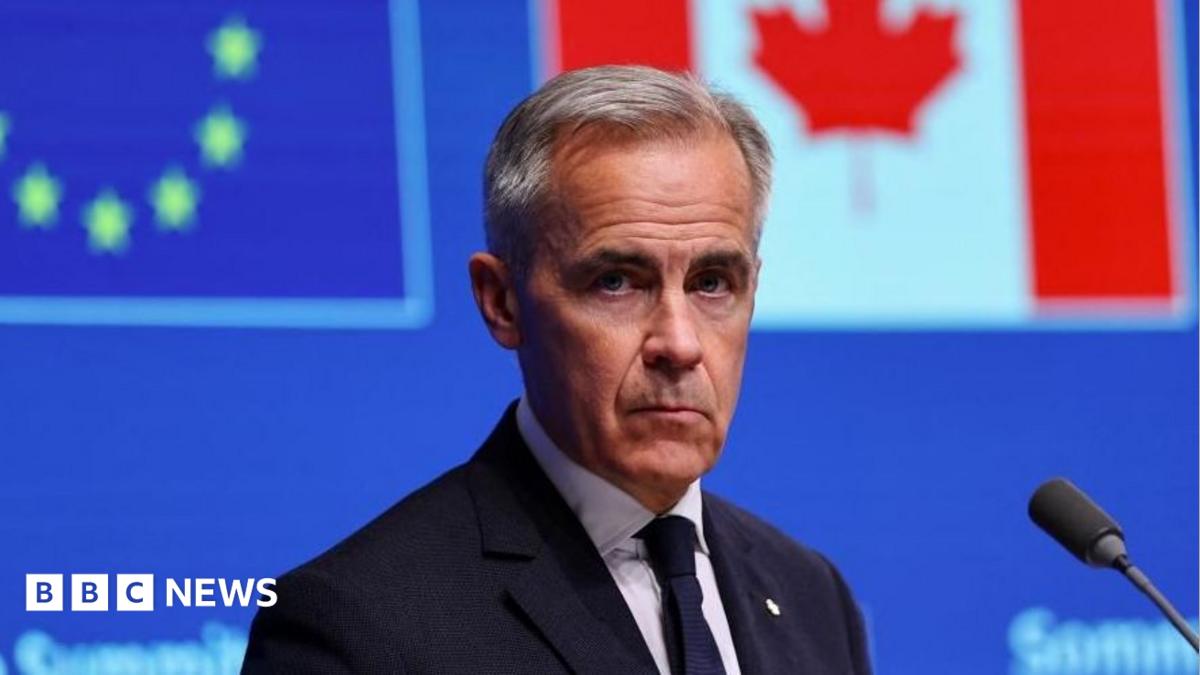
Canadian Prime Minister Mark Carney said Canada is seeking a "unique alliance" with the European Union. This was reported by Qazaqyia.kz citing BBC News.
In a speech on Wednesday, European Commission President Ursula von der Leyen said she wanted to work "on opening the door" for Canada to be the EU's "associate member" — which would involve closer ties on various sectors including manufacturing and energy.
The catalyst for this very public, ardent new love-in is Donald Trump. Just the other day, the US president posted a map of North America on his Truth Social site, including Canada and Greenland — a territory that's part of EU country Denmark — all overlaid with the US flag.
Trade negotiations between the US and Canada broke down late last month. European countries, which have been hit by their own Trump tariffs, have privately watched the spat play out with a mixture of interest and, for many, admiration.
While the EU, led by the European Commission, simply accepted new blanket Trump tariffs without fighting back, Carney has prominently stood up to the US president, swiftly imposing counter-tariffs on the United States.
When it comes to courting the EU, Canada appears to some to be even keener than one of the bloc's closest neighbours. "Canada right now seems more interested than the UK to get as close to Brussels as possible, as a non member state," says Mark Leonard, director of the European Council of Foreign Relations think tank. "It's remarkable."
Canada, but not the UK, successfully joined the European Union's Security Action for Europe (SAFE) defence fund earlier this year. The UK remained on the sidelines following a row over costs and political tensions. A summit designed to reset and improve EU-UK relations has just been delayed — again — over cross-Channel differences.
This week, Carney is invited as a special guest to the European Commission President's annual State of the Union address in Strasbourg, France on Wednesday. Carney will hold a speech in the European Parliament there on Thursday, a day after President von der Leyen outlines the EU's political and policy priorities.
Officials on both sides insist this is more than just "blah blah politics," as one EU diplomat put it. Carney and von der Leyen are both expected to mention plans to forge closer ties. "As close as you can get without (Canada) actually becoming an EU member," the diplomat told me.
The unofficial aim for both Brussels and Canada is to reduce reliance on Washington in several key areas: digital and tech developments, energy, raw materials and critical minerals, and trade and defence procurement.
A Nanos opinion poll from April suggests more than four in five Canadians favour strengthening ties with the EU. Close to three in five support Canada actually joining the bloc, though Article 49 of the EU Constitution would appear to make that impossible.
Back to trade: ties between Canada and the EU are far from novel. The EU is already Canada's second-largest trading partner — albeit far behind the US, which buys about 70% of Canadian exports. The far-reaching Comprehensive Economic and Trade Agreement (CETA) trade deal was agreed just under a decade ago and has been provisionally implemented, eliminating 99% of tariffs on Canadian goods exports.
Privately, European officials admit this renewed high-level courtship between Ottawa and Brussels has everything to do with the actions of Trump's second term in office.