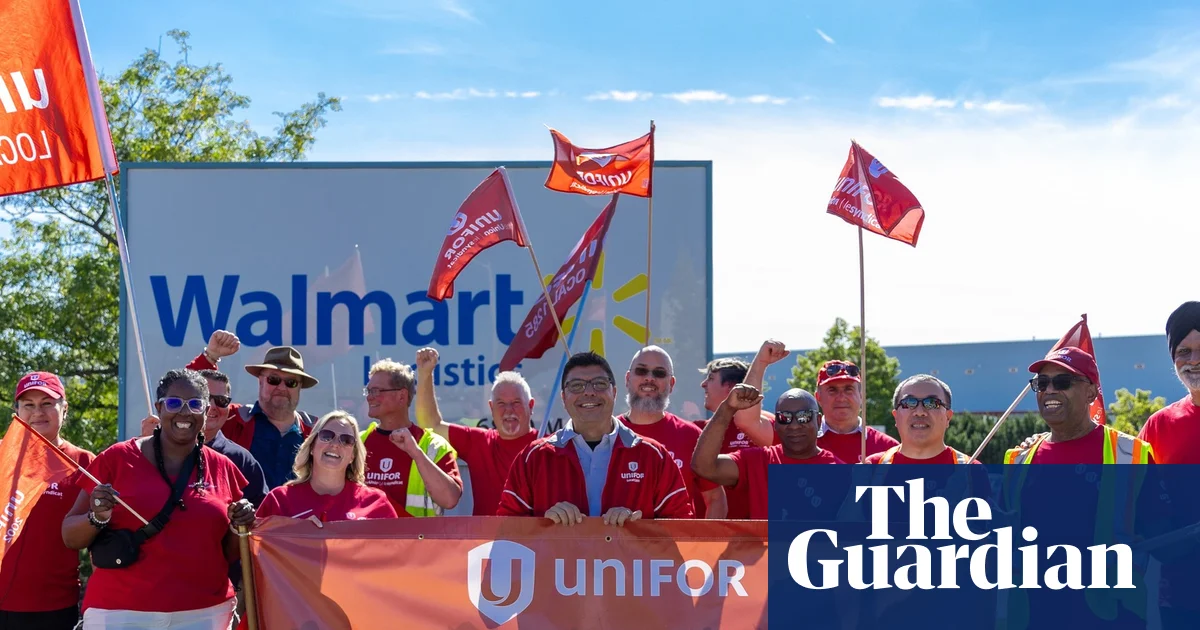
Workers at a Walmart warehouse in Canada have signed the first collective agreement with the company. This was reported by Qazaqyia.kz citing The Guardian.
Union leaders called the agreement "a historic and powerful step." However, they note that this is only the beginning of a broader struggle to organize large employers across the country.
In May, workers at a warehouse in Mississauga, Ontario, signed a contract with Walmart, the world's largest employer, which includes wage increases, working condition guarantees, and a lump-sum payment to settle complaints of unfair labor practices.
"These members were determined to achieve workplace democracy and did not back down," said Lana Payne, president of Unifor, Canada's largest private-sector union. "Their courage and determination, their decision to engage in collective bargaining with one of the largest corporations in the world — that is why they have made labor history."
Workers at the high-volume distribution warehouse, which serves one of Walmart's largest markets in Canada, first decided to unionize in 2024. It took two years for both sides to agree on a contract.
Payne noted that this victory was the result of a targeted union strategy to cover those parts of the business that could have the greatest impact. Although retail outlets had previously unionized, powerful distribution centers supplying more than 100 stores and handling online orders remained out of reach.
"We felt we had to make a serious effort to cover the entire supply chain," she said. "This victory will create momentum in the warehouse sector."
In the case of Mississauga, Walmart raised wages for other workers in the region, but not at the warehouse that unionized. Under the new collective agreement, Walmart will pay a lump sum to settle a complaint of unfair labor practice. The company did not respond to a request for comment.
According to Payne, drastic changes in the economy in recent years have increased the influence of technology and e-commerce companies, changing the nature of worker organization. "Our labor laws are not designed to deal with large corporations that can oppose unions, and therefore they make the system difficult," she said.
Unifor has already opened a second front: an Amazon facility in British Columbia, where laws are more favorable to unions. Recently, the British Columbia Labor Relations Board found that Amazon illegally withheld a planned wage increase from workers at that facility, despite raising wages at all other Amazon facilities in the region. The company will likely have to pay more than $1 million in back wages.
Amazon said it misunderstood the labor code and believed it "prevented us from making changes to employee pay at the warehouse." However, the board's decision means that previously excluded employees will now receive "updated compensation as soon as possible."
Economist Jim Stanford noted that Amazon and Walmart are among the companies with enormous pricing power. "There is an incredible contradiction between the fact that Walmart is one of the largest and most profitable companies in the world and that many of its workers are forced to turn to food banks because they cannot afford groceries. But with a union and a contract, workers have a chance to get a fair share of the wealth they produce," he said.
Stanford noted that in recent years there has been a "shift in attitude" as workers realize that employers can take advantage of them. Despite the difficulties, the recent success will likely lead to an increase in union campaigns.