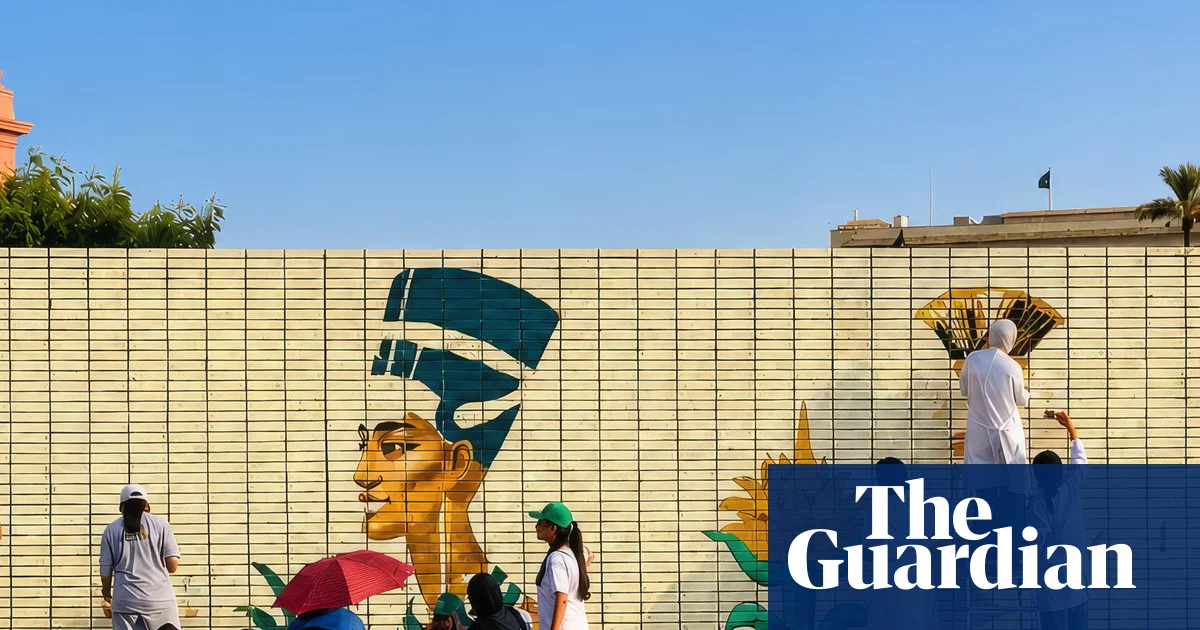
On the eve of Chinese president Xi Jinping's state visit to Cairo last month, the city authorities were busy removing a 66-metre-long mural from the esteemed guest's line of sight. Depicting the Pharaoh Tutankhamun and Queen Nefertiti, the painting was among 40 murals commissioned to beautify the city for Xi's arrival and was painted by volunteer youth group Rasmet Basma, in Tahrir Square. This was reported by Qazaqyia.kz citing The Guardian.
But it drew a furious reaction for depicting the two historical figures with dark skin – angering those Egyptians who saw it as reviving Afrocentric claims about the Pharaohs' origins. The artwork vanished under fresh paint just hours before Xi landed.
Now, Ahmed Moussa, the 22-year-old founder of Rasmet Basma, has admitted it was asked by the Cairo governorate to paint over its work, which had been prepared in just five days in late August.
The team used the AI programme ChatGPT to generate the designs, which volunteers then painted on to the wall.
Moussa said Cairo's deputy governor and the head of the district had visited the site throughout the process and were impressed by the murals – until controversy began to build on social media.
"We used a golden-bronze tone that cast a kind of shadow on the faces at night, so they appeared dark-skinned," Moussa said.
"We acknowledge our mistake in not consulting specialists in archaeology and art."
Afrocentrism is a political movement asserting that ancient Egyptian civilisation was black African in origin and population.
One user asked whether anyone involved had "even seen what Nefertiti actually looked like", while others accused Afrocentric groups of appropriating the images to claim Egyptians endorsed their theories.
Zahi Hawass, Egypt's former antiquities minister, said the volunteers should not have been allowed to paint a city site as significant as Tahrir Square without expert oversight, and that the public outrage was justified.
"Claims linking ancient Egyptian civilisation to sub-Saharan Africa are nonsense," Hawass said.
"Temple carvings from the late period show Egyptian kings depicted alongside captives from parts of Africa, Libya, Syria and Palestine, with the king himself not shown as dark-skinned," he said.
This is just the latest episode in a long-running debate over the complexion of ancient Egyptians. In 2023, a Netflix documentary provoked discussion after casting a dark-skinned actor as Cleopatra, and a similar dispute flared in June 2024 after a guide reportedly gave an Afrocentric perspective of Egyptian history in Cairo's Egyptian Museum.
Monica Hanna, an Egyptologist at the American University in Cairo, labelled Afrocentric claims "pseudoscience". She said Egyptian society had always been ethnically diverse, from Nubian communities in the south to Mediterranean populations in the north.
"Egyptians were never one skin colour," she said. "We are not snow-white, or the colour of cream."
Walid Mahmoud, an AI researcher and expert in African anthropology, said AI tools such as ChatGPT reflected whatever information was most widely shared online, rather than what was factually accurate.
They were built by companies in the US and Europe, he said, and the content they generated could shape how those audiences saw themselves.
"That's why we should never simply accept what it produces, especially when it comes to cultural identity and heritage," Mahmoud said.
Mostafa Eissa, an art critic, said AI should remain a tool, never a decision-maker in its own right.
"I favour using technology without abandoning the human element within the artist," he said, warning that letting such tools substitute an artist's own skill risked emptying a work of its originality.
This article is published in collaboration with Egab.