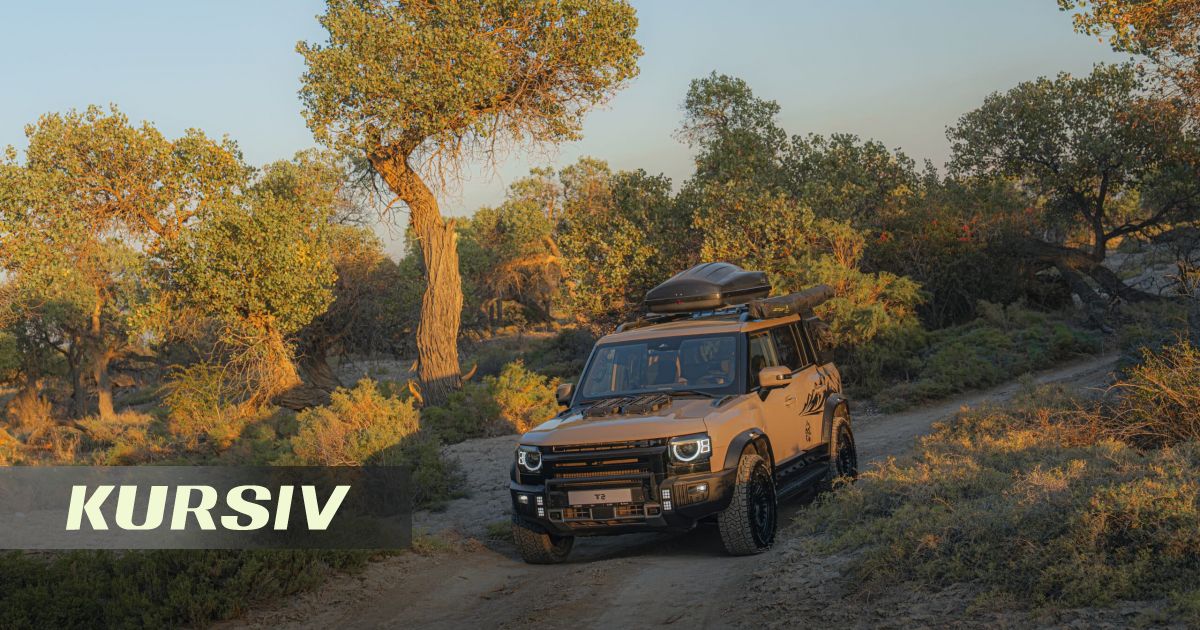
A journey begins not when the car leaves the city, but much earlier, when a route appears, gear is packed and the desire to see new places arises. It is precisely for such trips that the Jetour T-series T1 and T2 vehicles were created. They are suitable for daily city use, yet are ready to go beyond familiar routes: to lakes, mountains, steppes and remote natural locations. This was reported by Qazaqyia.kz citing Kursiv Media.
Specifications of Jetour T1 and T2
Jetour T1 is equipped with a 2.0-liter turbocharged engine producing 254 hp, an 8-speed automatic transmission and an intelligent XWD all-wheel drive system with a BorgWarner coupling. The model's ground clearance is 190 mm. More details about Jetour T1 specifications here.
Jetour T2 offers even more possibilities for trips outside the city. The vehicle has a 2.0-liter engine producing 254 hp, 220 mm ground clearance, a spacious interior and several transmission options, including a 7-speed robotic gearbox and an 8-speed automatic in the Explorer trim. More details about Jetour T2 specifications on the website.
But even a well-prepared vehicle can be made even more convenient and functional with additional equipment.
Roof tent
A tent turns the car into a full-fledged base for travel. This is especially convenient on trips where the route passes far from hotels and equipped campsites. A roof tent allows you to organize a sleeping place directly on the vehicle. It sets up quickly, does not take up space in the cabin and helps you settle even where the ground surface is unsuitable for an ordinary tent. This format is especially valued by travelers who frequently change overnight stops and do not want to spend much time setting up camp.
When choosing a tent, it is important to consider its weight, dimensions, number of sleeping places and the permissible load on the vehicle's roof. Equipment must be selected taking into account the specific model, the luggage system and the intended route.
Awning
An awning helps quickly create a protected space next to the car. It saves from the scorching sun, light rain and wind, and at a parking spot it turns into a convenient area for rest, cooking or socializing.
Together with the tent, the awning forms a small campsite: there is no need to look for shade or build a canopy from improvised materials. It is enough to stop and unfold the equipment, and the crew gets its own place to rest.
Roof box
Even a spacious interior and trunk are not always designed for everything you want to take on a long trip. Sleeping bags, a tent, folding chairs, camping dishes, clothes and other gear quickly take up free space. In such a situation, a roof box helps. It allows you to free up the cabin and preserve passenger comfort. Things remain organized and protected from dust and precipitation, while inside the car you can place what really needs to be kept at hand.
Protective body kit
Additional body kits can perform not only a decorative function. Protective elements for the front and rear of the body, sills and the lower part of the vehicle help reduce the risk of damage on gravel roads, rocky sections and when driving over rough terrain. In addition, a body kit can make the vehicle more convenient to use on trips.
When selecting equipment, it is important to consider compatibility with the specific Jetour model, mounting features and the effect of accessories on clearance, approach and departure angles. Stock tires are sufficient for the city, highway and most popular suburban routes. But if trips take place on mud, sand, stones or broken roads, the type of tires begins to matter greatly. Off-road rubber is distinguished by a more aggressive tread pattern and reinforced sidewalls. It helps improve traction on loose soil, gravel and mud, and also better withstands contact with sharp stones. At the same time, off-road tires can be noisier on asphalt and slightly affect fuel consumption. Therefore, they should be chosen not only by appearance, but based on real routes: a universal option is suitable for mixed use, while more specialized rubber is needed for regular trips over difficult off-road terrain.
Reinforced suspension
During long trips, the vehicle often moves fully loaded: passengers, luggage, water, equipment and a fuel supply create additional load on the suspension. Reinforced suspension helps the vehicle more confidently maintain its operating characteristics under increased weight. It can be especially useful for those who regularly install heavy equipment, carry a lot of gear or go on long autonomous journeys. The suspension must be selected individually. It is important to consider the mass of additional equipment, driving style and the nature of the routes. A properly tuned system should not just increase clearance, but preserve the vehicle's stability, handling and comfort.
Conclusion
Not every owner needs a full set for an autonomous expedition. For short weekend trips, a box and an awning may be enough. If overnight stays in the mountains or steppe are planned, a tent will come in handy. For regular trips on difficult roads, it is worth paying attention to suitable tires, a protective body kit and reinforced suspension. The main thing is to select equipment not separately, but as a single system. Additional weight, roof load, clearance and suspension characteristics must correspond to the vehicle's capabilities and the owner's tasks.
On trips, it is precisely such details that often determine the impressions of the journey. Morning by a lake, dinner under the open sky, the road to a place not listed in tourist guides, and a sense of freedom when there is no usual schedule ahead. This is why many set out on the road, and properly selected equipment helps make such trips more comfortable, safer and richer.
Additional equipment for Jetour T1 and T2 vehicles can be purchased at official Jetour dealerships throughout Kazakhstan, and detailed information can be found on the jetour-auto.kz website.