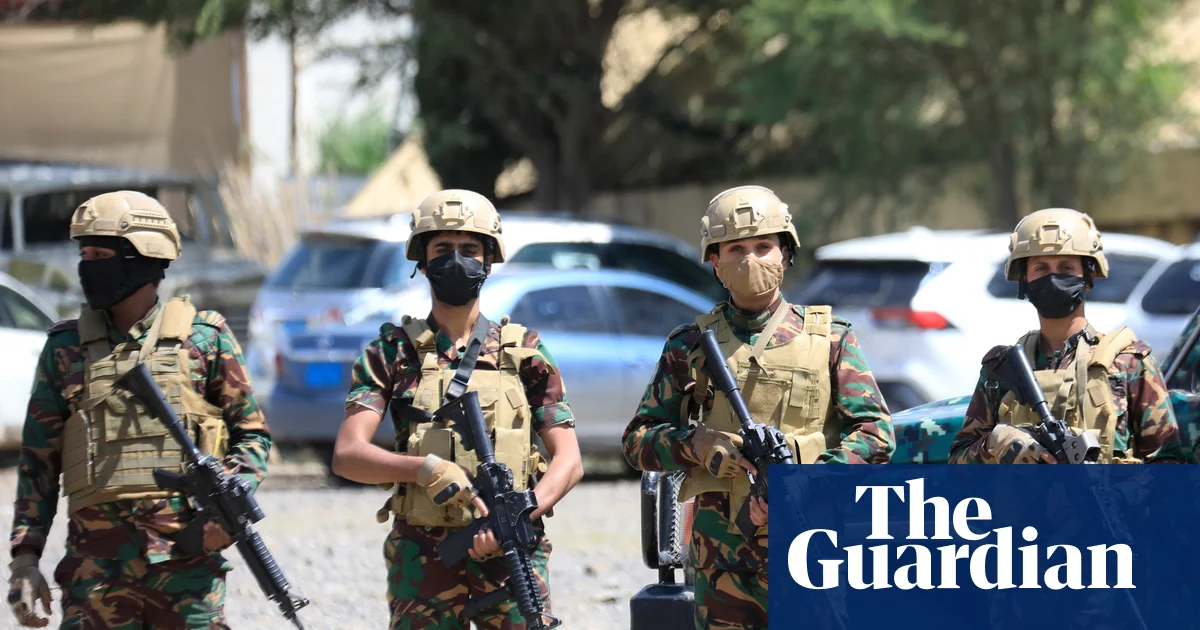
A bitter inquest is under way among Yemen's anti-Houthi forces as to how what was being billed as a decisive assault on Sana'a, the Houthi-controlled capital, suddenly collapsed into a military rout. More than 15 brigades were defeated as the country's entire west coast fell into Houthi hands. This was reported by Qazaqyia.kz citing The Guardian.
Efforts are now being made to reorganise the anti-Houthi forces representing the UN-recognised Yemeni government in order to capture the Kahbob mountains, a strategic point from which to restrict Houthi forces moving closer to the crucial Bab al-Mandab strait.
Some Yemeni politicians are claiming that billions of dollars were offered to persuade the forces defending the west coast to abandon their position. It is thought as many as 30,000 well-equipped fighters retreated, raising questions about coordination, readiness and morale.
The claim made by the governor of Hadramaut, one of Yemen's largest governorates, did not identify the source of the payment, but others have tried to draw conclusions from the past links between the United Arab Emirates and the pro-government National Resistance Forces led by Tareq Saleh. The UAE left Yemen in January, but remains bitter at the role played by Saudi Arabia in forcing it out and in the outlawing of the separatist Southern Transitional Council.
The Yemeni Nobel peace prize winner Tawakkol Karman has called for an investigation, while another political activist, the Mocha resident Abdu Mukabib, described the withdrawal of forces from the now Houthi-held port city in the early hours of 10 September as a great betrayal.
Saleh's National Resistance Forces have said they made a necessary tactical retreat.
Hours before, the Houthis had captured the headquarters of the National Resistance Forces operating along Yemen's western coast, situated on the high ground of Jabal al-Nar (Fire Mountain) and supposed to contain six military brigades and sophisticated weaponry provided by Saudi Arabia.
Mukabib said on his Facebook page that by the time the Houthis entered the city at 6am their forces numbered less than 20: two military vehicles, each carrying five people, and four motorcycles, each carrying two people.
He said that what happened, in his words, caused "humiliation" and betrayal to those who trusted the forces they fought alongside. "We are not accusing anyone, but they all participated in betraying us, conspiring against us, selling out our cause and abandoning us.
"It was not a withdrawal from weakness or lack of equipment and supplies, but rather a cowardly and shameful withdrawal."
The National Resistance Forces said they had withdrawn after the death of 500 of their soldiers and to prevent encirclement. Saleh has said he is now forming the "Tihami Resistance", a group that was entirely independent of Yemen national forces.
Others point to explanations for the reverse including poor command and control communications that led to slow decision-making, high-level Houthi intelligence and divisions within the anti-Houthi military forces, including the influence of Saudi commanders.
Alongside the inadequacies of the UN-backed forces, the Houthis have become an increasingly sophisticated army, bolstered by Iranian intelligence. They have benefited from the cut-price nature of modern warfare, using cheap drones to harass maritime traffic. But more than 10 years in control of many of Yemen's key regions and the occasional payoff from Saudi Arabia have swelled their coffers enough to not only buy ballistic missiles, but develop their own indigenous weapon-making infrastructure, becoming less reliant on Iran in the process.
Iranian officials insist the Houthis are not a simple proxy force, but have their own unified command structure and set of priorities.
The inquest into what is widely regarded as a military catastrophe is not entirely retrospective. Both Yemen government and Saudi forces are urgently reviewing the lessons of defeat to better understand whether the Houthi gains can still be reversed.
It was claimed that a limited force from the Giants Brigades, a group once linked with the UAE-backed southern separatists, managed to repel the Houthi advance and recapture positions in the days before the fall of Mocha, which could have served as a springboard for regaining the initiative. However, the withdrawal of neighbouring National Resistance units weakened this advance and turned it into a series of retreats.
Prof Dr Abdulwahab al-Awaj at Taiz University in Yemen said: "The collapse of the western coastal fronts is not merely a conventional military defeat, but a warning sign of a breakdown in coordination and trust among the anti-Houthi forces. The Houthis exploited this breakdown more than any decisive military superiority.
"Regaining the initiative cannot be achieved simply by sending reinforcements. What is needed is a reorganisation of government forces and allied formations under a unified operational vision, addressing security gaps, and building genuine trust on the ground to prevent a recurrence of this scenario."