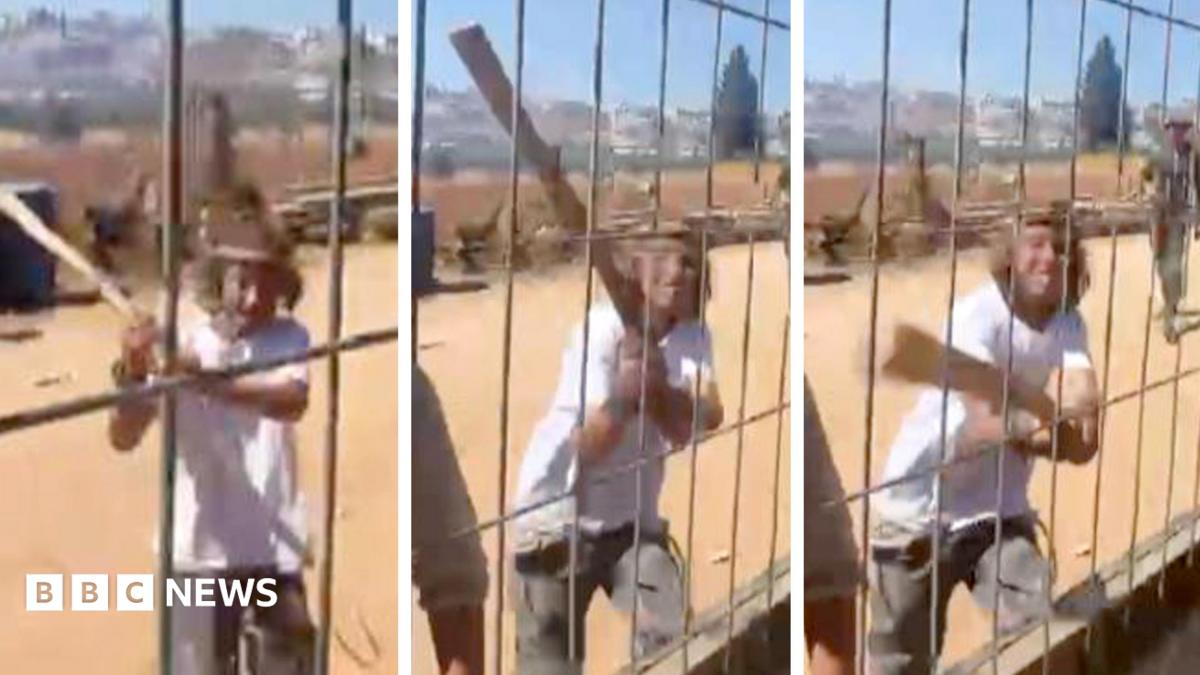
The large, bolted gate of the Abu Alia family compound in al-Mughayyir village held firm against the teenage settlers; its thin metal bars ringing with each blow, as they smashed it again and again with their clubs. But the insults hurled by both sides that day passed freely through the bars. One offensive slur - almost identical in both Hebrew and Arabic - delivered with nonchalant contempt by the Israeli boys bashing at the gate; and with fear and frustration by the Palestinian man inches away from them on the other side, filming the encounter on his phone. This gate, on the edge of al-Mughayyir, has become a weekly frontline in the battle for the occupied West Bank. And this kind of attack by settlers on Palestinian homes, a weekly routine in villages across the territory. This was reported by Qazaqyia.kz citing BBC News.
This was reported by Qazaqyia.kz citing BBC News.
When we arrived in al-Mughayyir that day, the confrontation at the Abu Alia compound had already begun. The Israeli army and border police were already moving through the streets, and residents were running from their vehicles - soldiers, like settlers, are seen as the enemy here. Some young men rolled rocks into the road to block it, as the sound of gunshots cracked over the village. On the hill above them, the local mosque was calling on people to help the family trapped by the settlers. But slipping past Israeli soldiers has become a dangerous gamble. Residents, medical workers and journalists have all been shot during Israeli military operations in the West Bank. This is what passes for a normal weekend now in al-Mughayyir, and in villages across the West Bank, but it rarely breaks beyond the local news.
We spent a week around al-Mughayyir, and its neighbouring village, Khirbet Abu Falah, to see what life was like here for a single community, or a single family. What we found shows how quickly control of this landscape is changing, and how local attacks by settlers here are the tip of a national project to bring West Bank land under Israeli control.
Since occupying the West Bank during the 1967 Middle East war, Israel has built more than 100 settlements housing more than half a million Jews on land Palestinians want for a future state. Some Israeli settlers have also established hundreds of wildcat outposts - often starting with a single tent or caravan on a hilltop, and often very close to Palestinian homes. Both Israel's official settlements and its outposts are illegal under international law.
Israeli Prime Minister Benjamin Netanyahu has described those carrying out settler attacks as a handful of misguided young people: "150 juvenile delinquents", he's called them, or "70 teenagers from broken homes". The settlers smashing the Abu Alia gate that Saturday in al-Mughayyir seemed to be mainly teenagers, but earlier that day, a settler group had put out a call on social media to "expel the enemy", including a quote from the Torah. "If you do not drive out the inhabitants of the land from before you, those you leave will become spikes in your eyes and thorns in your sides," it says. And behind the young faces at the gate in al-Mughayyir were much older settlers - at least one of them armed - standing with Israeli soldiers not far from the house.
There is a widespread belief among Palestinians in the West Bank that Israeli soldiers support settlers during these attacks. Footage of the confrontation at the gate, filmed by the Abu Alia family, shows soldiers strolling up to the teenagers who are attacking it, and making gentle moves to guide them away. It is not effective: the teenagers return again and again to smash their clubs against the gate, as a woman inside screams at them to get away. The soldiers standing with them at the gate make no attempt to question or detain the attackers, or even confiscate their clubs. Footage, also filmed from the Abu Alia compound, appears to show young settlers breaking fencing around the property, as soldiers stand by a short distance away, helmets off, phones out. In one photo, there appears to be an angle-grinder or similar power tool lying on a log behind them. We later photographed it in the hands of soldiers, then in the hands of settlers, then with soldiers again at the Abu Alias' fence.
We asked the Israel Defence Forces (IDF) about these incidents. It gave no explanation for the events, but said in a general response that it was investigating claims of damage to property. Rafeeq Abu Alia, who was one of the family members in the house that day, told me the attack had followed a familiar pattern. "First thing this morning, they came... There were four settlers and they were armed. Then more settlers came and laid siege to the house, insulting and provoking us," he said. "They came with the army. The soldiers entered, followed by the settlers. The army beat people inside the house." We filmed soldiers trying to break down the Abu Alias' gate that day, while settlers stood beside them. And later saw workers fixing the broken entrance. Medics told us they had treated several Palestinians for tear gas and beating injuries, and that another person had been taken to hospital with a gunshot wound.