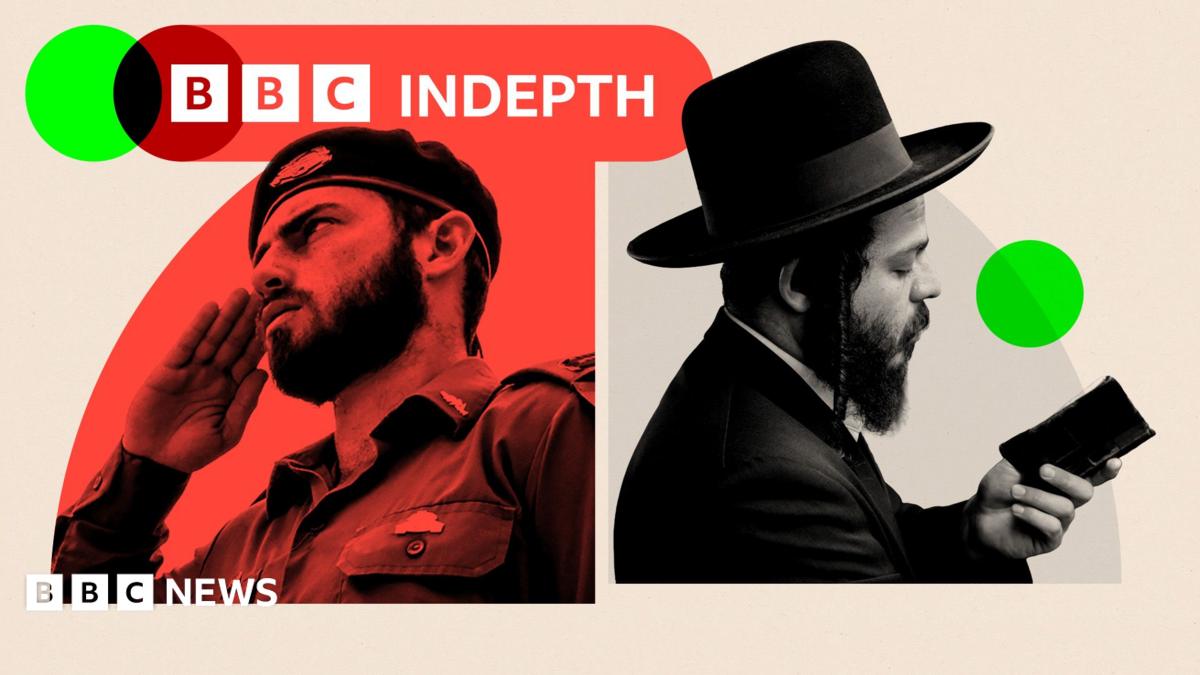
A clash occurred in the Israeli city of Modi'in between military police and hundreds of ultra-Orthodox men in white shirts, black fedoras, and long black frock coats. The police had come to arrest a young ultra-Orthodox Jewish (Haredi) man who had failed to report for military service. This was reported by Qazaqyia.kz citing BBC News.
The clash in early October is one of many in recent months in which one of the deepest schisms in Israeli society has become ever more exposed. This widening fault line is playing out against the backdrop of the wars Israel is currently fighting, including the unresolved conflict against Hamas in Gaza, as well as increasing violence by extremist settlers against Palestinians in the occupied West Bank.
Once a tiny minority, the ultra-Orthodox remain a group apart even as their numbers expand year by year. Currently, they are estimated to make up about 14% of the population, and the birth rate within the community remains far higher than among other Israelis. If their numbers continue to grow at a similar rate, they could make up one-third of the Jewish Israeli population by 2050.
As the ultra-Orthodox community becomes bigger, so has the debate around the expense of supporting them with stipends so they can devote themselves to full-time religious study. Subsidies to the group are estimated to cost the government 35bn shekels (£8.4bn) per year and, until recently, they were exempted from military service.
Now they're no longer an insignificant minority, they're facing pressure to engage more with wider Israeli society. National security and the economy are two of the key issues this election. That means the division between the ultra-Orthodox and the majority of Israelis who believe they are not contributing their fair share to either is starker than ever.
With no outright majority likely for any current political alliance, and the future of Prime Minister Benjamin Netanyahu in doubt, the role of smaller parties - including Haredi parties - will once again be crucial in deciding who will govern Israel.
To have any chance of staying in power, Netanyahu needs to keep the ultra-Orthodox parties on side, however much pressure there is within Israel for their special status to be diminished. From the ultra-Orthodox perspective, their social contract with the Israeli state is increasingly coming under pressure. Their all but exclusive focus on the study of Judaism's religious texts - such as the Torah, the Jewish Bible - means their education system is separate and many Haredim are not part of Israel's workforce.
For the ultra-Orthodox, the biggest issue of all is holding on to the exemption from serving in the IDF for students at traditional religious - or yeshiva - institutions. This dates back to the earliest days of the Israeli state when the Haredim were a miniscule community of survivors struggling to rebuild from the near extinction of the Holocaust.
But as Israel has become more embattled after the attacks of October 7, fighting wars on several fronts, their near complete absence from the country's conscription army has become more controversial. Religious students and their rabbis believe that if young ultra-Orthodox men enter the military, they will be exposed to influences and behaviours that may decisively turn them away from their community. Beyond that, they believe that their staying true to the traditions of their community is vital for the very survival not only of Israel but the Jewish people.
When asked not long after October 7 why the ultra-Orthodox didn't contribute more to the military in such an emergency, one of the community's most senior leaders, Rabbi Dov Landau, said that not only should religious students not serve in the army, but they shouldn't even visit the wounded or attend the funerals of soldiers. The rabbi said that in a time of such danger, only Torah students could protect Israel spiritually. "Salvation only comes through Torah learning, orderly Torah learning. And any neglect of or disruption to Torah learning, woe and alas for what will happen… The more Torah learners multiply, the more Torah learners increase their learning, the better. They protect us."
It would be a considerable understatement to say that this view is not shared by wider Israeli society. Polls have shown public support for conscripting the ultra-Orthodox surge throughout the war in Gaza. Many see it as a dereliction of responsibility by the Haredi community, made all the more galling by the fact that such a stance comes at the expense of taxpayers. The IDF has bemoaned a deficit in manpower, while many Israelis have had to serve hundreds of days in the past three years.
Dahlia Scheindlin is a leading political consultant and pollster in Israel. She says this issue is critical for Netanyahu and is key to understanding this moment in Israeli society against the backdrop of the war in Gaza, particularly among the political right. "Really the most burning, more immediate issue is the right-wing communities who are furious at the government for protecting the blanket exemption from the IDF at a time when, especially among the right, but really everybody in the Jewish community in Israel, is serving and many dying in these wars."
Two years ago, the Supreme Court ruled that the exemption for ultra-Orthodox men from serving in the military was effectively null and void.