With less than a month to go before Israel's parliamentary elections, uncertainty hangs over the streets of Jerusalem. The vote could mark a turning point for a country profoundly changed after the Hamas attacks of 7 October 2023 and nearly three years of war in Gaza, Lebanon and Iran. This was reported by Qazaqyia.kz citing The Guardian.
The political battle remains on a knife-edge. For over two years most polls have predicted that the coalition of parties led by prime minister Benjamin Netanyahu will collectively slip below the 61-seat threshold needed to form a government. But there is no clear path to power for his main opponent, Gadi Eisenkot, the former chief of staff of the Israel Defense Forces, even if he maintains current levels of support, because he has ruled out going into coalition with any of the parties led by Palestinian citizens of Israel, who are projected to claim a critical 12 seats.
For Netanyahu to stay in power, he would have to either put together a different coalition or pull off an unprecedented election night surprise. Another deeply fragmented Knesset seems likely, in which neither side is close to securing a majority.
The latest Channel 13 poll, published last week, captured that deadlock: Jewish Israeli parties opposed to Netanyahu were projected to win 52 seats, against 51 for the prime minister's bloc, with both falling short of the 61 required for a majority. Eisenkot's Yashar party topped the poll with 22 seats, while Netanyahu's Likud was projected to take 18. The lack of clarity over the next government – with both main blocs on the right – is fuelling unease among Israelis, some of whom believe little will change whoever becomes prime minister.
"I'm not going to vote because I don't trust anyone," said Rachel, 42, an Israeli citizen living in West Jerusalem. "I used to vote for Yair Lapid," she added, referring to the leader of the centrist Yesh Atid party. "The party's name means 'there is a future'. But today, I don't see any future for this country." Average public trust across the eight Israeli institutions measured consistently by the Israel Democracy Institute, a statistics body, stood at 34% in 2025, compared with 61% in 2012.
An atmosphere of pessimism and indecision is palpable in Jerusalem, where tensions between Palestinians in occupied East Jerusalem – the majority of whom cannot vote in Israeli national elections – and rightwing Jewish Israelis have deepened since 7 October. The Hamas attack is likely to weigh heavily on the ballot: a recent poll by the Israel Democracy Institute found that 68% of Jewish respondents said 7 October would be a central factor in deciding how they voted.
"After 7 October, everyone in this government has to take the blame," said Ilda, who owns a clothing shop on Jaffa Street, one of Jerusalem's oldest and busiest thoroughfares. Referring to a Haaretz investigation claiming Netanyahu had been warned about the possibility of a major Hamas attack, which he denies, she said: "After journalists exposed what happened, look what they did: they attacked the journalists instead of taking responsibility."
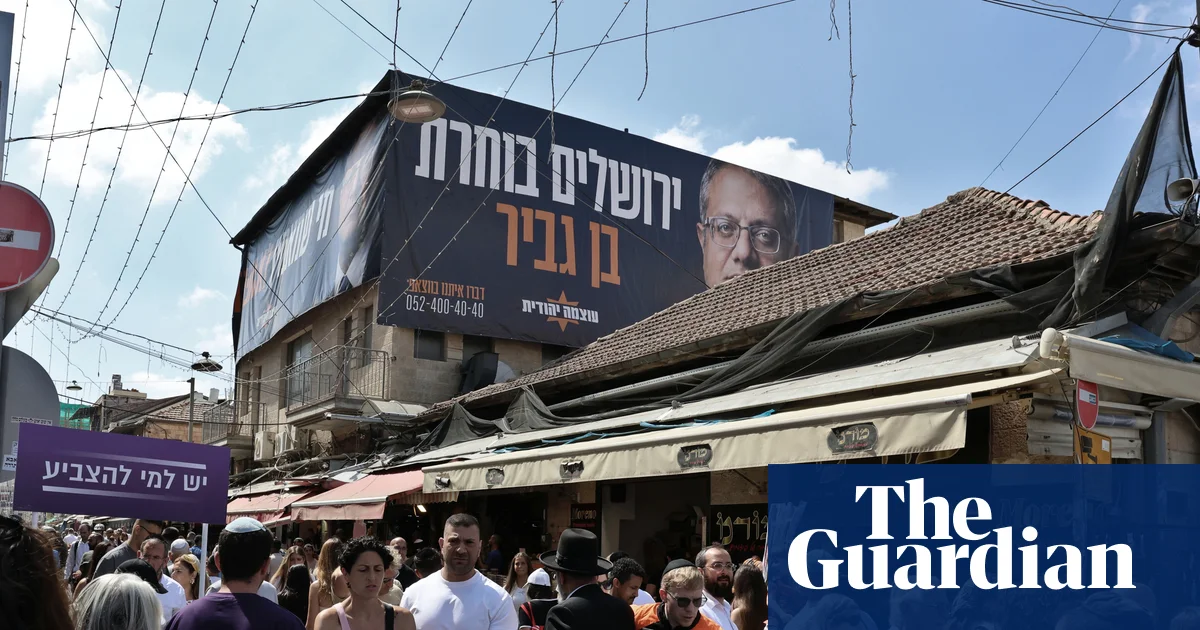
West Jerusalem has long been considered fertile ground for Netanyahu and the Israeli right. Yet Israel's growing diplomatic isolation and the prospect of seemingly endless conflict on multiple fronts are beginning to worry voters even here, a few steps from the bustling Mahane Yehuda market, where giant election posters for Itamar Ben-Gvir, the far-right national security minister known for his anti-Palestinian rhetoric and championing a racist death penalty law that in practice applies only to Palestinians, loom over the streets.
"This country needs radical change. I think I'll vote for Naftali Bennett," said Yosef, 26, a religious Israeli, referring to the rightwing former prime minister who now leads the B'Yachad alliance and is one of Netanyahu's main political rivals.
On one side are tens of thousands of Netanyahu supporters – called "Bibi-ists" in reference to the prime minister's nickname – as well as backers of the far-right ministers Ben-Gvir and Bezalel Smotrich, who want to return the current coalition to power to "finish the job" in Gaza, Iran, Lebanon and the West Bank.
On the other are tens of thousands of voters who believe Israel is losing its standing in the world and needs a change of direction – something many see as embodied by the centre-right Eisenkot. His supporters argue that he would place greater emphasis on education, social policy and the economy, areas they say have been neglected by the current government.
"I'll vote for anyone but the prime minister of 7 October," said Turgeman as he enjoyed a coffee with his wife at a cafe in Jaffa during the Jewish high holiday season. "I've never voted Likud in my life, and I'm certainly not going to start now. I'll vote for Eisenkot. We need a normal prime minister – someone who also cares about the economy and about prices, which have soared because of the war." Food prices in Israel have reached record highs amid the regional conflict and supply chain disruption, with food inflation outpacing the broader consumer price index. The cost of food, including fresh fruit and vegetables, has risen.