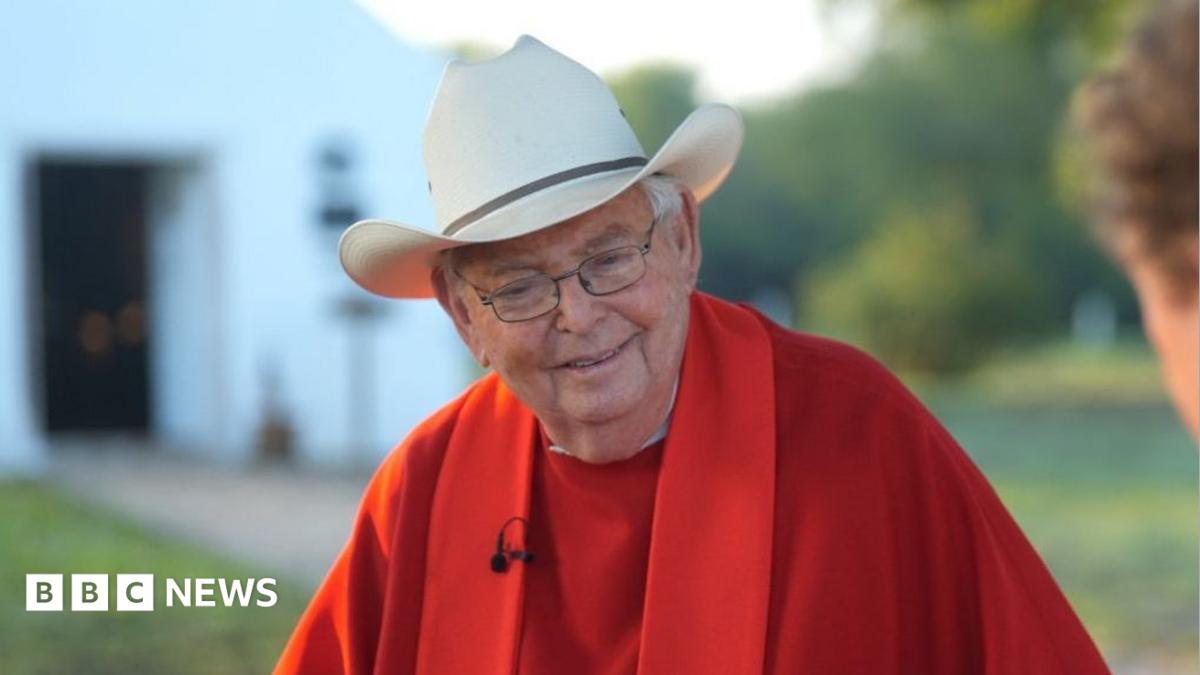
It was just before dawn in the Rio Grande Valley in Texas and the congregation were arriving for the Friday service at the tiny La Lomita Catholic Chapel. This was reported by Qazaqyia.kz citing BBC News.
The whitewashed building, which has been here since the days of the American Civil War, rises from the surrounding scrub and sits about 200 yards from the Rio Grande river itself. As cars pulled up to the chapel, the sound of Father Roy Snipes' barking dogs signalled his arrival. He has been the priest here for almost half a century - and is known locally as the Cowboy Priest.
"I'm not sure why I picked that up, but it's nice," he said of the nickname. In truth, it is pretty obvious why. Snipes wears a Stetson in place of the more traditional priest's hat. And moments later, the chapel was filled by the sound of a Roy Rogers song - the singer and actor known as the King of the Cowboys.
During the first Trump administration, Snipes resisted plans to seize the chapel's land to build the US president's border wall. Eight years on, at the early Friday service, he focused his short sermon on the actions of Immigration and Customs Enforcement (ICE).
"There's no good excuse to detain, incarcerate and deport poor, good folks who are our neighbours," Snipes told the congregation of about 30, mainly Hispanic worshippers.
Texas accounted for roughly one-third of all ICE arrests nationwide in July 2026 - a larger share than any other state - according to government figures obtained by the Deportation Data Project.
"They said we're gonna seek out, capture, detain and deport the worst of the worst," Snipes said in his sermon. "Well, we're here on the border and the cartel is the worst-of-the-worst. So we thought, well, that's a good thing. But it turned out, you can hear almost every day, some poor guy going to work and they stop him and detain him and start a big fight."
After the service, two members of the congregation stopped to chat. "We're educators, and we have a lot of students that are having to go back because their parents are getting deported," one said. "The cruelty that we're seeing - I think that's turning the tide, at least I hope so," their friend added.
Turning the tide politically is what Democrats are hoping they can do in Texas in the midterm elections on 3 November. But that will not be easy.
This stretch of the Rio Grande was once one of the busiest crossing points on the US-Mexico border. Under former President Joe Biden, hundreds of thousands of migrants came through here, with more than two and a half million apprehensions recorded in a single year.
Trump promised to stop these illegal crossings during his 2024 election campaign, and in large parts he has delivered. Border crossings are now at their lowest level in decades. And it was that promise which in part drove Trump's astonishingly high level of support in the state, taking around 55% of Hispanic votes in Texas alone - a record for a Republican presidential candidate.
Javier Villalobos is the Republican Mayor of McAllen, one of the biggest cities in the Rio Grande Valley. He expects Republicans will find it tough this time around, but credits the Trump administration with stemming the border problem.
"I remember I put out a video… thanking the administration for immediately securing the border. That was great," he said. "And I think generally most people are okay with the deportation of criminals, violent people, or people that really are not productive at all." But if you start deporting people that are productive and law-abiding, that is where the problem is, he added.
Recent polls suggest much of Trump's support among Hispanic voters has ebbed away since 2024. Surveys taken since late summer indicate a majority of Texan Hispanic voters disapprove of the president. They also suggest Hispanic voters are favouring Democrats over Republicans by a significant margin.
"When I voted for President Trump, I voted for him because we saw an influx of immigration during the Biden administration," said Mario Guerrero, a young Mexican-American businessman who leads the South Texas Builders Association. It needed to be fixed, he said. "We thought that we were in the right by voting for Trump, and that he was going to do what was best in order to fix the crisis on the border. And I think to myself, we were really not told the extreme that they were willing to go to make a point," he added, before referencing recent shootings involving ICE agents in US cities.
Guerrero is a reminder that, for many who live and work close to the US-Mexico border, security and immigration enforcement are two distinct issues. A voter here may be supportive of securing the border and stopping illegal crossings, but oppose the actions of ICE and how the administration is enforcing its crackdown on undocumented migration.
Guerrero voted for Trump three times in a row - but is planning to vote Democrat in November, in part due to his unease with that crackdown. "There's a man that I know that… last year, had 35 workers that were working for him every day," he said. "Right now, he just told me two days ago that he would be lucky if he would get four to six guys to show up to work."